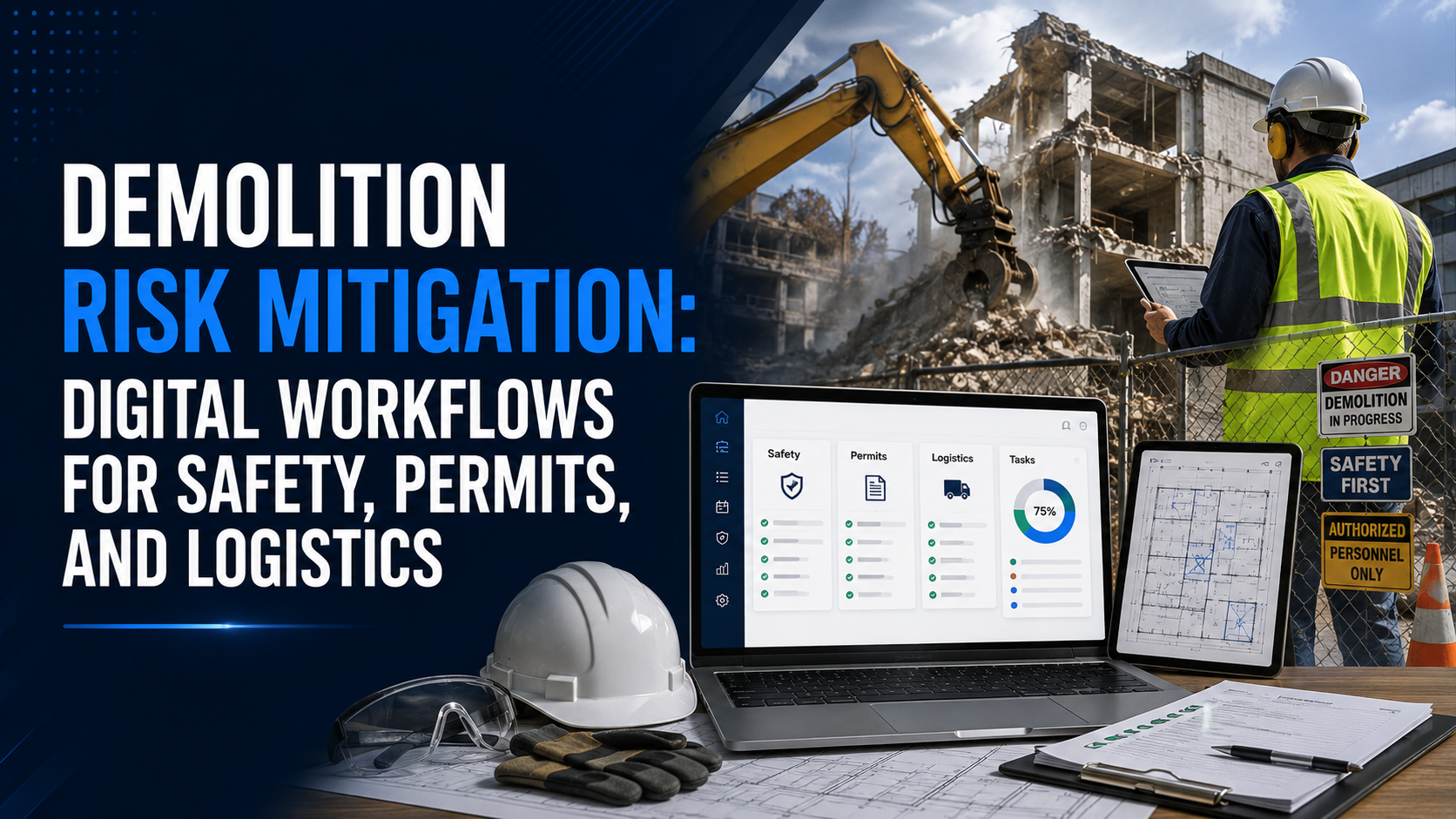
Demolition projects—whether selective interior strip-outs or total structural teardowns—carry zero margin for operational error. Striking a live gas main, disturbing unmapped asbestos insulation, or failing to secure load-bearing shoring can trigger catastrophic safety incidents, regulatory shutdowns, and severe financial liability.
Yet on many job sites, operational coordination remains fragmented. Critical utility sign-offs exist as isolated paper forms, daily safety briefings are scrawled on clipboards, and heavy haul-away logistics are coordinated across disconnected phone calls and messaging groups. As demolition firms scale across multiple active sites, manual coordination quickly breaks down.
Key Takeaways
- Pre-demolition verification requires strict gates: Demolition activity should never commence without digital verification of utility disconnects, structural engineering assessments, and environmental clearances.
- Structured workflows eliminate safety blind spots: Moving daily safety briefings, toolbox talks, and hazard inspections from paper to connected digital workflows ensures mandatory sign-offs happen on time.
- Milestone reporting connects field to office: Real-time visibility into waste manifests, hazardous material abatement, and haul-away logistics prevents perimeter bottlenecks and compliance fines.
- AI and automation support, not replace, human oversight: Connected operations platforms automate follow-ups and surface schedule anomalies, keeping project managers and civil engineers in control of safety-critical decisions.
Industry Context: The High Cost of Uncontrolled Jobsite Risks
The construction and demolition sectors face intensifying pressure to modernise site management and improve overall productivity. According to the RICS Construction Productivity Report 2026, citing McKinsey research, global construction productivity grew by just 0.4% annually between 2000 and 2022, compared with approximately 2% across the wider economy. The same RICS report highlights that 40% of industry respondents rate practical site management improvements as high-impact interventions.
Demolition is inherently volatile. Unlike ground-up construction, where building materials are assembled in controlled sequences, demolition involves dismantling structures under dynamic structural loads. Unforeseen structural weaknesses, unrecorded utility modifications from decades past, and hidden hazardous substances (such as lead paint, silica dust, and asbestos) represent active threats to worker safety and project viability.
When operations rely on fragmented tracking methods, project leadership loses visibility into whether prerequisite safety milestones were actually executed or merely assumed complete.
Operational Challenges Demolition Contractors Face
Demolition teams must coordinate specialised crews, hazardous material abatement sub-contractors, structural consultants, municipal inspectors, and heavy equipment operators. In practice, operational complexity stems from five critical failure points:
- Unverified Utility Disconnections: Utility providers (power, water, sewer, gas, telecommunications) operate on disparate timelines. Beginning physical demolition before receiving written confirmation and air-gap verification poses extreme electrocution, explosion, and flooding hazards.
- Environmental Hazard Sign-Off Gaps: Asbestos abatement, lead containment, and universal waste removal require third-party environmental hygienist sign-offs and regulatory chain-of-custody manifests before structural demolition permits become active.
- Inconsistent Daily Safety Briefings: Toolbox talks and daily job safety analyses (JSAs) are frequently treated as administrative box-ticking rather than dynamic hazard identification for changing daily site conditions.
- Haul-Away Logistics and Waste Manifest Bottlenecks: Coordinating fleets of dump trucks, roll-off containers, sorting facilities, and certified landfills requires continuous coordination to avoid congested site perimeters or unpermitted dumping.
- Selective Demolition Shoring and Sequence Failures: In selective demolition and adaptive reuse, removing a non-load-bearing partition without verifying secondary load paths can cause progressive collapse in preserved structural zones.
Why Traditional Processes Fail to Scale
When a demolition contractor manages a single job site, an experienced superintendent can oversee utility checks, safety briefings, and haul trucks using memory, paper clipboards, and direct phone calls. However, as an enterprise grows to 10, 20, or 50 concurrent projects across multiple jurisdictions, these manual methods collapse.
The Fragmentation Bottleneck: At a Glance
- Field tasks and inspections: Handled via phone calls and WhatsApp groups, creating isolated update threads that cannot be audited or linked to project milestones.
- Attendance and crew allocation: Logged on paper timesheets, obscuring whether certified operators are on-site for hazardous equipment shifts.
- Utility and permit tracking: Kept in separate spreadsheet folders, forcing project managers to manually cross-check completion before issuing notices to proceed.
- Waste manifests and haul tracking: Tracked across paper weight tickets, leading to delayed billing, missing compliance proof, and haul-away scheduling delays.
- Executive reporting: Compiled manually over hours or days, ensuring leadership reviews outdated operational data.
When safety managers spend their days chasing crew leaders for signed hazard forms and engineers struggle to confirm whether utility lines were cleared, operational risk escalates dramatically. This administrative friction creates dangerous blind spots.

How Connected Digital Workflows Mitigate Demolition Risks
Scaling demolition operations safely requires moving from reactive communication to structured, milestone-driven digital workflows. In a connected system, tasks are linked by dependencies: heavy machinery cannot begin structural demolition until the digital prerequisite checklist is completed and signed off by qualified personnel.
Key Demolition Workflows That Require Structured Automation
- Pre-Demolition Utility Disconnect & Air-Gap Verification: A structured workflow requiring photographic evidence, utility reference numbers, and digital signatures from municipal providers and the project safety officer before site power and gas are logged as isolated.
- Hazardous Material Abatement Clearance: Multi-step digital workflows linking environmental survey findings, hazardous removal notices, and final industrial hygienist clearance certificates before structural crews enter the zone.
- Daily Safety Briefings & Dynamic JSA Sign-Offs: Geolocation-verified morning toolbox talks and risk assessments logged by foremen, ensuring daily risks (weather, changing drop zones, vibration thresholds) are reviewed and acknowledged by every crew member.
- Selective Demolition Load Path & Shoring Inspections: Task sequences requiring structural engineer inspection reports and sign-offs before removing load-bearing elements or adjacent foundations.
- Perimeter Dust, Noise, and Vibration Monitoring: Scheduled recurring tasks for field teams to log readings against municipal noise and dust suppression permits.
- Debris Haul-Away & Disposal Chain of Custody: Digital tracking linking waste classification, vehicle license numbers, disposal tickets, and weighbridge manifests to ensure regulatory compliance with environmental agencies.
- Site Boundary & Public Protection Audits: Daily digital checklists verifying fencing integrity, pedestrian gantry safety, sidewalk closures, and traffic management equipment.
- Hot Work Permit Approvals: Time-bound digital permits for torch-cutting operations, including mandatory 60-minute post-work fire-watch checklist sign-offs.
The Strategic Role of Modern Task Tracking Tools Across Operations
Deploying purpose-built operational management platforms transforms how different project stakeholders collaborate. Modern task tracking tools deliver measurable benefits by providing tailored interfaces and clear accountability for diverse operational domains:
- Task Tracking Tools for Construction & Engineering Teams: Purpose-built task tracking tools for construction, civil engineers, and structural specialists provide rigorous milestone gating. Digital tools allow engineers to review photographic submissions, approve shoring installations, verify vibration sensor data, and sign off on demolition sequence steps remotely or on-site.
- Task Tracking Tools for Decision Making: Executives and operations directors gain unified dashboard views across all job sites, spotting stalled permit applications, unresolved safety infractions, or low haulage turnarounds before they delay project timelines.
- Task Tracking Tool for Enterprises & Scaling Entrepreneurs: Growing demolition contractors and industrial entrepreneurs require enterprise-grade governance, multi-tier permissions, role-based access, and cross-site visibility to standardise standard operating procedures (SOPs) across regional offices and hundreds of field workers.
- Task Tracking Tools for Data Analysts & Controllers: Structured task completion data, downtime records, and disposal cycles give project data analysts clean, real-time datasets to evaluate equipment utilisation, cycle times, safety compliance rates, and operational risk patterns.
- Task Tracking Tools for Cross-Functional Execution: Demolition projects require coordination across diverse specialist functions. Executive assistants managing regulatory board filings, coordinators running public consultation and traffic management planning (mirroring methodologies from event planning), specialist freelance machine operators, training officers handling site safety education, and procurement teams managing ecommerce and equipment rentals all require centralised visibility to prevent schedule gaps.
- Support for Public Affairs & Communication: Transparent public notices, community vibration updates, and photographic milestones created by project media specialists and content creators ensure neighbouring businesses and municipal stakeholders remain informed throughout high-impact teardowns.
Operational Shift: Before and After Structured Digital Tracking
Evaluating your current operational maturity highlights where workflow automation removes risk:
- Utility Isolation:
- Traditional Approach: Project manager asks superintendent if gas and electric were cut; verbal confirmation assumed sufficient.
- Scalable Digital Approach: Work order cannot transition to ‘Active Demolition’ until utility company letters and physical isolation photos are uploaded and digitally verified.
- Daily Safety Compliance:
- Traditional Approach: Paper sign-in sheets collected at the end of the week, often incomplete or water-damaged.
- Scalable Digital Approach: Mobile-based check-in with GPS verification and mandatory daily hazard briefings completed prior to shift work assignment.
- Debris Hauling Logistics:
- Traditional Approach: Truck drivers manage physical slips; lost manifests cause invoice disputes and recycling credit delays.
- Scalable Digital Approach: Real-time tracking of container numbers, haul manifests, and certified recycling depot receipts logged directly into inventory and logistics trackers.
- Executive Oversight:
- Traditional Approach: Regional managers spend hours on individual calls chasing status reports across 15 active demolition sites.
- Scalable Digital Approach: Real-time operational dashboards surface exceptions, blocked tasks, and milestone delays automatically.
How AI and Automation Enhance Operational Control
Integrating artificial intelligence into operations platforms is not about replacing human decision-making; it is about eliminating administrative drag and highlighting operational risk. In safety-critical sectors like demolition, people define the rules, while AI assists with prioritisation and trend detection.
- Automated Milestone Reminders: Configured rules automatically alert site supervisors 48 and 24 hours before permit expirations, hot-work renewals, or scheduled environmental inspections.
- Predictive Bottleneck Detection: Machine intelligence identifies recurring delays in municipal sign-offs or equipment haulage cycles, alerting project managers before project timelines slip.
- Automated Summary Reporting: Converting hundreds of daily field activity logs and checklist confirmations into executive daily WhatsApp summaries or email dashboards, keeping management informed without manual compilation.
- Human Responsibility Retained: High-risk clearances—such as issuing a structural demolition notice to proceed—always require explicit, authenticated sign-off from licensed project managers and civil engineers.
Evaluating Demolition Management Software: What to Look For
When selecting an operations platform for selective and total demolition projects, evaluate systems against clear operational criteria:
- Ease of Field Adoption: The mobile interface must be simple enough for site foremen, equipment operators, and sub-contractors to update with minimal taps in bright sunlight or wet conditions.
- Customizable Step-by-Step Workflows: Ability to build mandatory linear workflows with prerequisite dependencies (e.g., Step 1: Utility Cut -> Step 2: Environmental Sign-off -> Step 3: Mechanical Demolition).
- Integrated Shift and Attendance Tracking: Geolocation-verified attendance to confirm that qualified supervisors and certified operators are physically present on site.
- Automated Notifications via Standard Channels: Integration with common communication channels, such as automated WhatsApp or email alerts for overdue safety milestones.
- Asset & Inventory Tracking Integration: Capability to monitor machinery allocation, attachments, and waste roll-offs across active projects.
- When a Simple Tool Is Enough: For a two-person team conducting single-room residential cosmetic strip-outs, a basic shared checklist or simple visual board may suffice. As soon as heavy machinery, structural modifications, environmental hazards, and multiple sub-contractors are involved, a connected operations platform is essential.
Scaling Demolition Operations with TrackerSuite
TrackerSuite is an AI-powered operations platform designed to help growing contractors and industrial teams connect people, field tasks, assets, and reporting into a unified system.
Rather than forcing teams to navigate disconnected software suites, TrackerSuite aligns with practical demolition workflows:
- Task Tracker: Standardise pre-demolition checklists, structural inspection sequences, and regulatory permit tracking with clear accountability, due dates, and escalation rules.
- Mobile Geolocation & Shift Management: Track crew attendance and ensure daily safety briefings are conducted on site before hazardous work begins.
- Automated Reporting: Generate automated daily reports and milestone updates delivered directly via WhatsApp and email, eliminating manual report compilation.
- Stack Tracker Integration: Monitor site equipment, safety gear allocations, and roll-off haul containers across multiple concurrent demolition sites through Stack Tracker’s inventory capabilities.
- Predictive Task Management with TAVI: Surface overdue milestones and workload bottlenecks automatically, allowing operations leaders to focus on high-risk site decisions.
Review TrackerSuite’s straightforward pricing plans to identify the configuration that matches your organisation’s scale.
Practical Implementation: A Step-by-Step Rollout
Transitioning from manual tracking to a connected digital platform should follow a phased, practical path:
- Step 1: Map the Pre-Demolition Gate: Identify every mandatory permit, utility disconnect, and environmental survey required before structural work begins. Standardise this into a mandatory digital workflow template.
- Step 2: Digitize Daily Field Safety Checklists: Convert paper toolbox talks, hot-work permits, and daily equipment walk-around inspections into mobile-friendly digital checklists.
- Step 3: Establish Milestone Dependency Rules: Configure workflow gates so that phase transitions (e.g., Abatement Complete -> Structural Teardown) require authenticated engineering sign-offs.
- Step 4: Connect Haul-Away & Disposal Manifests: Train logistics coordinators to log container numbers and weighbridge receipts digitally against project disposal milestones.
- Step 5: Automate Exception Reporting: Set up automated alerts for overdue tasks and daily WhatsApp executive summaries, allowing management to resolve bottlenecks immediately.
Frequently Asked Questions (FAQs)
How does digital milestone tracking improve regulatory compliance during demolition?
Digital milestone tracking creates an unalterable audit trail of dates, timestamps, photographic evidence, and authenticated digital sign-offs for utility disconnections, asbestos abatement, and disposal manifests. If a municipal or environmental inspector audits the project, complete compliance documentation can be retrieved instantly rather than searched for across paper filing cabinets.
Can digital task tracking prevent accidental utility strikes?
Yes. By configuring mandatory prerequisite gates in your workflow, mechanical demolition tasks cannot be assigned or approved until field supervisors upload verified disconnect certificates and photographic evidence of physical air-gaps for gas, power, and water lines.
How do mobile task tracking tools function on sites with poor cellular coverage?
Most robust field operations platforms allow field supervisors to complete daily safety briefings, log equipment checklists, and capture photos offline. The platform automatically synchronises the data to the central dashboard once mobile data or Wi-Fi connectivity is restored.
Why are connected workflows better than standard messaging apps for haul-away logistics?
Messaging apps like WhatsApp create unstructured, unsearchable message threads where load counts, disposal receipts, and contaminated soil manifests easily get lost. A structured operations platform attaches every haul-away ticket to the specific project, trackable waste category, and financial ledger entry in real time.
Conclusion: Building Scalable, Risk-Controlled Demolition Operations
Selective and total demolition projects represent some of the highest-risk operations in the built environment. As demolition firms take on larger contracts, manage more concurrent job sites, and navigate stricter environmental regulations, traditional manual tracking methods become an active liability.
Mitigating risk requires connected operations: standardising safety-critical workflows, connecting field verification with office project controllers, and automating routine follow-ups. By implementing structured task tracking and real-time operational visibility, demolition contractors protect their workforce, maintain compliance, and deliver projects profitably.
Ready to standardise your field operations, eliminate safety blind spots, and streamline milestone tracking across your projects? Contact the TrackerSuite team to discover how our AI-powered operations platform supports your team’s growth.
Leave a Reply