Key Takeaways
- Task management software helps automobile manufacturers assign work, set deadlines, monitor progress, and track pending activities across departments.
- Digital task tracking helps production, quality, maintenance, warehouse, and administrative teams coordinate their daily responsibilities.
- Centralized task records reduce dependence on scattered Excel sheets, paper registers, WhatsApp messages, and manual follow-ups.
- Digital checklists, task updates, and proof of work help managers review whether assigned activities have been completed.
- Automated reminders and approval workflows help teams follow up on pending inspections, maintenance activities, and corrective actions.
- TrackerSuite.ai helps businesses manage tasks, workforce activities, approvals, reminders, and AI-powered work validation through a connected platform.
Introduction
An automobile manufacturing company depends on hundreds of activities happening in the right sequence. Production teams must complete their assigned work, quality teams need to perform inspections, maintenance teams must address equipment issues, and warehouse teams need to coordinate the movement of components and materials.
A delay in one activity can affect several others. If a quality inspection remains pending, a component may not be cleared for the next stage. If a maintenance issue is not assigned quickly, equipment downtime may continue. If a shift ends without a clear handover, the incoming team may lose time understanding what remains incomplete.
The challenge is not just managing production. It is making sure employees across departments know what they need to do, when they need to do it, and how to report completion.
Many automobile manufacturers and automotive component suppliers use a combination of spreadsheets, paper checklists, phone calls, and messaging apps to coordinate daily activities. These tools can become difficult to manage when work spans multiple production lines, shifts, departments, and locations.
Task management software for automobile companies provides a structured way to assign responsibilities, track deadlines, record updates, and follow up on pending work. It helps managers gain better visibility into daily operations without repeatedly asking employees for status updates.
Why Do Automobile Companies Need Task Management Software?
Automobile manufacturing involves several connected activities. A vehicle or component passes through different stages, and each stage depends on people completing their assigned responsibilities correctly.
When task ownership is unclear or updates are delayed, managers may struggle to identify problems before they affect other activities.
1. Coordinating Work Across Departments
Automobile manufacturers work with production, quality control, maintenance, procurement, warehousing, and dispatch teams. Although each department has different responsibilities, their work often depends on one another.
For example, the production team may need a component inspection to be completed before moving forward. The quality team must conduct the inspection, record the result, and communicate whether further action is required.
If these steps are coordinated through separate spreadsheets and messages, the production supervisor may have to contact multiple employees to understand the current status.
Task management software helps create clear ownership for each activity. Managers can assign tasks to the relevant employees, set deadlines, and track progress from one place.
This makes it easier to identify pending work and coordinate the next action. It does not replace production planning or systems that control the manufacturing process, but it can improve the coordination of work around those processes.
2. Tracking Quality Inspections and Corrective Actions
Automobile manufacturers must maintain consistent quality throughout their operations. Depending on the process, employees may need to inspect incoming components, check assemblies, verify dimensions, review documentation, or report defects.
When an inspection identifies a problem, the team may need to investigate the cause, assign corrective work, and verify that the issue has been addressed.
If these activities are tracked manually, follow-ups can become difficult, especially when several issues remain open at the same time.
Task management software can help assign inspection-related activities, record updates, set deadlines, and track corrective actions through completion. Employees can attach supporting documents or photographs when the workflow requires them.
For example, if an inspection identifies a damaged component, the issue can be assigned to the responsible team for investigation. The task record can show who is handling it, what action is required, and whether the follow-up has been completed.
Formal automotive quality requirements may also require dedicated quality management systems and controlled traceability records. Task management software should complement those systems where needed, not replace them.
3. Managing Machine Maintenance and Equipment Checks
Automobile factories depend on production equipment, assembly tools, conveyors, welding systems, and other machinery. Equipment problems can interrupt work and create additional pressure on production teams.
Routine maintenance and inspection activities are therefore important. However, these activities need clear schedules, assigned responsibilities, and timely completion updates.
Task management software can help maintenance supervisors assign routine checks, monitor deadlines, and track unresolved issues. When an employee reports a problem, the supervisor can assign the required follow-up and monitor its status.
Consider an assembly line where a technician identifies an equipment issue during a routine inspection. The technician can record the issue, and the maintenance supervisor can assign a follow-up task to the appropriate person.
The team can then record progress and confirm when the assigned activity is complete.
For complex asset maintenance, spare-parts planning, condition monitoring, or predictive maintenance, a dedicated computerized maintenance management system (CMMS) may also be required.
4. Improving Shift Handovers
Many automobile manufacturing plants operate across multiple shifts. The incoming team needs to know which activities have been completed, which issues remain unresolved, and what needs attention next.
When this information is shared only through verbal updates or informal messages, employees may miss important details.
A shared task record can provide information about the assigned employee, current status, deadline, and previous updates. This gives the next shift a consistent reference when reviewing pending activities.
For example, if a maintenance task remains incomplete at the end of a shift, the outgoing employee can update its status and record the outstanding action. The incoming team can review the task and continue the follow-up.
This helps reduce confusion during handovers and makes responsibilities easier to track.
5. Managing Work Across Multiple Plants and Locations
Automobile companies may operate several manufacturing facilities, assembly units, warehouses, or component production locations. Managers need to understand whether assigned activities are progressing consistently across these sites.
When every location maintains separate task records, consolidating updates can take time. It may also be harder to identify recurring delays or activities that require management attention.
A centralized task management system can help managers review work across supported locations, departments, and teams.
For example, a regional operations manager can review pending inspections or overdue administrative activities across several units without collecting separate reports from every supervisor.
The value depends on having clear task definitions and consistent reporting practices across locations.
How Task Management Software Helps Automobile Companies
The benefits of task management software extend beyond assigning individual tasks. When used consistently, it helps companies create a clearer process for managing work from assignment to completion.
1. Assign Tasks with Clear Responsibilities
Every task should have a responsible person, a clear description, and a realistic deadline.
Task management software allows managers to assign work directly to employees instead of relying on verbal instructions or separate messages. Employees can review their assigned activities and update their status as work progresses.
This is useful for routine inspections, housekeeping, equipment checks, documentation, and other activities that require consistent execution.
Clear task ownership also makes it easier for supervisors to identify who needs support when a task is delayed.
2. Automate Reminders and Follow-Ups
Supervisors often spend time asking employees whether inspections, approvals, or other assigned activities have been completed.
As the number of tasks grows, these follow-ups can take attention away from other responsibilities.
Task management software can send reminders for approaching deadlines and notifications for pending work. Depending on the configured workflow, overdue tasks can also trigger escalations to supervisors.
For example, if a scheduled inspection remains incomplete, the employee can receive a reminder. If the task is still pending after the deadline, the system can notify the responsible supervisor.
This helps teams identify outstanding activities without relying entirely on manual follow-ups.
3. Record Proof of Work
A task marked complete does not always provide enough information to confirm what was done. For some activities, managers need supporting evidence before accepting the work.
Depending on the task, employees may submit photographs, videos, documents, or other records. Supervisors can review the submission and request corrections if the required outcome has not been achieved.
For example, an employee completing a designated housekeeping check can upload a photograph of the area. The supervisor can review the submission against the defined requirements.
This creates a more consistent record of task completion. However, photographs and documents should support the inspection process rather than replace qualified quality or safety checks.
4. Improve Approvals and Task Reassignment
Some automotive activities require a supervisor or department head to review the work before the process can move forward.
When approvals are managed through separate messages, employees may struggle to determine who needs to act next.
A task management system can organize approval workflows and keep the status visible. If a task needs correction, the reviewer can communicate the required action through the configured process. If responsibilities change, managers can reassign the task to another employee.
This helps reduce confusion about pending approvals and makes the next action clearer.
5. Monitor Employee Tasks and Attendance
Automobile manufacturing companies also need to coordinate workforce activities across shifts and departments. Managers may need to review attendance, assigned tasks, timesheets, and completion records.
Software that combines task tracking with workforce management can help bring these activities together.
For example, a supervisor can review assigned work, check task completion, and identify activities that need follow-up. This provides a more structured view of employee responsibilities than maintaining separate records for every activity.
Attendance and task completion should still be evaluated separately where appropriate. Being present at work does not necessarily mean every assigned task has been completed correctly.
Key Features to Look for in Task Management Software for Automobile Companies
Automotive businesses should choose software based on their actual workflows rather than the number of features listed on a product page.
Important capabilities include:
- Task assignment and deadlines: Managers should be able to assign work to specific employees, define expected outcomes, and set deadlines.
- Task status tracking: The system should show which activities are pending, in progress, completed, or overdue.
- Recurring tasks: Routine inspections, housekeeping activities, and other repeated responsibilities should be easy to schedule where supported.
- Automated reminders: Employees and supervisors should receive useful notifications when tasks approach their deadlines or require attention.
- Approval workflows: Managers should be able to review submitted work, request corrections, and track approval status.
- Proof of work: Employees should be able to submit relevant photographs, videos, or documents when evidence is required.
- Mobile access: Employees and supervisors should be able to access task information conveniently from supported mobile devices.
- Reporting and dashboards: Managers should be able to review task completion, overdue activities, and pending work by employee, department, or location.
- Workforce management: Businesses that need attendance tracking, timesheets, and employee task monitoring should check whether these features are available in the same platform.
- Integration with existing systems: The software should work alongside the company’s ERP, MES, CMMS, or quality management systems where necessary. Confirm that the specific integrations required by your business are supported.
The right combination depends on whether the company manufactures complete vehicles, produces automotive components, operates an assembly facility, or manages several plants.
Task Management Software vs. Excel and WhatsApp
Excel and WhatsApp can be useful for small teams and straightforward activities. The challenge is keeping information organized when tasks involve several departments, deadlines, approvals, and supporting documents.
| Requirement | Excel and WhatsApp | Task Management Software |
|---|---|---|
| Task assignment | Instructions may be spread across messages and sheets | Tasks can be assigned to specific employees |
| Deadline tracking | Often requires manual monitoring | Pending and overdue tasks can be tracked centrally |
| Follow-ups | Employees may need repeated messages | Configured reminders can automate follow-ups |
| Completion evidence | Photos and documents may be scattered across chats | Evidence can be linked to the relevant task where supported |
| Approvals | Updates may sit in separate conversations | Approval status can be recorded in a defined workflow |
| Management reporting | Information may need to be consolidated manually | Dashboards can provide a consolidated view, depending on the software |
The objective is not to eliminate every spreadsheet or messaging tool. It is to establish a reliable system for activities that need clear ownership, deadlines, follow-ups, and completion records.
How to Choose the Right Software for Your Automobile Company
Start by identifying the operational problems you want to address. For one company, the main concern may be overdue maintenance activities. For another, it may be quality inspection follow-ups, shift handovers, or a lack of visibility across multiple facilities.
Choose one workflow and map it from beginning to end. Identify who assigns the task, who performs it, what evidence is required, who approves the result, and what happens if the deadline is missed.
Next, involve the employees and supervisors who will use the system. A workflow that looks good on paper may not work well if employees find it difficult to update tasks during their shift.
Run a pilot in one department or facility before expanding it. During the pilot, track practical indicators such as:
- Number of overdue tasks.
- Time taken to complete assigned activities.
- Time spent by supervisors collecting updates.
- Percentage of required inspections completed on schedule.
- Time taken to resolve pending approvals.
- Number of tasks returned for correction.
Compare these results with your existing process. This helps you understand whether the software is improving coordination and where the workflow needs adjustment.
Finally, confirm whether you need task management alone or a broader system for production execution, quality management, maintenance, and inventory. Choosing the right category of software is just as important as choosing the right provider.
How TrackerSuite.ai Helps Automobile Companies Manage Daily Work
Automobile companies need a practical way to coordinate people, monitor assigned work, and follow up on activities that remain incomplete.
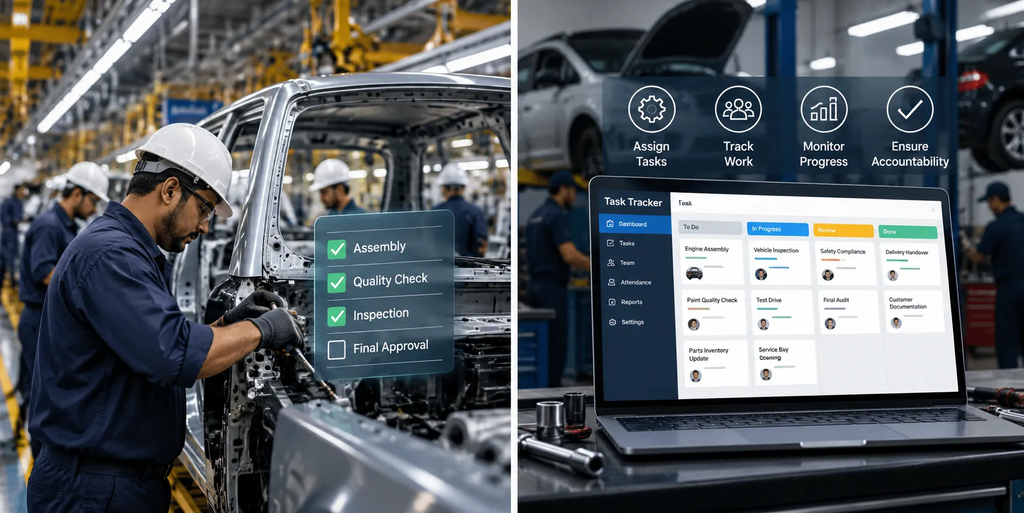
TrackerSuite.ai helps businesses manage these responsibilities through a connected platform. Its Task Tracker supports task assignment, deadlines, reminders, approvals, workforce management, timesheets, and task-related reporting.
For example, a company can use Task Tracker to coordinate routine facility checks, assign housekeeping activities, manage internal follow-ups, and track completion of designated inspections. Employees can update their tasks and submit supporting evidence, helping supervisors review the status of assigned work.
TrackerSuite.ai also offers AI Work Validation within Task Tracker. It can check uploaded images, videos, or documents against defined criteria and return an approval or disapproval outcome. This can support the review of submitted work and help flag exceptions for attention. Critical automotive quality and safety decisions should continue to follow the company’s approved procedures and qualified review processes.
Beyond task management, TrackerSuite.ai includes:
- Sales Tracker: For managing sales activities and follow-ups.
- Stack Tracker: For inventory and stock movement.
- TAVI AI: For business intelligence and AI-enabled workflows.
Companies can explore the modules relevant to their needs while continuing to use dedicated systems for specialized manufacturing functions.
The aim is to make day-to-day work easier to assign, track, review, and complete, while giving managers better visibility into pending activities.
Frequently Asked Questions
1. What Is Task Management Software for Automobile Companies?
It is software that helps automobile manufacturers and automotive suppliers assign work, set deadlines, track progress, manage approvals, and record completed activities. It can support daily coordination across production, quality, maintenance, warehouse, and administrative teams.
2. How Can Task Management Software Help Automobile Manufacturers Reduce Delays?
It makes task ownership and deadlines clearer, helps managers identify pending activities, and supports reminders and escalation workflows. These capabilities can help teams respond to delays earlier, although actual results depend on the workflow and how consistently employees use the system.
3. Can Automotive Component Manufacturers Use Task Management Software?
Yes. Component manufacturers can use it to coordinate routine inspections, housekeeping, equipment-related follow-ups, documentation, internal approvals, and other assigned activities. Specialized production and quality systems may still be necessary for process control and detailed component traceability.
4. Can Task Management Software Support Quality Inspections?
Yes. It can assign inspection-related tasks, record updates, collect supporting documents or photographs, and track corrective actions. Companies with formal automotive quality requirements should confirm that the software complements their quality management and traceability systems.
5. Can Automobile Companies Track Work Across Multiple Plants?
Software with suitable location-based reporting can help managers review assigned tasks and pending activities across multiple facilities. Consistent workflows and reporting practices are important for comparing results between plants.
6. What Is the Difference Between Task Management Software and Automotive ERP Software?
Task management software focuses on assigning and tracking work. Automotive ERP software manages broader business processes, which may include procurement, inventory, production planning, finance, and order management. Both can work together when the company needs specialized systems for different functions.
7. Is Task Management Software Suitable for Small Automotive Suppliers?
Yes. Small and medium-sized suppliers can begin with a specific problem, such as missed inspections or manual follow-ups. They can introduce digital task tracking in one department and expand to other activities as employees become comfortable with the system.
Conclusion
Automobile manufacturing requires close coordination between people, departments, and processes. Even when a company has production planning and enterprise software, employees still need a reliable way to manage routine activities, complete assigned work, and follow up on unresolved issues.
When these responsibilities are spread across spreadsheets, paper registers, and informal messages, managers may struggle to identify delays and maintain consistent records.
Task management software for automobile companies helps create a structured process for assigning work, tracking deadlines, recording completion, and managing follow-ups. It can improve operational visibility without replacing the specialized systems needed for production control, automotive quality, or equipment management.
Start by identifying the activities that create the most follow-up work in your business. Choose a workflow, establish clear responsibilities, and measure whether digital task tracking helps your team complete work more consistently.
TrackerSuite.ai can help automobile manufacturers and component suppliers coordinate daily tasks, manage workforce activities, automate reminders, and review submitted proof of work through a connected platform.
Explore TrackerSuite.ai to see how digital task management can help your teams stay organized and keep daily work on track.
Research Sources
- Poka — Automotive Manufacturing Software: Industry-specific examples of frontline coordination, quality checks, maintenance, and shift-related challenges.
- IFS — Automotive Manufacturing Software and AI: Background on automotive manufacturing systems, quality, supply chains, and asset management.
- L2L — Automotive Manufacturing Software: Examples of operational workflows, maintenance coordination, and multi-plant visibility.
- NIST — The Present Status and Future Growth of Maintenance in U.S. Manufacturing: Research on manufacturing maintenance practices.
Editorial note: The examples in this article illustrate potential uses of task management software. No specific percentage improvement or financial saving is claimed for TrackerSuite.ai.
Leave a Reply