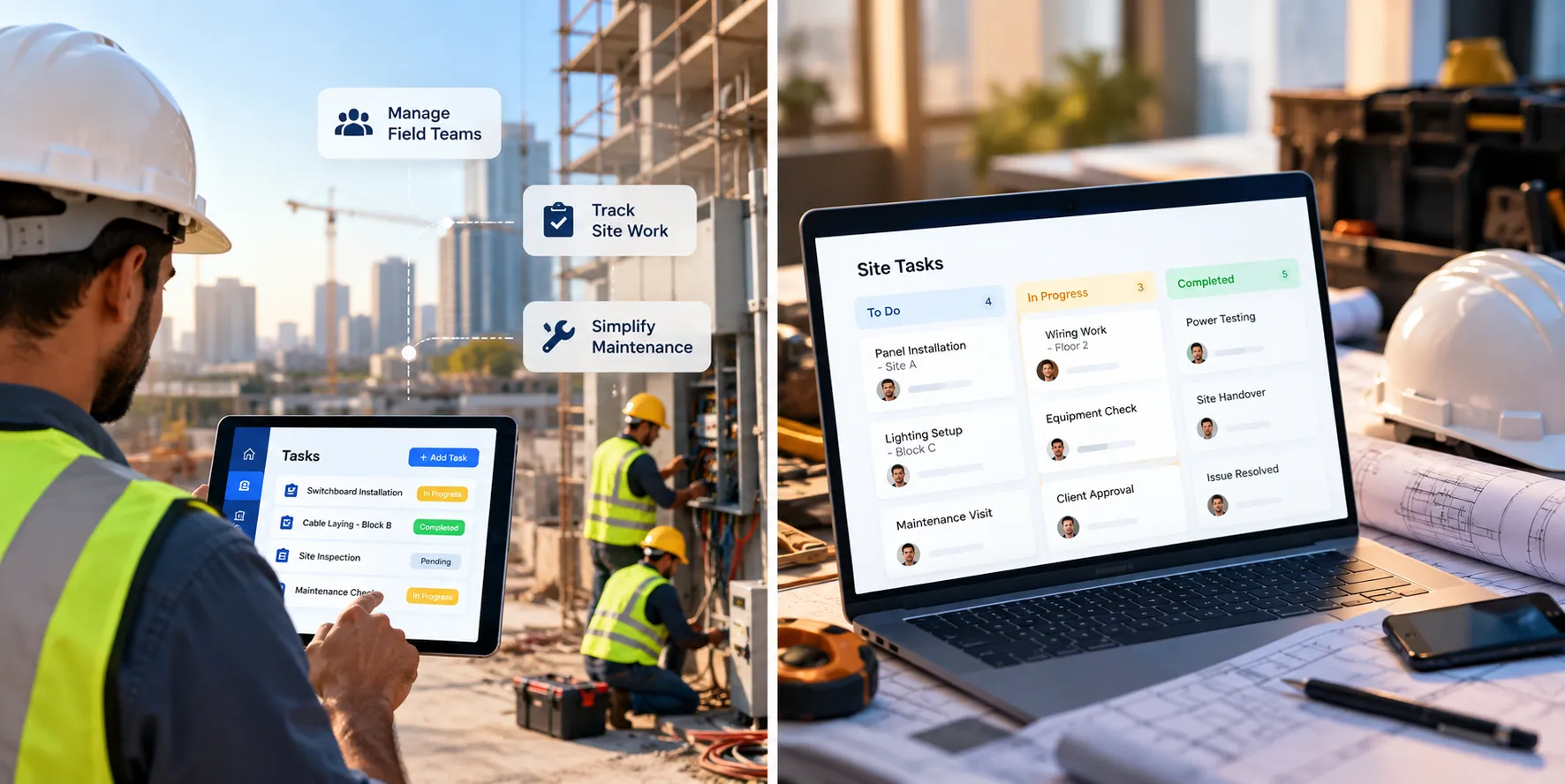
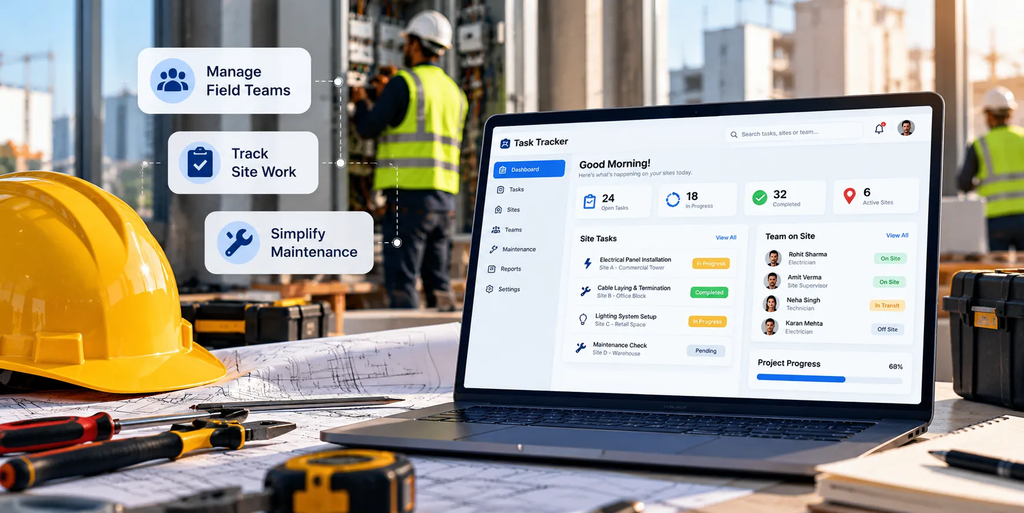
Key Takeaways
- Electrical contractors often manage electricians, supervisors, subcontractors, and maintenance teams across multiple sites.
- A task tracker helps assign jobs, set deadlines, record updates, and monitor work completion.
- Digital task records can help supervisors review site visits, inspection activities, and supporting proof of work.
- Reminders, recurring tasks, and approval workflows help teams manage maintenance schedules and pending activities.
- Attendance tracking and timesheets can support workforce coordination and operational reporting.
TrackerSuite.ai helps organize daily work and team activities, while specialist electrical design, estimating, safety, and billing systems continue to handle their respective functions.
Introduction
Electrical contracting companies manage work across construction sites, commercial buildings, factories, residential projects, and maintenance locations. Their teams may handle electrical installations, wiring, panel work, equipment maintenance, fault-related jobs, and scheduled inspections.
As the number of projects grows, coordinating field teams becomes more difficult. Supervisors need to assign work, confirm site visits, collect progress updates, and follow up on unfinished activities. Electricians need clear instructions, while office teams need visibility into what has been completed and what still requires attention.
When these activities depend on phone calls, WhatsApp groups, and spreadsheets, updates can get missed. A site supervisor may not know whether a job is complete, an inspection may remain pending, or an urgent maintenance request may need another follow-up.
A task tracker for electrical contracting companies helps organize these activities in one place. It allows teams to assign responsibilities, set deadlines, record progress, and review pending work across projects and locations.
With TrackerSuite.ai, electrical contractors can bring more structure to daily operations, coordinate field teams, and reduce the manual effort involved in tracking work.
Why Do Electrical Contracting Companies Need a Task Tracker?
Electrical contracting work requires coordination between office staff, project managers, site supervisors, electricians, and sometimes subcontractors. Each person may be responsible for a different part of the job.
Without a clear system for tracking responsibilities, even straightforward activities can require repeated follow-ups.
1. Managing Electricians Across Multiple Sites
An electrical contractor may have teams working at several locations on the same day. One team could be installing wiring at a commercial building, while another handles maintenance at a factory and a third completes work at a residential project.
Supervisors need to know which jobs have been assigned, who is responsible, and which activities are still pending.
A task tracker provides a centralized view of assigned work and recorded progress. Managers can review updates across sites without relying entirely on individual calls or separate spreadsheets.
2. Tracking Installation and Maintenance Work
Electrical jobs often involve several steps. An installation may require site preparation, material coordination, wiring, equipment installation, testing, and a final review.
If these activities are not tracked individually, supervisors may struggle to identify the exact stage where work is delayed.
A task tracker lets managers break a larger job into smaller activities. Each activity can have an owner, deadline, instructions, and status.
This makes it easier to see which steps are complete and which still need attention.
Technical testing and formal electrical inspections must still follow the company’s established procedures and applicable requirements.
3. Reducing Repeated Phone Calls and Messages
Site supervisors frequently contact electricians to ask whether a job has started, whether a site visit is complete, or when a pending activity will be finished.
These follow-ups take time, particularly when teams are spread across multiple locations.
With a task tracker, employees can update task progress and add relevant notes. Supervisors can check the recorded status and focus their attention on delayed or blocked activities.
This does not eliminate the need for urgent communication. It reduces unnecessary status-checking when information can be recorded and reviewed centrally.
4. Keeping Maintenance Activities on Schedule
Electrical contractors may provide ongoing maintenance services to factories, offices, housing societies, retail outlets, or other facilities.
These services can involve recurring activities such as scheduled site visits, routine checks, equipment-related follow-ups, and maintenance reporting.
A task tracker can help teams create recurring tasks, assign responsibilities, and set reminders for upcoming activities.
Managers can review whether the assigned work has been reported as complete and identify overdue activities that require follow-up.
5. Maintaining Records of Completed Work
Clients may ask contractors for updates on completed installation work, maintenance visits, or other assigned activities.
When records are scattered across personal phones, messages, and paper documents, collecting this information can take time.
A task tracker can keep task updates, notes, timestamps, and supporting files together where the platform supports them.
For example, an electrician may submit a completion update with relevant site photos. A supervisor can review the submitted information as part of the task workflow.
Photos and task updates can support operational records, but they should not be treated as substitutes for required test results, technical documentation, or formal safety approvals.
What Is a Task Tracker for Electrical Contracting Companies?
A task tracker is software that helps teams create, assign, organize, and monitor work. For electrical contractors, it can support the everyday activities involved in installation projects, maintenance services, and field-team coordination.
Examples include:
- Assigning installation activities to electricians.
- Scheduling and tracking site visits.
- Coordinating work between supervisors and field teams.
- Following up on unfinished installation activities.
- Recording maintenance visit updates.
- Managing internal approval tasks.
- Collecting supporting photos or completion notes.
- Tracking material-related follow-ups with the responsible team.
- Monitoring employee attendance and timesheets where required.
- Preparing reports on assigned and completed activities.
Consider an electrical contractor working on a commercial building. The project manager assigns tasks for cable installation, panel installation, and related site activities. Each task has a responsible person and a target date.
As work progresses, the team updates task status. The supervisor can review the outstanding activities and coordinate the next steps.
The task tracker provides visibility into the work being managed through it. It does not automatically verify electrical safety, calculate loads, design circuits, or replace specialist project management and engineering systems.
How a Task Tracker Helps Electrical Contracting Companies
1. Assign Jobs to the Right Electricians
Clear task ownership is important when several electricians work on different jobs or sites.
A task tracker allows managers to assign work to specific employees, set deadlines, add instructions, and break larger activities into subtasks.
For example, a supervisor may create a task for installing lighting at a commercial property. Related tasks can cover site preparation, fixture installation, and completion reporting, with each activity assigned to the appropriate person.
This helps employees understand what they are responsible for and gives supervisors a clearer view of pending work.
2. Track Work Across Multiple Project Sites
When contractors manage several projects, supervisors may struggle to understand the status of every site.
One location may have completed its assigned installation activities, while another may still have pending work or require additional coordination.
A task tracker helps organize work by project, team, or location, depending on the system’s configuration.
Managers can review the status of recorded activities, identify overdue tasks, and follow up with the responsible employees.
This is especially useful for contractors handling installations and maintenance work across multiple customer locations.
3. Improve Coordination Between Office and Field Teams
Electrical contracting work involves more than the electricians on-site. Office teams may need to coordinate customer requests, documentation, approvals, materials, and site-related information.
When each team maintains separate records, important updates may not reach the people who need them.
A task tracker creates a common place to record responsibilities and progress.
For example, if a site activity is waiting for a document or internal approval, the responsible person can be assigned a follow-up task. The project supervisor can then check whether the issue has been resolved before coordinating the next activity.
4. Manage Maintenance Visits and Follow-Ups
Electrical maintenance providers often need to organize recurring visits and follow up on reported issues.
A task tracker can help managers assign maintenance-related tasks, set target dates, record visit updates, and create reminders for recurring activities.
For example, a contractor providing maintenance services to several commercial properties can organize the assigned work by customer location and responsible team.
After each visit, the employee can update the task with the work reported as completed and any pending follow-up. The office team can review the recorded information and coordinate the next action.
For technical fault diagnosis, repair procedures, and formal maintenance records, contractors should continue using the appropriate technical processes and systems.
5. Collect Proof of Work From the Field
Supervisors may need confirmation that an assigned activity has been completed at a particular site.
A task tracker that supports attachments or proof-of-work submissions can help employees provide relevant photos, notes, or other supporting information.
For example, an electrician may upload photos after completing a lighting installation. The supervisor can review the submission and follow the defined task approval process.
TrackerSuite.ai’s Task Tracker includes proof-of-work capabilities, allowing supporting information to be associated with assigned tasks.
This can improve visibility into reported work and help supervisors identify submissions that need clarification or further review. It does not independently certify that an installation meets electrical standards.
6. Keep Attendance and Timesheets Organized
Electrical contractors may need to manage employees working across different sites and shifts.
Supervisors may need to review attendance, while office teams may need to collect timesheets or follow up on missing entries.
A task management platform with attendance and timesheet features can help centralize these activities.
For example, the office team can assign a recurring task to collect timesheets before an internal deadline. Another task can be assigned to the responsible manager to review pending submissions.
Where required, location-based attendance features can help record check-ins according to the platform’s configuration.
Attendance and timesheet records should be managed according to the company’s employment policies and the specific requirements of its client contracts.
7. Reduce Delays Caused by Pending Approvals
Some electrical work may require a supervisor or another authorized person to review a task update before the next step can proceed.
When approval requests are buried in messages, employees may not know whether they can move forward.
A task tracker with approval workflows helps route tasks or submissions to the appropriate person for review.
Managers can identify pending approvals and follow up where needed.
Formal electrical safety clearances, statutory inspections, and client-mandated sign-offs must still follow the applicable authorization procedures. A general task approval is not a substitute for these requirements.
8. Improve Visibility Into Team Performance
Contractors need to understand how work is progressing across teams and projects.
A task tracker can provide reports on recorded task completion, overdue activities, pending work, and other available performance indicators.
Managers can use these reports to identify recurring delays and understand where better coordination may be needed.
For example, if site completion reports are repeatedly submitted late, the contractor can review the reporting process and clarify responsibilities.
Task reports should be interpreted in context. A delayed task may result from a site access issue, material availability, a customer decision, or another dependency—not necessarily an employee’s performance.
Task Tracker vs. WhatsApp and Spreadsheets
Many electrical contractors begin with phone calls, WhatsApp, and spreadsheets. These tools are familiar, but manual coordination becomes harder as the number of jobs and sites increases.
| Daily Activity | WhatsApp and Spreadsheets | Task Tracker |
|---|---|---|
| Assigning jobs | Instructions may be spread across messages. | Tasks can have defined owners and deadlines. |
| Tracking progress | Supervisors may need to ask for updates. | Employees can record progress against assigned tasks. |
| Managing multiple sites | Separate sheets may need manual consolidation. | Tasks can be organized by project or location. |
| Maintenance follow-ups | Reminders may depend on manual checks. | Recurring tasks and reminders can support scheduling. |
| Completion records | Photos and updates may remain in separate chats. | Supporting information can be linked to tasks where supported. |
| Approvals | Requests may be buried in conversations. | Defined task approval workflows can organize reviews. |
| Attendance and timesheets | Records may be maintained separately. | Available workforce features can help centralize records. |
| Reporting | Information may need manual compilation. | Dashboards can summarize available task information. |
The benefit is not simply replacing a spreadsheet with another tool. It is creating a consistent process for assigning work, recording progress, and identifying what still needs attention.
Features to Look for in a Task Tracker for Electrical Contractors
Before choosing a task tracker, consider the activities your company needs to manage.
Task Assignment and Deadline Management
Look for task owners, deadlines, priorities, subtasks, and status updates. These features help supervisors divide jobs into manageable activities and track responsibilities.
Recurring Tasks and Reminders
Useful for scheduled maintenance activities, recurring site visits, internal reporting, and other repeatable work.
Mobile Access for Field Teams
Electricians and supervisors may need to check assigned work and submit updates while working away from the office. Mobile access can make these activities easier, depending on the platform.
Proof-of-Work Submissions
If supervisors need supporting information, look for the ability to attach relevant photos, notes, timestamps, or documents to a task.
Approval Workflows
These help route task submissions to the right person for review. Keep formal technical and safety approvals within the applicable authorized processes.
Attendance and Timesheet Management
If workforce coordination is a priority, check whether the platform supports attendance records, relevant location-based check-ins, timesheets, and reports.
Dashboards and Reports
Managers should be able to review pending tasks, overdue work, and recorded progress without manually consolidating multiple spreadsheets.
Integration With Existing Systems
Electrical contractors may already use accounting, estimating, project scheduling, inventory, or customer management systems. Check whether the task tracker fits into the existing workflow rather than creating unnecessary duplication.
How TrackerSuite.ai Helps Electrical Contracting Companies
TrackerSuite.ai provides task management and workforce coordination capabilities that electrical contractors can use to organize daily operations.
Its Task Tracker can help teams:
- Assign and manage field tasks: Create jobs, assign responsibilities, set deadlines, and break work into smaller activities.
- Track progress across sites: Organize tasks and review recorded updates to understand which activities are pending or complete.
- Collect proof of work: Use supported attachments and task updates to help supervisors review reported work completion.
- Manage recurring activities: Use recurring tasks, reminders, and notifications to support routine maintenance-related follow-ups and internal processes.
- Organize attendance and timesheets: Use available workforce features to manage relevant attendance records and working-hour information.
- Review performance reports: Use dashboards and reports to review recorded task progress, overdue activities, and available performance information.
- Support task planning with AI: TAVI AI-powered predictive tasking can use available task history to recommend relevant next steps, helping teams organize upcoming work.
These capabilities can help contractors reduce manual follow-ups and maintain better visibility into daily operations.
TrackerSuite.ai is designed to support task and workflow management. Electrical design, load calculations, specialist estimating, technical testing, formal safety compliance, and accounting may still require dedicated tools and established professional procedures.
Leave a Reply