
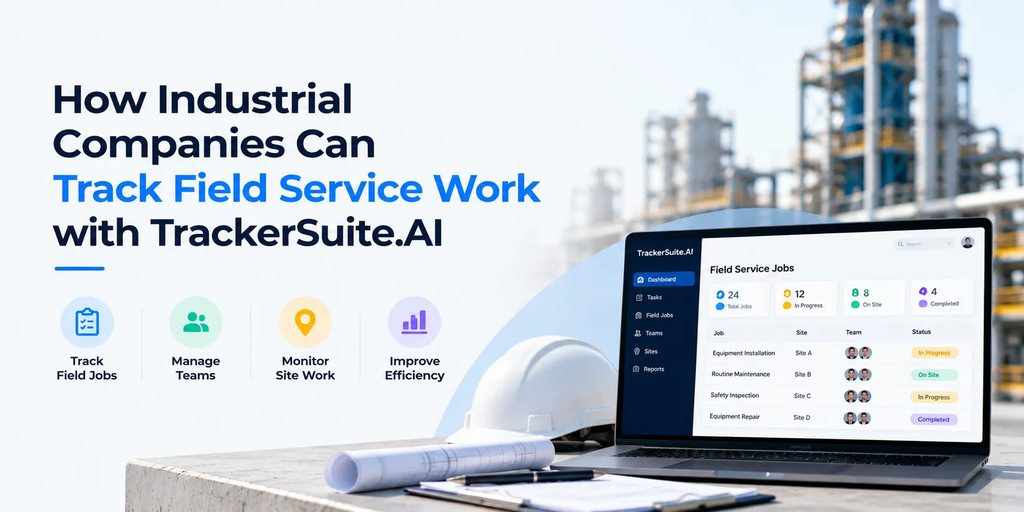
Industrial companies manage field service activities such as equipment installation, maintenance, inspections, and repairs across multiple customer sites. Tracking these jobs through spreadsheets, phone calls, and WhatsApp can make it difficult to monitor progress, manage technicians, and verify completed work.
Field service management software helps companies organize these activities and improve visibility across their operations.
Field service management (FSM) applies to businesses where important services or customer interactions happen outside the main office or facility. These include industrial maintenance, manufacturing, HVAC installation, facilities management, medical equipment servicing, and home services.
As field operations expand, companies need a structured way to manage distributed teams, changing schedules, equipment-related tasks, service requests, and customer communication.
What Kinds of Companies Rely on Field Service Management?
Field service management is useful for businesses that coordinate employees and service activities across multiple locations.
These companies often need to:
- Manage distributed teams and changing schedules.
- Assign service requests based on availability and responsibilities.
- Track equipment-related inspections, installations, and repairs.
- Coordinate parts, inventory, and other resources.
- Maintain communication between field employees, managers, and customers.
- Record completed work and follow up on unresolved issues.
The exact requirements depend on the industry, the complexity of the service, and the number of customer locations involved.
Why Is Field Service Tracking Important for Industrial Companies?
Field service teams play a critical role in keeping industrial equipment operational and meeting customer service requirements. Depending on the business, technicians may visit factories, warehouses, construction sites, or customer facilities to install machinery, troubleshoot problems, perform preventive maintenance, and complete repairs.
Managing these activities requires coordination between service managers, technicians, customers, and other departments. Managers need to assign jobs, communicate requirements, track deadlines, and ensure that technicians submit the necessary updates after completing their work.
When service operations are small, phone calls and spreadsheets may be sufficient. However, as the number of technicians, service requests, and customer locations increases, manual tracking becomes harder to manage.
Managers may spend more time collecting updates than reviewing service performance, while technicians may not always have clear visibility into their pending assignments.
A structured field service tracking process helps companies:
- Maintain records of assigned work.
- Monitor job progress across locations.
- Identify delayed or incomplete activities.
- Document service activities and completed tasks.
- Improve coordination between field teams and office staff.
Common Challenges in Managing Field Service Work
1. Tracking Technicians Across Multiple Locations
Industrial service companies often have technicians working at different customer sites throughout the day. A service manager may need to coordinate several ongoing jobs while handling new requests and following up on earlier assignments.
Without a centralized tracking system, managers may need to contact technicians individually to find out whether they have reached a site, started a job, or completed the assigned work. These repeated calls interrupt daily operations and do not always provide a complete picture of the team’s workload.
A centralized task tracking system allows managers to review assigned work and its current status. Employees can update their tasks through a defined process, giving managers a clearer view of field activities without depending entirely on phone-based reporting.
2. Managing Service Requests and Priorities
Not all field service requests have the same urgency. A machine breakdown that affects production may require immediate attention, while a routine inspection can be scheduled for a later date.
Service managers must consider the nature of the problem, technician availability, customer requirements, and other ongoing assignments before allocating work.
When requests arrive through different communication channels, it can become difficult to maintain a consistent record of priorities and deadlines. A request shared over the phone may not be recorded in the main spreadsheet, while a technician may receive incomplete instructions through a message.
A structured workflow helps companies record each service request, assign responsibility, set deadlines, and communicate the work required. Managers can then review pending assignments and make decisions based on the status and priority of each job.
3. Preventing Delays in Maintenance and Repairs
Preventive maintenance helps industrial companies identify equipment issues and carry out servicing at planned intervals. However, maintenance schedules can become difficult to manage when activities are spread across multiple machines, facilities, and service teams.
A missed inspection or delayed maintenance task may create additional work later. Similarly, when a technician identifies a problem during a service visit, the corrective action may remain pending if responsibility and follow-up dates are not clearly recorded.
Companies can use task management software to schedule recurring activities, assign technicians, establish deadlines, and monitor completion.
If an inspection identifies an issue that requires further work, a follow-up task can be assigned to the appropriate person.
Task tracking improves visibility into maintenance activities, although companies with complex asset management requirements may also need a dedicated computerized maintenance management system (CMMS).
4. Verifying Completed Field Service Jobs
A technician reporting that a job is complete does not always provide enough information for a manager to evaluate the result. Depending on the service activity, the company may require a checklist, inspection report, photographs, or other supporting documentation.
When technicians send these records through email or WhatsApp, managers may need to search through multiple conversations to find the information related to a particular job. This makes reviewing completed work more time-consuming and can lead to incomplete records.
A digital task workflow can keep the job description, completion status, and supporting evidence together. Technicians can submit the required information against their assigned tasks, allowing managers to review the submission and request corrections where necessary.
For industrial companies, completion criteria should reflect the actual service requirements. Evidence collection can support the review process, but it does not automatically establish that a machine is safe or that a repair meets all technical standards.
5. Reducing Manual Reporting
Field service managers often prepare daily or weekly reports covering jobs completed, outstanding service requests, delayed activities, and technician performance.
When information is collected manually from different employees, preparing these reports can take considerable time.
The problem becomes more pronounced when different teams use different formats for recording their work. One technician may provide a detailed report, while another sends a short message that requires additional clarification.
A centralized system creates a more consistent way to record task assignments and progress. Managers can use the available task data to review completion trends and identify pending work, reducing the need to collect every update individually.
How Industrial Companies Can Improve Field Service Tracking
Addressing these challenges requires more than moving an existing spreadsheet into software. Companies need a consistent process for assigning work, updating progress, documenting completion, and managing follow-ups.
1. Create a Centralized Record of Every Service Job
Every service request should have a clear record that identifies the problem, the customer or site, the responsible technician, and the expected completion date.
This reduces the risk of requests being overlooked or instructions getting lost in separate communication channels.
For example, an industrial equipment manufacturer may receive a service request from a customer experiencing irregular machine performance. The service manager can record the issue, assign a technician, and provide the necessary instructions and deadline.
The technician can then refer to the assigned task instead of relying on scattered messages for job details.
A centralized record also makes it easier to review previous updates and understand what remains to be done. Where the company uses a separate CRM or service desk, it should determine how service requests will move between that system and the task management platform.
2. Define Clear Responsibilities and Deadlines
A service job may involve several people, including a technician, a service manager, a parts coordinator, and a customer representative. If ownership is unclear, each person may assume that someone else is responsible for the next step.
Companies should define:
- Who is responsible for completing each activity.
- Who reviews the result.
- Who handles delays or exceptions.
- When the work should be completed.
Deadlines should reflect the job’s priority and operational requirements.
Task management software can help record these responsibilities and make due dates visible. When a task remains incomplete, the manager can identify the owner and determine what is preventing progress.
Clear ownership is particularly important for jobs that require multiple visits or depend on spare parts, customer approvals, or support from another department.
3. Standardize the Service Workflow
Industrial companies often handle similar service activities repeatedly. Equipment installation, routine inspection, machine repair, and scheduled maintenance may each follow a defined set of steps.
Creating task templates for these activities helps teams follow a consistent process.
For example, a maintenance task may include:
- Performing the inspection.
- Recording findings.
- Documenting identified issues.
- Submitting the service report.
- Obtaining the required approval.
The workflow should specify which steps apply to each type of job and what information must be submitted before the task can be considered complete.
Standardization does not mean every service job must follow an identical process. Emergency repairs and complex technical issues may require additional steps or different approval requirements.
4. Enable Timely Status Updates
Managers need reliable updates to understand whether service jobs are progressing as expected. However, technicians should not have to spend excessive time preparing reports while working at customer sites.
A practical approach is to define a few meaningful task statuses, such as:
- Assigned
- In progress
- Awaiting parts
- Completed
- Pending review
Technicians can update the status when the job reaches the relevant stage, while managers can focus on tasks that are delayed or require intervention.
Task reminders can also help employees keep deadlines visible. The organization should configure reminders and escalation rules according to its service process rather than sending unnecessary notifications for every change.
Timely updates help managers identify delays earlier and communicate more accurately with customers about the progress of service work.
5. Record Proof of Work and Service Reports
Service records help companies understand what work was performed and what action was taken. Depending on the job, this may include an inspection checklist, photographs, equipment readings, a service report, or confirmation that a particular activity was completed.
Companies should define the evidence required for each service category and provide employees with a consistent way to submit it. Keeping these records associated with the relevant task makes it easier for authorized managers to review the submission.
TrackerSuite.AI’s Task Tracker supports task workflows that can include submitted images, videos, and documents. Its AI Work Validation capabilities can help review submitted evidence against predefined criteria and flag items that may need further attention.
For example, a company could define the photographs or documents required after a particular inspection. AI-assisted review may help identify submissions that appear incomplete, allowing the responsible manager to examine them more closely.
Technical decisions, safety checks, and mandatory approvals should remain with qualified personnel.
6. Monitor Overdue Jobs and Resolve Bottlenecks
A job can be delayed for several reasons. A technician may need a replacement part, the customer may not be available, or the initial diagnosis may reveal that additional work is required.
Simply marking a task as overdue does not explain the cause or resolve the problem.
Service managers should review overdue activities and record the reason for the delay where the workflow supports it. They can then assign the next action, establish a revised deadline, or involve another team if necessary.
When managers can see the status and ownership of pending work in one place, they can prioritize their follow-ups more effectively.
Over time, the data may also reveal recurring problems, such as repeated delays for a particular service category or dependencies on a specific department.
7. Use Performance Data to Improve Service Operations
Field service tracking can provide useful information about how work is distributed and completed.
Managers can review:
- The number of jobs assigned to each technician.
- Completion timelines.
- Overdue activities.
- Incomplete submissions.
- Recurring service issues.
These indicators should be interpreted in context. A technician handling complex repairs may complete fewer jobs than someone performing routine inspections, while travel distances and spare-part availability may affect completion times.
Rather than relying on a single productivity measure, companies should review several indicators together. This helps managers identify where additional training, better planning, clearer instructions, or changes to resource allocation may improve service delivery.
TrackerSuite.AI provides task and workforce management capabilities to support visibility into assigned work and completion trends. TAVI AI adds AI-powered capabilities for analyzing business activity and identifying areas that may need attention, depending on the enabled features and available data.
Field Service Tracking Examples Across Industrial Industries
Although the basic principles of field service tracking are similar, the specific requirements vary by industry and service model.
Industrial Equipment Manufacturers
Equipment manufacturers often provide installation, maintenance, repairs, and after-sales support. Their service teams may handle requests from customers across multiple cities, with each job requiring different technical skills and parts.
A task tracking system can help service managers assign requests, monitor progress, collect service reports, and manage follow-up visits.
When a technician identifies an unresolved issue, the company can record the next action and assign responsibility instead of leaving the update in an informal conversation.
This approach can improve coordination between the service team and office staff while creating a more organized record of job execution.
Manufacturing Plants
Manufacturing plants need maintenance teams to inspect machinery, address equipment issues, and complete planned servicing. Supervisors must coordinate maintenance activities without losing visibility into production-related priorities.
Task tracking can help assign inspection activities, establish deadlines, document findings, and follow up on corrective work.
If a maintenance task cannot be completed because a component is unavailable, the responsible team can record the dependency and monitor the next step.
Companies managing complex equipment histories, maintenance strategies, and spare-parts planning should assess whether task management needs to work alongside a CMMS or ERP system.
HVAC and Industrial Installation Companies
HVAC contractors and industrial installation providers coordinate site surveys, equipment installation, inspections, repairs, and handover activities. A single customer project may involve several technicians and multiple stages of work.
A structured workflow helps managers assign each stage, track completion, collect the required records, and identify activities that are holding up the overall job.
It also gives the team a clearer record of outstanding work before the site is handed over.
The workflow should reflect the company’s actual installation and approval requirements rather than treating every job as a simple task with a completion checkbox.
Industrial Maintenance Service Providers
Third-party maintenance providers may serve many customers with different equipment, service schedules, and contractual commitments. Their managers need to allocate technicians, coordinate visits, and keep customers informed about unresolved requests.
Centralized task tracking can help maintain visibility into assigned jobs and follow-ups. Managers can review pending work, identify resource constraints, and organize service records around individual assignments.
Where service-level agreements (SLAs), automated dispatching, or route optimization are important, companies should verify whether those capabilities are available in the selected software or require separate tools.
How TrackerSuite.AI Supports Field Service Work
TrackerSuite.AI is an AI-powered platform that brings together task management, sales tracking, and inventory management. For industrial companies that want to improve field service coordination, Task Tracker provides a starting point for organizing assigned work and monitoring execution.
Task Tracker
Task Tracker helps managers assign activities, define deadlines, send reminders, and review task progress.
These capabilities can support:
- Service visits and follow-ups.
- Equipment inspections.
- Maintenance activities.
- Installation tasks.
- Service documentation workflows.
The suitability of these workflows depends on the company’s service requirements and how tasks are configured.
AI Work Validation
AI Work Validation can help review submitted task evidence against defined criteria and flag submissions that may require additional attention.
This can support managers who need to review photographs, videos, or documents submitted as part of task completion.
It should be used as an aid to review rather than a replacement for technical inspection or mandatory sign-off.
TAVI AI
TAVI AI, the intelligence layer behind TrackerSuite.AI, offers AI-powered capabilities for analyzing business activity and performance.
Depending on the enabled features and available data, it can help identify work that may need attention and provide insights into operational activity.
Stack Tracker
For field service companies that also manage physical inventory, Stack Tracker may support relevant inventory and stock movement processes.
Companies should confirm that the available functionality meets their requirements for spare-parts availability, reservations, and service-related inventory workflows.
Before implementing the platform, organizations should evaluate how it fits with their existing service desk, CRM, ERP, or maintenance systems.
Requirements such as offline access, automated dispatching, route planning, asset history, and SLA management should be verified rather than assumed.
How to Implement Field Service Tracking Successfully
A gradual implementation helps industrial companies establish a practical workflow before introducing it across the entire service operation.
1. Identify the Main Operational Problem
Start by identifying the biggest operational challenge. This might be delayed maintenance, incomplete service reports, difficulty locating field updates, or the amount of time managers spend following up with technicians.
Starting with a specific problem makes it easier to determine whether the new process is helping.
2. Document the Existing Service Workflow
Identify how a request is received, who assigns the job, what the technician must do, which evidence is required, and who reviews completion.
This exercise often reveals gaps in responsibility or communication that software alone will not resolve.
3. Configure and Test a Small Workflow
Configure task templates, deadlines, status options, and completion criteria for a small number of service activities.
A pilot with one team or region allows managers to collect feedback from technicians and identify unnecessary steps before expanding the process.
4. Measure Results Against a Baseline
Useful indicators include on-time job completion, overdue tasks, time spent collecting updates, completeness of service records, and the time between job assignment and completion.
Metrics should account for differences in job complexity, travel, and parts availability.
5. Expand and Improve the Process
Once the workflow is working consistently, the company can expand it to other teams and service categories.
Regular reviews help ensure that the system continues to support the way field service work is actually performed.
Frequently Asked Questions
What Is Field Service Management Software?
Field service management software helps businesses coordinate work performed outside their offices or main facilities. Depending on the product, it may support job assignment, scheduling, technician updates, task tracking, service reports, and performance reporting.
How Can Industrial Companies Track Field Technicians?
Companies can assign jobs digitally, set deadlines, define completion requirements, and ask technicians to update task status as work progresses. Managers can review pending and completed tasks from a centralized view.
Location tracking may also be available in some systems, subject to the features enabled and applicable privacy requirements.
Can Field Service Tracking Software Help Reduce Delays?
It can make job ownership, deadlines, and pending activities easier to track. This helps managers identify delays and assign follow-ups.
Actual improvements depend on the service process, technician adoption, resource availability, and how consistently the system is used.
How Can Companies Verify Completed Service Work?
Companies can define completion criteria and request supporting evidence such as checklists, photographs, or service reports.
AI-assisted validation can help flag submissions that may need further review, but qualified personnel should perform required technical checks and approvals.
Can TrackerSuite.AI Be Used to Track Industrial Field Service Tasks?
TrackerSuite.AI’s Task Tracker supports task assignment, deadlines, reminders, and progress tracking. AI Work Validation can help review submitted task evidence against defined criteria.
Companies should evaluate the available features against their specific field service requirements before deployment.
Does Task Tracking Software Replace a CMMS or ERP?
Not necessarily. Task tracking helps organize and monitor work, while a CMMS may manage equipment records, maintenance schedules, and work orders. An ERP supports broader business processes.
Some companies may need task tracking alongside these systems, depending on the complexity of their operations.
Conclusion
Effective field service tracking helps industrial companies coordinate technicians, manage maintenance activities, monitor service jobs, and maintain clear records of completed work.
A consistent process also helps managers identify pending activities and address delays before they create further operational problems.
TrackerSuite.AI helps businesses organize tasks, coordinate employees, and monitor work progress. Its AI-powered work validation and business insight capabilities can further support the review of task evidence and identification of activities that may need attention.
Industrial companies can start by digitizing one important service workflow, measuring the results, and expanding gradually as their requirements evolve.
Ready to improve visibility into your field service operations? Book a demo of TrackerSuite.AI to explore how its task management and AI capabilities can support your team’s workflow.
Leave a Reply