
Motor manufacturers rarely lose output because of a weak production plan. They lose it in the gaps between people: a parts shortage nobody chased, a quality hold stuck waiting for sign-off, a handover between shifts that never happened.
Task management software for lending companies closes those gaps. It gives every loan file a clear owner, a deadline and a visible status, so managers can act on problems instead of hunting for them.
Key takeaways
- Process efficiency shows up in cost. Mortgage Bankers Association data for 2025 shows a wide gap in per-loan production expense between the most and least profitable US lenders.
- Spreadsheets and WhatsApp groups work well for a small team. They start to strain once you add branches, partners and new loan products.
- Map a handful of recurring workflows, such as document collection, approvals and repayment reminders, before you add automation or AI.
- AI is useful when it works on connected task and customer data under clear rules. Credit decisions and compliance sign-off stay with people.
- Payment companies, recruitment firms and staffing agencies run similar high-volume, deadline-driven work, so the same model applies.
At a glance
- Who it suits: NBFCs, microfinance lenders, gold loan businesses, mortgage brokers and digital lenders with growing teams.
- What it manages: The human work around each loan, not the loan record itself.
- Where to start: Three to five recurring workflows in one branch.
- Role of AI: Prioritising work, flagging delays and supporting follow-ups under rules you set.
- What stays human: Credit decisions, exceptions and compliance sign-off.
What does task management software for lending companies do?
Task management software gives a lending team one place to assign, track and close the work around each loan. That includes document requests, verifications, approvals, disbursement checks and repayment follow-ups. Each task has an owner, a due date and a status, so managers can see what is stuck without calling five people.
A task tracker does not replace a loan origination system (LOS), the system that records the application, credit data and loan terms. The LOS stores the loan. The task layer manages the people work around it: who calls the borrower, who checks the documents, who approves the exception and who confirms the money went out.
This matters most for This matters most for motor manufacturers and their tier 1 and tier 2 suppliers, where work spans assembly lines, parts inventory, field service and dealer networks. A parts shortage, a quality hold or a late supplier delivery usually passes through several teams before anyone solves it. Much of that follow-up happens on phones, on the shop floor and on the road, so it rarely shows up in any single system., where work spans assembly lines, parts inventory, field service and dealer networks.
These teams often rely on field officers and direct selling agents (DSAs), the outside partners who source borrowers. Much of their work happens on phones, at branches and on the road, so it rarely shows up in any single system.
Why do lending operations get harder to manage as loan volume grows?
Every new loan adds documents, checks, approvals and follow-ups, and every new branch or partner adds more handoffs. A small team can coordinate over calls and a shared sheet. With hundreds of staff across many branches and shifts, nobody sees the full picture, so delays and audit gaps grow quietly.
The cost of running that work shows up in industry data. ## Why do motor manufacturing operations get harder to manage as they grow?
Every new line, shift, product variant or supplier adds handoffs, checks and follow-ups. A small plant can coordinate over calls and a shared sheet. With hundreds of staff across several shifts and sites, nobody sees the full picture, so delays and missed handovers build up without anyone noticing.
Downtime shows how expensive those gaps can become. Siemens’ 2024 True Cost of Downtime report found that an hour of downtime at a large automotive plant costs about $2.3 million, twice the 2019 figure (Siemens, 2024). Not every stoppage starts with a coordination failure. Still, an unchased parts shortage or a missed shift handover can keep a line waiting.
(MBA, 2026).
Most manufacturers follow a similar scaling path:
- Small: A plant manager and a few supervisors use WhatsApp, Excel and phone calls. Everyone knows every open issue.
- Growing: A second shift or a second site starts. Issues move between production, quality, stores and purchasing, and the shared sheet now exists in several versions.
- Complex: A named person must sign off quality holds. Customers and auditors ask for proof of who did what and when.
- Scaled: Workflows are standard, data sits in one place, reminders run on their own and managers act on exceptions instead of checking every line.
The jump from growing to complex is where most teams feel the pain. Accountability blurs, reporting becomes a weekly manual job and follow-ups depend on someone’s memory.

Which manufacturing workflows should you track and automate first?
Start with workflows that repeat daily, involve more than one person and cost output when they slip. For most motor manufacturers, that means parts shortages, quality holds, shift handovers, supplier follow-ups, maintenance requests, field service visits, dealer requests and compliance tasks. These eight make a practical starting list.
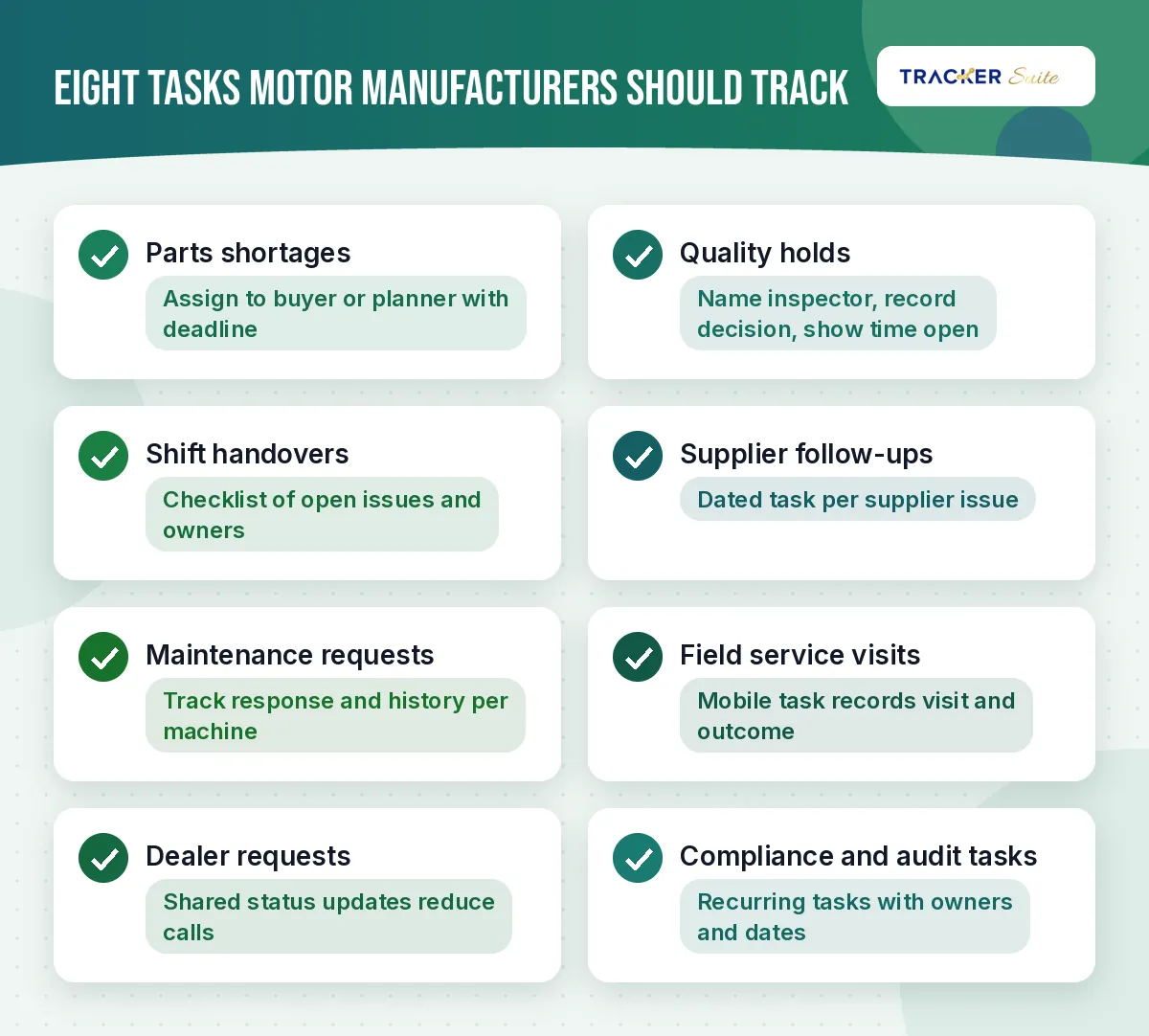
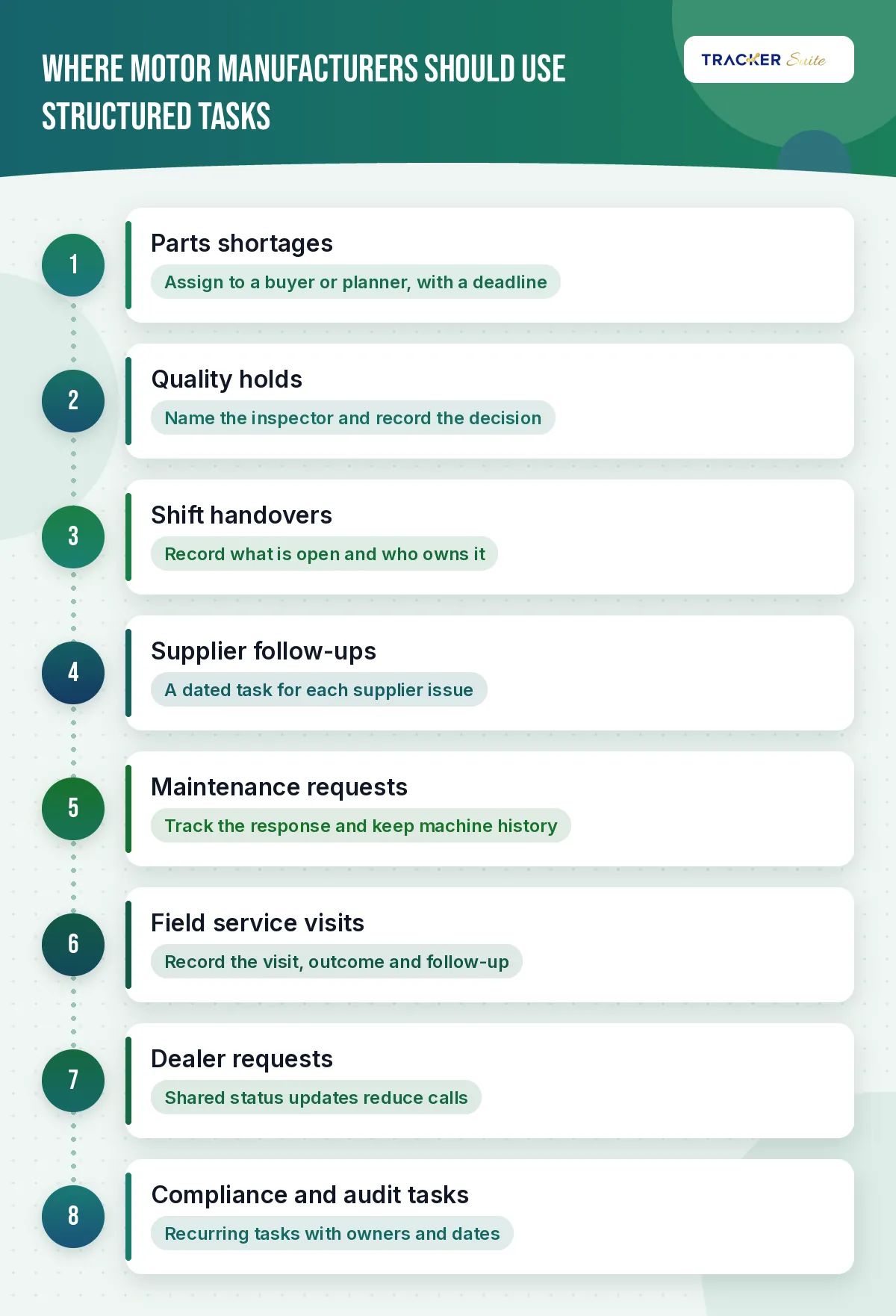
- Parts shortages: A storekeeper spots a low bin and tells someone on the floor. A structured task assigns the shortage to a buyer or planner, with a deadline set before the line runs out.
- Quality holds: Suspect parts or units wait for inspection and sign-off. A hold task names the inspector, records the decision and shows how long the hold has been open.
- Shift handovers: Open issues pass from one supervisor to the next by word of mouth. A handover checklist records what is open and who owns it on the next shift.
- Supplier follow-ups: Teams chase late deliveries and corrective actions over email. A dated task for each supplier issue shows what is overdue and who is chasing it.
- Maintenance requests: Operators report a fault and then wait. A request task sends it to maintenance, tracks the response and keeps a history for each machine.
- Field service visits: Technicians visit customer or dealer sites to install, repair or inspect motors. A mobile task records the visit, the outcome and any follow-up, so nobody has to phone the office.
- Dealer requests: Dealers call repeatedly about orders, spares and warranty claims. Shared status updates reduce those calls and keep a record of what was promised.
- Compliance and audit tasks: Calibration checks, safety inspections and audit responses often live in one person’s calendar. Recurring tasks with owners and dates make them visible to managers.
Each workflow generates useful data: timestamps, owners, outcomes and delays. That data becomes the foundation for reporting and, later, for AI.
How does connected data improve visibility for production teams?
Connected data means every task, issue status and follow-up sits in one shared record instead of scattered sheets and chats. Managers can then see open issues by line, shift, site and owner in real time. Problems show up as exceptions on a dashboard instead of as a stopped line or a dealer complaint.
Here is how that changes daily work:
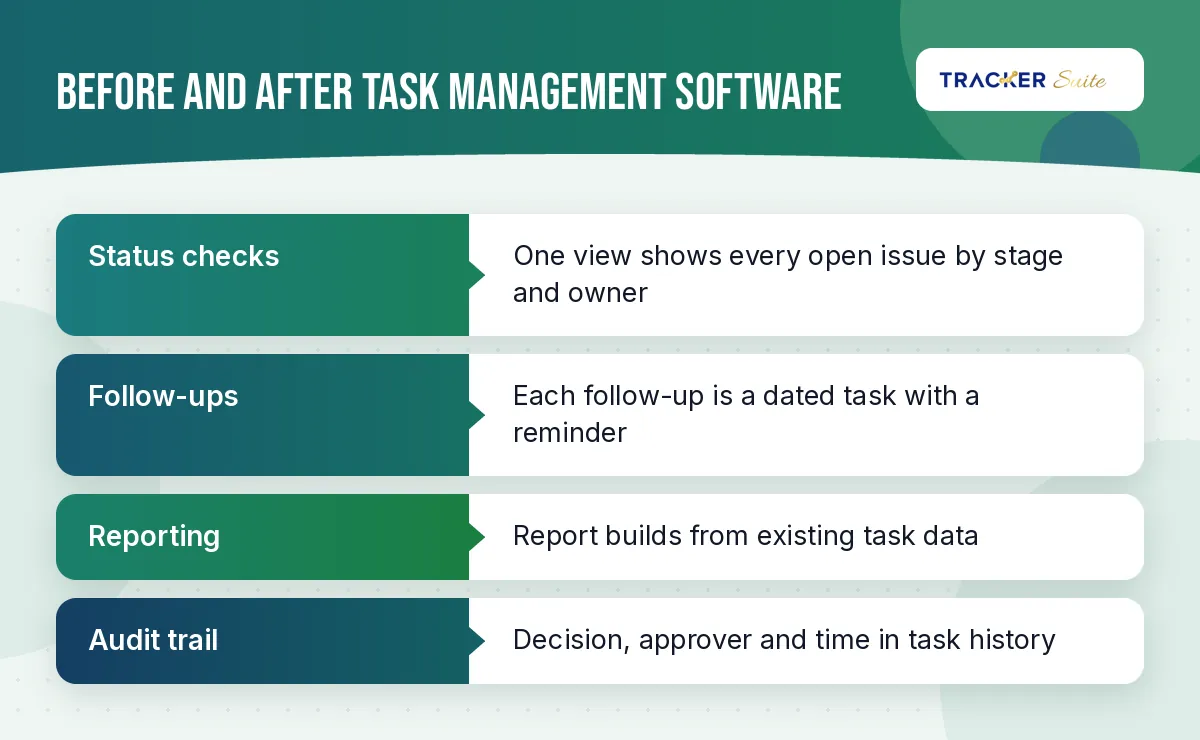
- Status checks: Before, a production manager asks five people for updates every morning. After, one view shows every open issue by stage and owner.
- Follow-ups: Before, a supervisor has to remember supplier call-backs. After, each follow-up is a dated task with a reminder.
- Reporting: Before, someone compiles a weekly report by hand from several sheets. After, the report builds from task data that already exists.
- Audit trail: Before, proving who released a quality hold means searching emails. After, the decision, the approver and the time are part of the task history.
Permissions matter here too. Plants hold supplier pricing, customer orders and staff records. A good setup gives operators and technicians access to their own tasks, gives quality teams access to the holds they review and limits sensitive records to the people who need them., twice the 2019 figure (Siemens, 2024). Those in the bottom 20% spent $12,603 (MBA, 2026).
Those figures include commissions, staff pay, occupancy, equipment and corporate allocations, not technology alone. Even so, they show that lenders selling similar products can carry very different costs depending on how they run the work.
In 2025, the least profitable US mortgage lenders spent $2,529 more to produce each loan than the most profitable ones (MBA, 2026).
Most lenders follow a similar scaling path:
- Small: A founder and a few loan officers use WhatsApp, Excel and phone calls. Everyone knows every file.
- Growing: A second and third branch open. Files move between sales, credit and operations, and the shared sheet now exists in several versions.
- Complex: Approvals need a maker-checker step, where one person prepares and another approves. Auditors ask for proof of who did what and when.
- Scaled: Workflows are standard, data sits in one place, reminders run on their own and managers act on exceptions instead of checking every file.
The jump from growing to complex is where most teams feel the pain. Accountability blurs, reporting becomes a weekly manual job and follow-ups depend on someone’s memory.

Which lending workflows should you track and automate first?
Start with workflows that repeat daily, involve more than one person and cost money when they slip. For most lenders, that means lead follow-up, document collection, field verification, approvals, disbursement checks, repayment reminders, partner coordination and compliance tasks. These eight make a practical starting list.
- Lead intake and first contact: Leads arrive from DSAs, web forms and ads. Manually, they sit in a sheet until someone calls. A structured workflow assigns each lead to an officer and sets a call-back deadline.
- Document collection: KYC papers, bank statements and income proof arrive in pieces over email and chat. A checklist task per file shows what is missing and sends a reminder when a due date passes.
- Field verification: Officers visit homes or businesses to confirm details. A mobile task records the visit, the outcome and any follow-up, instead of a phone call to the branch.
- Credit review and approvals: Files wait in inboxes for sign-off. An approval task routes each file to the right person by loan size or product and records who approved it and when.
- Disbursement checks: Signed agreements, mandate setup and final checks must be complete before money moves. A pre-disbursement checklist stops a file from moving forward with a step missing.
- Repayment reminders and early collections: Officers track due dates in personal notebooks. Scheduled tasks create reminders ahead of each due date and flag missed payments for follow-up.
- DSA and partner coordination: Partners call repeatedly to ask about file status and payouts. Shared status updates reduce those calls and keep a record of what was promised.
- Compliance and audit tasks: Periodic KYC refreshes, policy reviews and audit responses often live in one person’s calendar. Assigned compliance tasks with owners and dates make them visible to managers.
Each workflow generates useful data: timestamps, owners, outcomes and delays. That data becomes the foundation for reporting and, later, for AI.
How does connected data improve visibility for loan teams?
Connected data means every task, file status and follow-up sits in one shared record instead of scattered sheets and chats. Managers can then see open files by stage, branch and officer in real time. Problems surface as exceptions on a dashboard rather than as complaints from borrowers or auditors.
Here is how that changes daily work:
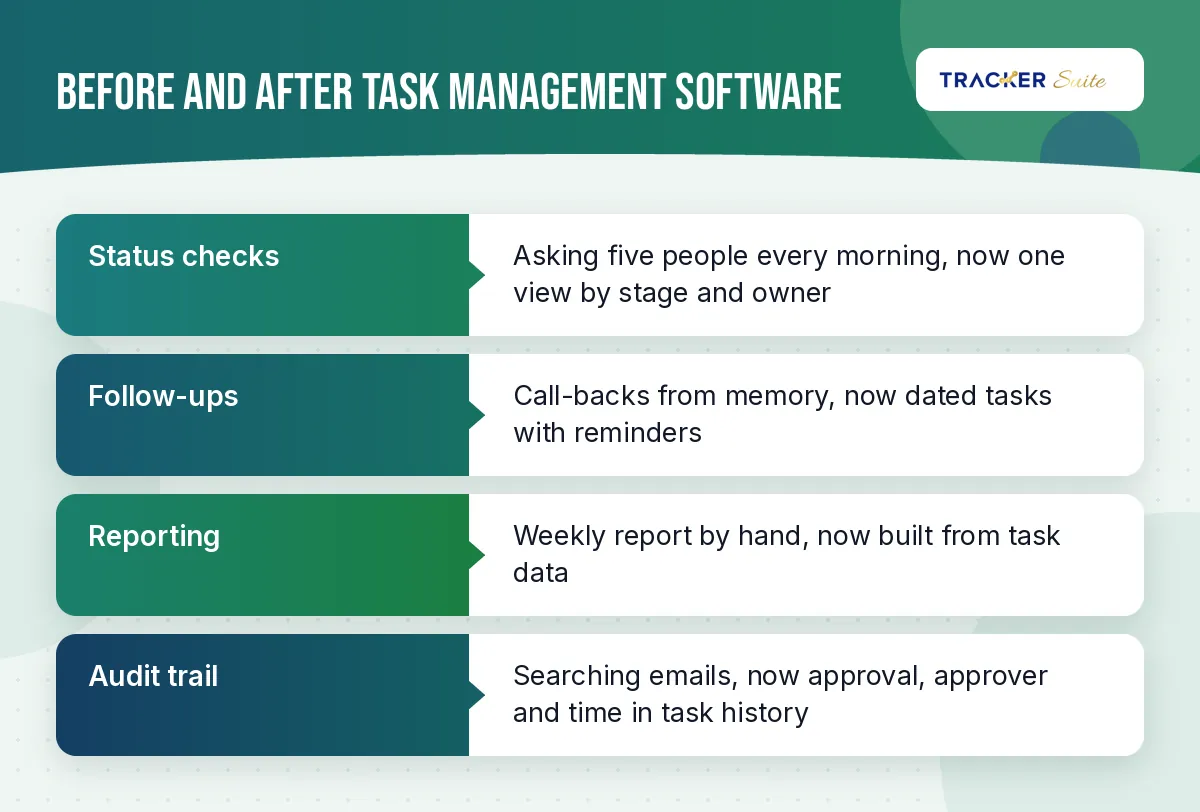
- Status checks: Before, a branch manager asks five people for updates every morning. After, one view shows every file by stage and owner.
- Follow-ups: Before, an officer remembers call-backs from memory. After, each follow-up is a dated task with a reminder.
- Reporting: Before, someone compiles a weekly report by hand from several sheets. After, the report builds from task data that already exists.
- Audit trail: Before, proving who approved a file means searching emails. After, the approval, the approver and the time are part of the task history.
Permissions matter here too. Loan files hold sensitive personal and financial data. A good setup gives field officers access to their own tasks, gives credit teams access to files under review and limits sensitive records to the people who need them.
Where does AI help in loan operations, and where do people stay in charge?
AI helps when it works on connected task and customer data under rules your team sets. It can sort work by urgency, flag files that are running late, draft reminders and point out where approvals pile up. People still make credit decisions, approve exceptions and own compliance sign-off.
Where does AI help in motor manufacturing operations, and where do people stay in charge?
AI helps when it works on connected task and inventory data under rules your team sets. It can sort work by urgency, flag issues that are running late, draft reminders and point out where sign-offs pile up. People still release quality holds, approve exceptions and own safety and compliance sign-off.
In practice, AI can help by:
- Flagging quality holds that have stayed open longer than usual.
- Spotting parts that are running low before they stop a line.
- Reminding shift leads about open handovers.
- Pointing out a line, shift or supplier where follow-ups keep slipping.
AI is only as good as the data behind it. If tasks are not logged consistently, no model can fix the gaps. That is why the workflow work comes first and AI comes second.
Does the same approach work for aviation, aerospace and supply chain businesses?
Yes, in most cases. Aviation and aerospace suppliers, discrete manufacturers and logistics and supply chain teams all run high-volume work with deadlines and handoffs between teams. The steps differ, but every task still has an owner, a due date, a status and a follow-up, so the same structured approach applies.
Aviation and aerospace suppliers typically track inspection sign-offs, non-conformance reports, part traceability and maintenance tasks. Records matter as much as speed, so each task needs a clear owner and history.
Discrete manufacturers and fabricators usually track work orders, rework, material requests and delivery deadlines. When many small orders run at once, a shared tracker stops jobs from stalling between steps.
Logistics and supply chain teams add warehouse moves, inbound and outbound shipments, carrier follow-ups and proof of delivery. Mobile updates and location visibility become important once people are spread across sites and routes.
A small workshop with one line may manage with a visual board. A larger group with several plants and many suppliers may need connected reporting. Practical examples include:
- Highlighting files that have waited at one stage longer than usual.
- Suggesting which leads to call first based on age and source.
- Spotting a branch or officer where follow-ups keep slipping.
- Supporting routine outreach, such as reminder calls, where your rules and local regulations allow it.
AI is only as good as the data behind it. If tasks are not logged consistently, no model can fix the gaps. That is why the workflow work comes first and AI comes second.
Does the same approach work for payment, recruitment and staffing companies?
Yes, in most cases. Payment companies, recruitment firms and staffing agencies all run high-volume work with deadlines and handoffs between teams. The steps differ, but the pattern of owner, due date, status and follow-up stays the same, so the same structured approach applies.
For payment businesses, task management software for payment companies typically covers merchant onboarding, KYC checks, dispute and chargeback deadlines and settlement exceptions. Missed dispute windows cost real money, so dated tasks with clear owners matter a lot.
Task management software for recruitment companies usually tracks candidate stages, interview scheduling, client feedback and offer follow-ups. Recruiters juggle many open roles at once, and a shared tracker stops candidates from going quiet between steps.
Task management software for staffing agencies adds operational layers: filling shifts, collecting worker documents, checking attendance at client sites and closing timesheets before payroll. Mobile attendance and field visibility become important once workers are spread across many locations.
PR firms and branding agencies face a lighter version of the same problem. Their tasks centre on client approvals, content deadlines and recurring reports. A visual board may be enough for a small agency, while a larger one with many retainers may need connected reporting.
What should you look for in task management software for lending companies?
Look for tools that match your workflows, not the longest feature list. The essentials are clear task ownership, due dates and reminders, mobile access for field staff, approval tracking, role-based permissions and reports managers can trust. AI features are useful only if they work on your real data.
Use this checklist to judge whether you need a connected platform:
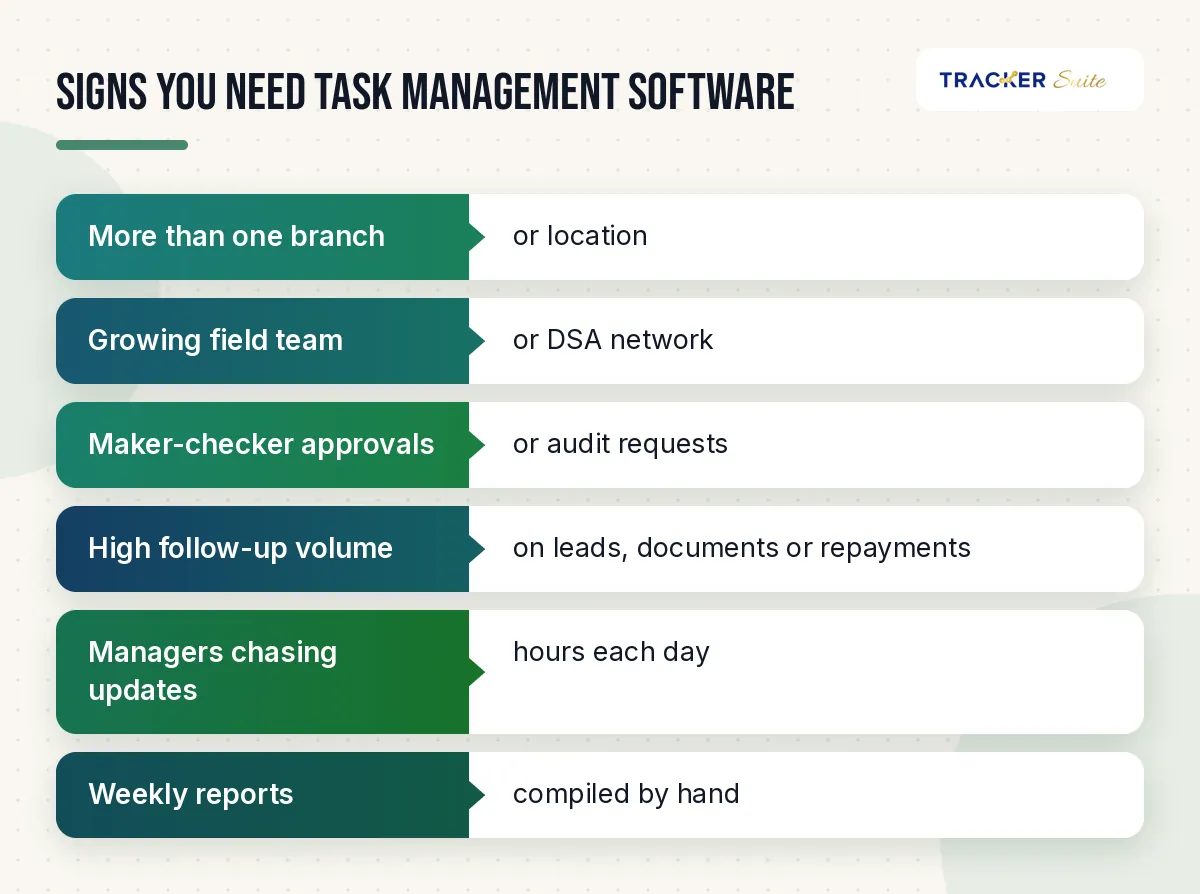
- More than one branch or location
- A growing field team or DSA network
- Maker-checker approvals or audit requests
- High follow-up volume on leads, documents or repayments
- Managers spending hours each day chasing updates
- Weekly reports compiled by hand
If you tick only one or two boxes, a simple task list or shared sheet may still be enough. A three-person lending team with one product does not need an enterprise task management platform. Revisit the decision when you add a branch or a new product.
Before you buy, ask vendors how they handle permissions, data storage and audit history. Ask for documented security controls rather than broad claims.
How does TrackerSuite fit lending teams?
TrackerSuite is an AI-powered operations platform that connects tasks, sales activity and reporting in one workspace. For lenders, its relevant parts map to the workflows above: Task Tracker for internal work, Sales Tracker for leads and field officers, and TAVI AI for insights and outreach support.
Here is how those capabilities connect to loan work, based on TrackerSuite’s published product pages:
- Document, approval and compliance tasks: Task Tracker handles assignment and tracking, with attendance management and real-time reporting listed among its features.
- Lead intake and DSA follow-up: Sales Tracker covers lead capture, lead tracking and client data, which suits loan sourcing pipelines.
- Field verification and sales visits: Sales Tracker lists real-time field officer tracking, which helps managers see field activity across locations.
- Prioritisation and reminders: TAVI AI works as an AI assistant that surfaces insights and supports reminders. Configure it under your own rules, and keep people responsible for credit and collections decisions.
How does TrackerSuite fit motor manufacturers?
TrackerSuite is an AI-powered operations platform that connects tasks, sales activity and reporting in one workspace. For motor manufacturers, our products map to the workflows above: Task Tracker for internal plant work, Stack Tracker for parts inventory and stock movement, Sales Tracker for leads and field teams, and TAVI AI for insights and reminders.
Here is how our products connect to plant and field work:
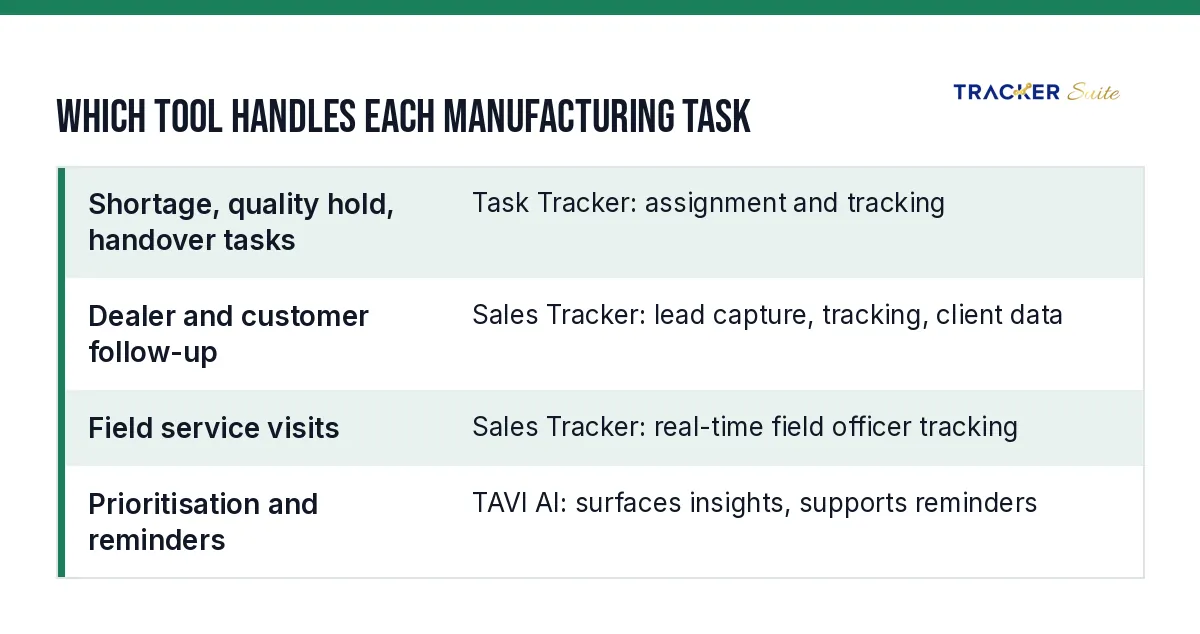
- Shortage, quality hold and handover tasks: Task Tracker handles assignment and tracking. It includes recurring tasks, attendance management and real-time reporting.
- Dealer and customer follow-up: Sales Tracker covers lead capture, lead tracking and client data, so every dealer or customer request has an owner.
- Field service visits: Sales Tracker includes real-time field officer tracking, so managers can see field activity across locations.
- Prioritisation and reminders: TAVI AI is our AI assistant. It surfaces insights and supports reminders. Set it up under your own rules, and keep people responsible for quality and safety decisions.
Every plant runs differently, so check approval routing and how TrackerSuite fits alongside the systems you already use. You can talk to the TrackerSuite team about current features, permissions and data handling before you roll out., so talk to our team about your setup, including approval routing and how TrackerSuite fits alongside the systems you already use. Treat those as questions to confirm. You can talk to the TrackerSuite team about current features, permissions and data handling before you roll out.
How do you roll out a task tracker in a lending business?
Start small, prove value in one branch and then expand. A focused pilot with three to five workflows shows what works before you change processes across the business. Many teams can start a pilot quickly if they map workflows first and keep the setup simple.
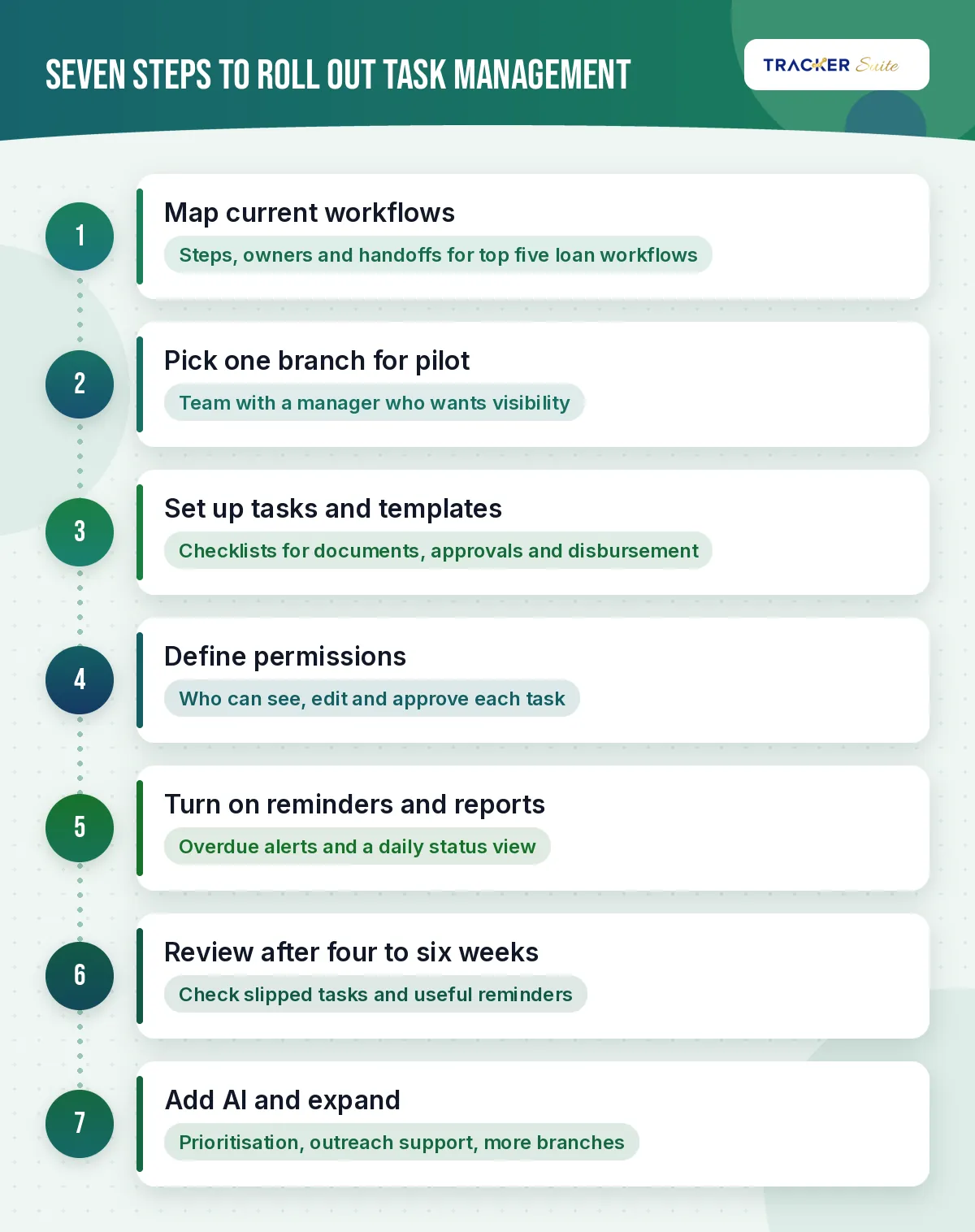
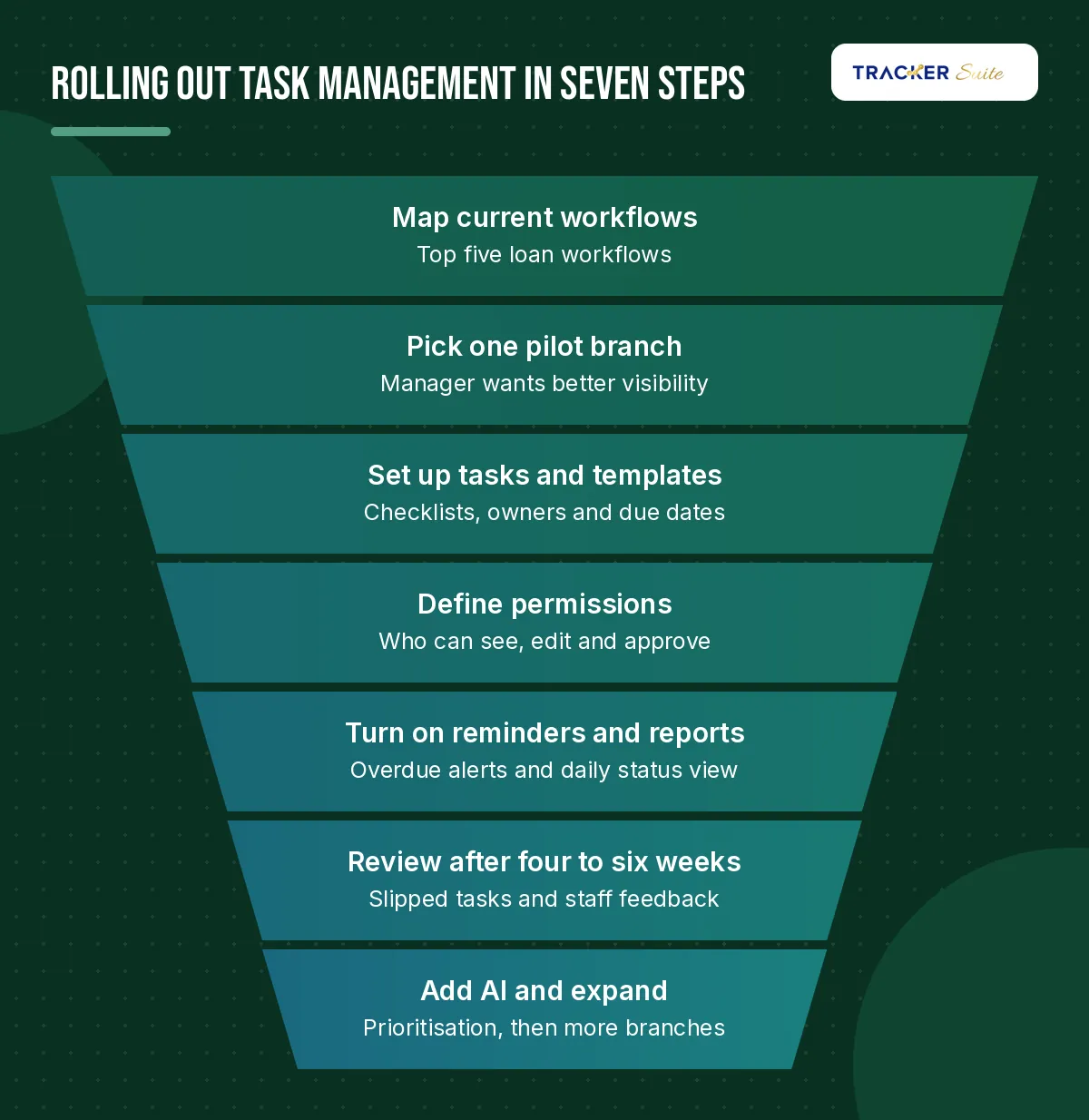
- Map current workflows. Write down the steps, owners and handoffs for your top five loan workflows. Note where files usually stall.
- Pick one branch for a pilot. Choose a team with a manager who wants better visibility.
- Set up tasks and templates. Build checklists for document collection, approvals and disbursement. Assign clear owners and due dates.
- Define permissions. Decide who can see, edit and approve each type of task, especially where personal data is involved.
- Turn on reminders and reports. Start with overdue alerts and a daily status view for the branch manager.
- Review after four to six weeks. Check which tasks slipped, which reminders helped and what staff found awkward.
- Add AI and expand. Once data is consistent, add prioritisation and outreach support, then roll out to more branches.
What this means for you
If your managers spend the day chasing updates, the problem is rarely effort. It is usually that the work lives in too many places. Fix that first by putting your highest-volume loan workflows into one shared tracker.
You do not need to automate everything at once. Pick the workflow that hurts most, often document collection or repayment reminders, and make it visible. Add automation and AI once your team trusts the data.
FAQs
Is task management software the same as a loan management system?
No. A loan management or loan origination system records the loan itself, including the application, terms and repayments. Task management software manages the human work around each loan, and the two usually work side by side.
When is a spreadsheet enough for a lending team?
A spreadsheet can work for one branch with a few loan officers and low volume. Once you add branches, partners, maker-checker approvals or audit requests, shared sheets tend to split into versions and follow-ups start to slip.
Can AI approve loans inside a task management tool?
AI in a task tool should not make credit decisions. It can sort work, flag overdue files and support reminders using your data and rules. Credit approval and compliance sign-off should stay with authorised people.
Can payment companies and staffing agencies use the same task software as lenders?
Often, yes. All three run high-volume, deadline-driven work with handoffs between teams. Each business should still build workflows around its own steps, owners and deadlines.
Conclusion
Growth in lending brings more files, more partners and more handoffs, and manual coordination does not scale with it. Task management software for lending companies gives each piece of work an owner, a deadline and a record, which is the base for better reporting and useful AI.
Start with one branch and a few workflows, keep people in charge of decisions and expand once the data is reliable. When you are ready to test it with your own team, compare TrackerSuite plans, including the free Starter plan.
Leave a Reply