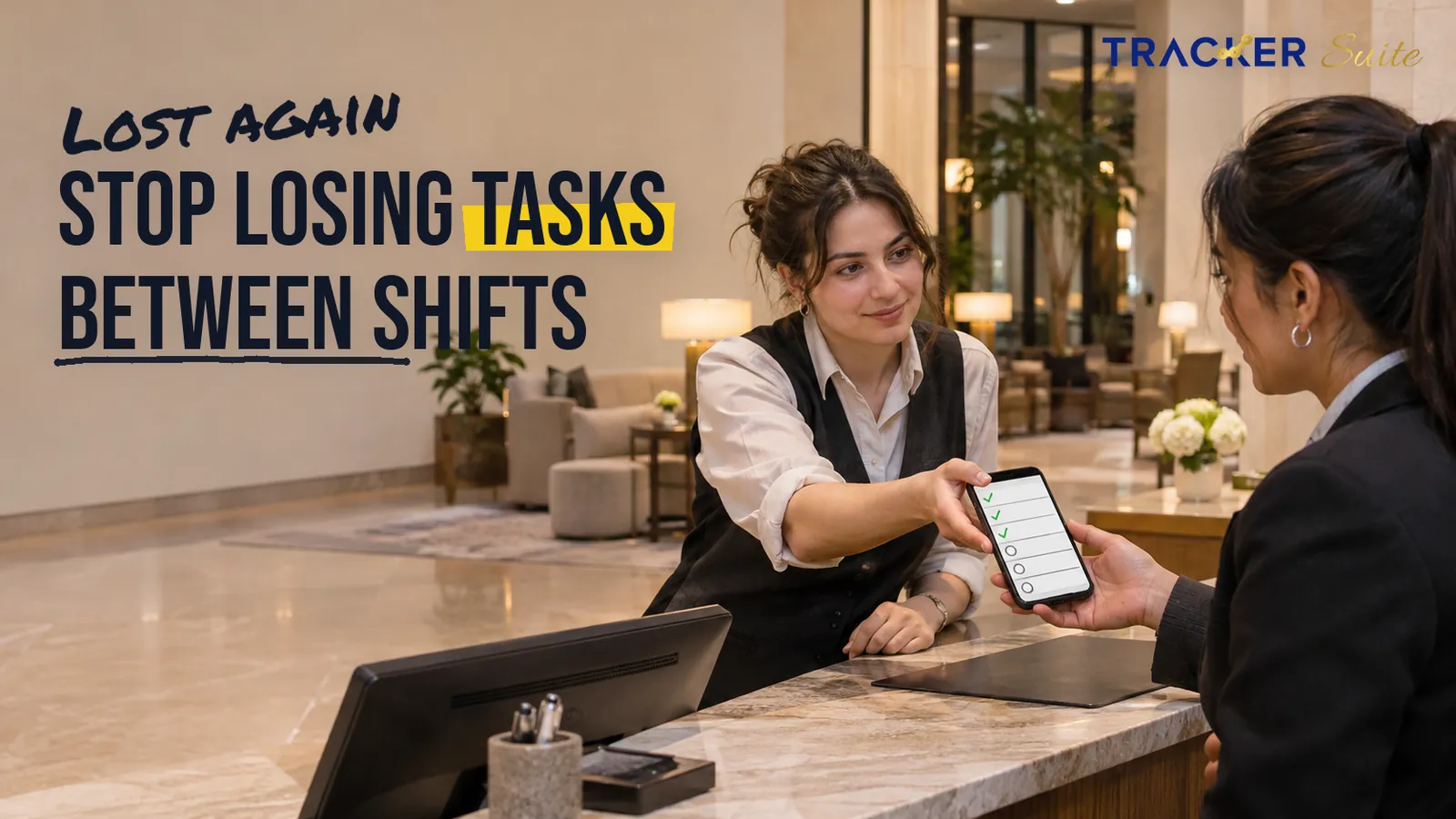
A guest calls the front desk at 9:50 p.m. asking for an extra pillow. The agent radios housekeeping, the evening attendant says "on it," and the shift ends at 10. The next morning, the guest mentions it at checkout. A task tracking tool for hotels exists to stop that kind of quiet failure by keeping every room, request and repair visible across shifts, not just in someone’s memory.
This guide covers the hotel workflows that create the most follow-up, why manual methods break down as properties grow, and how to set up a connected system without disrupting guests.
Key takeaways
- Most lost hotel tasks don’t vanish during a shift. They vanish at the handover, when a request lives only in a radio call, a chat message or a paper sheet.
- Housekeeping and front desk were the roles hotels most needed to fill in AHLA’s 2025 survey, so the teams carrying the most coordination work are often stretched thin.
- Recurring checklists, mobile task assignment, reminders and automated daily reports cover most of what a growing hotel needs before AI enters the picture.
- AI is useful when it works on real task data, such as overdue requests or repeat maintenance faults. Managers still decide priorities and service standards.
- A single small property with a stable team may only need a shared checklist. A connected platform earns its place with more rooms, more shifts or more properties.
**Scope of this guide
Written for general managers, executive housekeepers, front office managers and chief engineers at growing hotels or small hotel groups. It covers room turnaround, housekeeping checklists, maintenance requests, front desk handovers, shift changes, guest requests, preventive maintenance and linen stock.**
- Who this is for: General managers, executive housekeepers, front office managers and chief engineers at growing hotels or small hotel groups.
- Core problem: Tasks and guest requests get lost at shift change when they live in radio calls, WhatsApp threads and paper sheets.
- Workflows covered: Room turnaround, housekeeping checklists, maintenance requests, front desk handovers, shift changes, guest requests, preventive maintenance and linen stock.
- What to automate first: Recurring room and public-area checklists, plus reminders for open guest requests.
- When a simple tool is enough: One property, one or two shifts, a small stable team and low request volume.
What is happening in hotel operations right now?
Hotels are busier, but many properties still run lean in the departments that carry the most day-to-day coordination. Housekeeping, front desk and maintenance staff pass dozens of updates to each other every shift, and staffing gaps make every lost message more costly for both the guest and the team.
The American Hotel & Lodging Association (AHLA) surveyed 282 U.S. hoteliers with Hireology between December 2024 and January 2025. In that survey, 65% of hotels reported staffing shortages, and housekeeping was the role most in need at 38%, followed by front desk at 26% and maintenance at 13% (AHLA, 2025). The same release says 71% of hotels had openings they could not fill despite active recruiting.
Those three departments are exactly the ones that hand work to each other all day. When a housekeeping team is two attendants short, the supervisor has less time to chase a broken shower reported on a paper slip, or to confirm that a VIP room was inspected before arrival.
Hotel teams are still growing, too. AHLA’s 2026 State of the Industry report projects the U.S. hotel workforce will add more than 30,000 jobs in 2026, reaching about 2.2 million direct hotel operations employees, while rising costs keep gross operating profit per available room near 90% of 2019 levels (AHLA 2026 State of the Industry, reported by HOTELS, 2026). In plain terms, hotels have more work but tight margins, so time spent chasing updates is hard to absorb.
"Hospitality has always been a people business and will always be a people business." (Rosanna Maietta, AHLA President and CEO, AHLA, 2026)
That line sets the frame for the rest of this guide. Systems should make it easier for hotel staff to deliver service, not replace them.
Which hotel workflows create the most follow-up work?
Eight workflows generate most of the coordination in a hotel: room turnaround, housekeeping checklists, maintenance requests raised by housekeeping, front desk handovers, shift changes, guest-request follow-ups, preventive maintenance and linen or amenity stock. Each one produces useful data, and each one depends on someone passing an update to someone else.
- Room turnaround. A room moves from checkout to dirty, cleaning, cleaned, inspected and ready. The front desk needs to know the moment a room is ready, especially when early arrivals are waiting in the lobby. Data generated: room status, time stamps, attendant and inspector names.
- Housekeeping checklists. Every room type has a standard for the bed, bathroom, amenities, minibar and final check. Public areas such as the lobby, gym and pool restrooms have their own hourly or daily rounds. Data generated: completed items, missed items, who did the work and when.
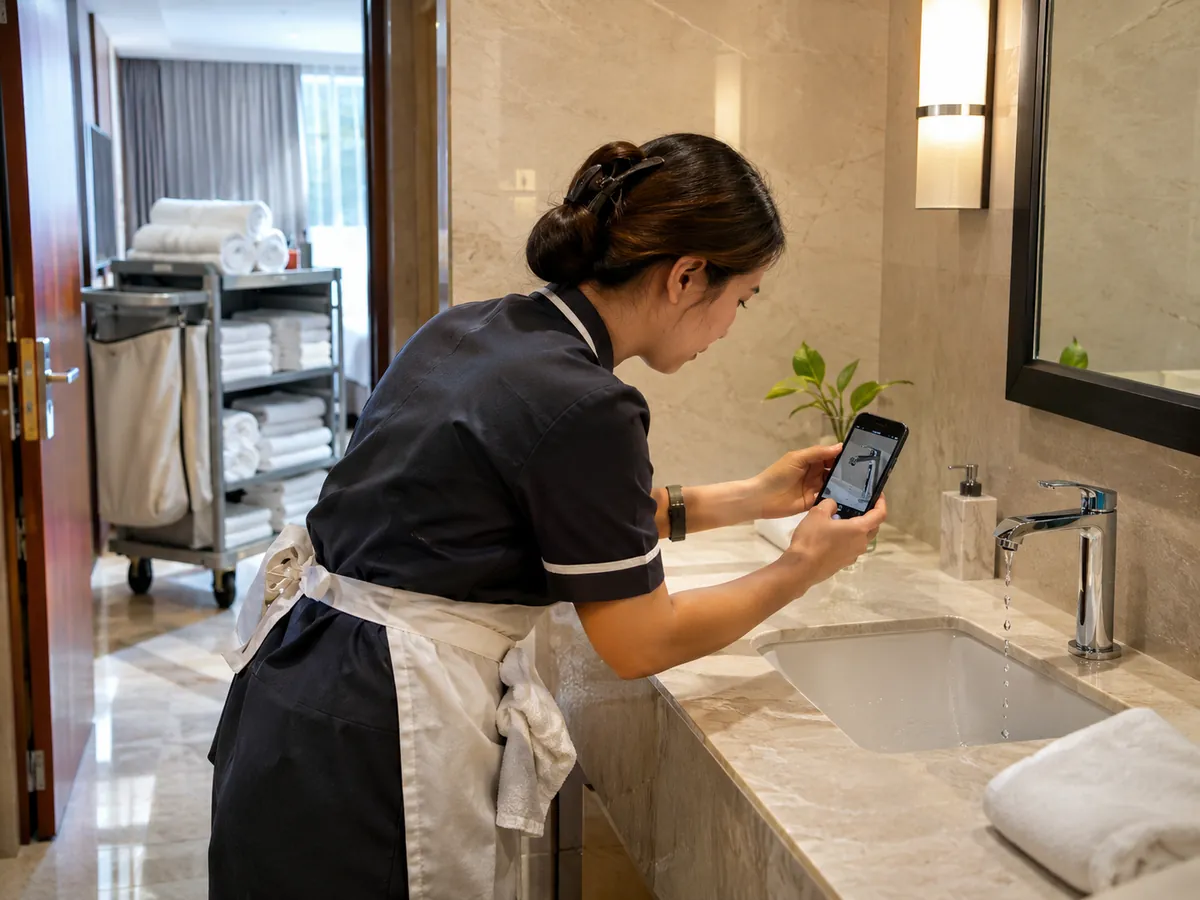
- Maintenance requests raised by housekeeping. An attendant finds a dripping tap or a dead bulb and tells engineering by radio, chat or paper slip. Hotel maintenance requests like these often decide whether a room can be sold tonight. Data generated: room number, issue type, priority, time raised and time fixed.
- Front desk handovers. The outgoing agent briefs the next shift on pending arrivals, VIPs, complaints, wake-up calls and promises made to guests. Data generated: open items, owners and guest notes.
- Shift changes across departments. Most hotels run morning, evening and night shifts, plus a night audit (the overnight closing of the day’s accounts). Every change is a point where open work must pass from one person to another.
- Guest-request follow-ups. Extra towels, a baby cot, a late checkout or a noise complaint each need an owner, a deadline and a closing check. Data generated: request time, response time and whether the guest was satisfied.
- Preventive maintenance. Engineering teams follow a schedule, often called PPM (planned preventive maintenance), for air-conditioning filters, water heaters, fire equipment and lifts. Data generated: due dates, completion records and repeat faults.
- Linen and amenity stock. Housekeeping keeps par levels, meaning the standard quantity of sheets, towels and toiletries each floor or property should hold. Data generated: stock counts, shortages and reorder needs.
Good hotel housekeeping task tracking pulls the first three workflows into one view, because a room is only ready when cleaning, inspection and any repair are all closed.
Why does the hotel shift handover lose tasks as properties grow?
The hotel shift handover loses tasks because radio calls, WhatsApp messages and paper sheets record that something was said, not who owns it or whether it was finished. With a small team, people remember. With more rooms, shifts and properties, open work quietly drops between people at shift change.
The scaling journey usually looks like this:
- Small property (around 30 rooms, one or two shifts): The owner or GM is on site. A WhatsApp group, a printed room sheet and a log book at the front desk work well because everyone sees everyone.
- Growing property (100 or more rooms, three shifts): Housekeeping, engineering and front office now have separate supervisors. Requests pass through two or three people before someone acts, and the night team rarely meets the morning team.
- Complex operation (several properties or a cluster team): A cluster housekeeping manager or area GM needs the same view across sites. Reports are compiled by hand from sheets and chats, often a day late.
- Scaled operation: Tasks, checklists and requests sit in one connected record, automation handles reminders and reports, and AI helps flag what needs attention.
Each manual tool fails in a specific way. A radio call is spoken and leaves no record, so nobody can check later whether the pillow ever reached room 412. A WhatsApp thread mixes real requests with greetings and photos, and an urgent message scrolls out of sight within an hour. A paper checklist stays on the trolley or in a drawer, so the next shift cannot see what is still open.
None of these tools is wrong. Excel, WhatsApp and paper work well for simple tracking. They struggle when a hotel has hundreds of tasks a day, many hands on each task and managers who spend the shift asking, "Did anyone do this?"
What changes when hotel tasks move to a connected system?
A connected system gives every task an owner, a status and a due time that every shift can see. Instead of asking five people for updates, a supervisor opens one list. Open items carry across the shift change automatically, and reminders go out before a request is forgotten.
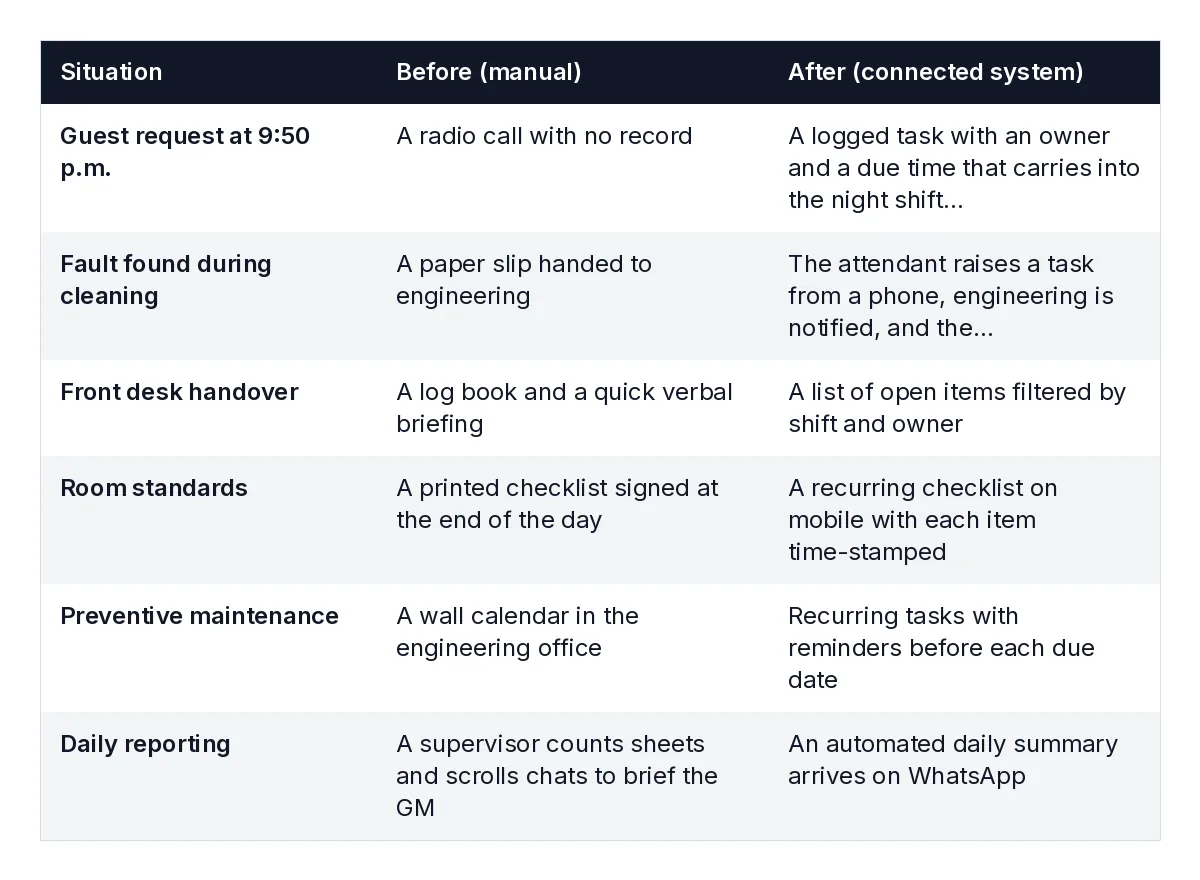
Here is the before and after for common hotel situations. These describe how the workflow changes, not guaranteed results.
Before and after: common hotel situations
At a glance
-
Guest request at 9:50 p.m.: Before (manual): A radio call with no record; After (connected system): A logged task with an owner and a due time that carries into the night shift if still open
-
Fault found during cleaning: Before (manual): A paper slip handed to engineering; After (connected system): The attendant raises a task from a phone, engineering is notified, and the supervisor can see whether the room is blocked
-
Front desk handover: Before (manual): A log book and a quick verbal briefing; After (connected system): A list of open items filtered by shift and owner
-
Room standards: Before (manual): A printed checklist signed at the end of the day; After (connected system): A recurring checklist on mobile with each item time-stamped
-
Preventive maintenance: Before (manual): A wall calendar in the engineering office; After (connected system): Recurring tasks with reminders before each due date
-
Daily reporting: Before (manual): A supervisor counts sheets and scrolls chats to brief the GM; After (connected system): An automated daily summary arrives on WhatsApp
-
Guest request at 9:50 p.m.: Before, a radio call with no record. After, a logged task with an owner and a due time that carries into the night shift if still open.
-
Fault found during cleaning: Before, a paper slip handed to engineering. After, the attendant raises a task from a phone, engineering is notified, and the supervisor can see whether the room is blocked.
-
Front desk handover: Before, a log book and a quick verbal briefing. After, a list of open items filtered by shift and owner.
-
Room standards: Before, a printed checklist signed at the end of the day. After, a recurring checklist on mobile with each item time-stamped.
-
Preventive maintenance: Before, a wall calendar in the engineering office. After, recurring tasks with reminders before each due date.
-
Daily reporting: Before, a supervisor counts sheets and scrolls chats to brief the GM. After, an automated daily summary arrives on WhatsApp.
The biggest change is accountability. When every request has a named owner and a visible status, the conversation moves from "who forgot?" to "what is still open, and who needs help?"
What should a task tracking tool for hotels include?
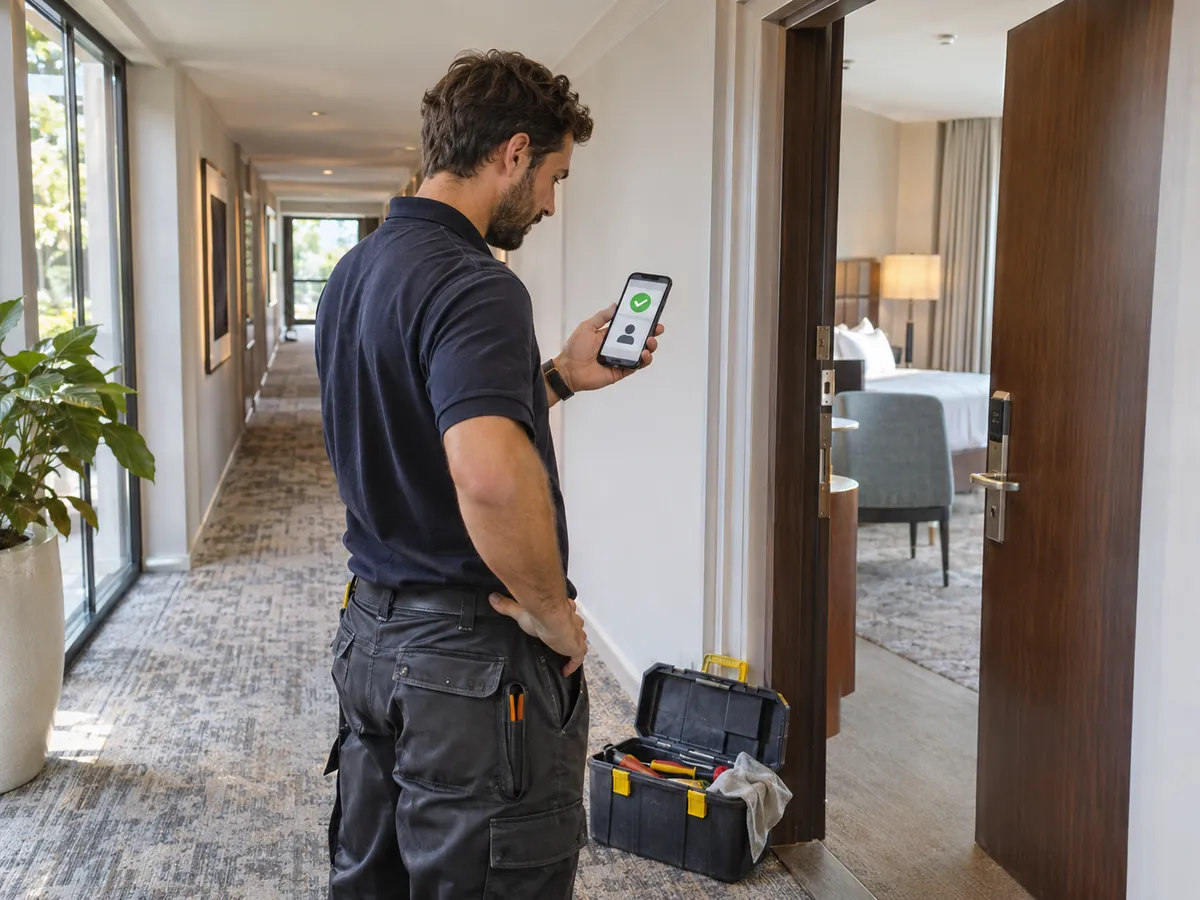
A useful task tracking tool for hotels should handle recurring checklists, mobile assignment, multiple shifts, reminders and simple reporting. It must be quick enough for a room attendant to use between rooms. If staff need training manuals to close a task, adoption will stall and the paper sheets will come back.
Use these criteria when comparing options:
- Recurring checklists and templates: Room types, public areas and PPM rounds repeat daily or weekly. A good housekeeping checklist app lets you build each standard once and schedule it.
- Mobile task assignment: Attendants, technicians and runners work on their feet, so tasks must reach a phone with push or WhatsApp notifications.
- Shift awareness: The tool should know who is on which shift so open work moves to the right person at handover.
- Reminders and escalation: Overdue items should trigger a reminder to the owner, then to the supervisor if still open.
- Reports managers will read: A daily summary of completed, overdue and repeat issues, delivered where the GM already looks.
- Permissions and accountability: Attendants see their own work, supervisors see their team, and managers see the whole property or group.
- Fit with existing systems: Most hotels run a PMS (property management system) for bookings and room status. Check how any task tool will sit alongside it before committing.
When a simple tool is enough: A 20-room guesthouse with one shift, a stable team and an owner on site may only need a shared checklist and a group chat. Employee task tracking software starts paying back when you see these signs:
- More than one shift or more than one property
- Guests repeating requests that were already made
- Supervisors spending much of each shift chasing updates
- Maintenance issues found by housekeeping that take days to close
- Reports compiled by hand from sheets and chats
Where does AI help hotel teams, and where do people stay in charge?
AI helps hotel teams when it works on real task data: spotting overdue requests, flagging rooms with repeat faults, suggesting recurring tasks and summarising the day. People still set service standards, decide priorities for VIPs and complaints, and choose when to take a room out of order.
Hoteliers already see value in this. In AHLA’s 2026 report with Actabl, 90% of respondents said AI helps routine work get done faster, and 84% said AI had improved their own work, but only 15% said it had improved frontline work (AHLA, 2026). That gap matters. The benefits are reaching managers before they reach the attendants and technicians who do the physical work.
Closing that gap means connecting AI to the frontline task flow, not adding a standalone chatbot. In practice, that can look like:
- Highlighting guest requests that are close to their due time with no update
- Showing that room 305 has had three plumbing tasks in a month, so engineering can look for the root cause
- Suggesting recurring tasks based on patterns in past work, which a manager then approves or edits
- Turning a day of task records into a short summary for the morning meeting
AI only works as well as the data underneath it. If requests still travel by radio, there is nothing for AI to read, which is why structured task tracking comes first.
How does TrackerSuite fit hotel housekeeping and front desk work?
TrackerSuite is an AI-powered operations platform that connects people, tasks and data. For hotels, the most relevant part is Task Tracker, which covers recurring tasks, mobile assignment, WhatsApp reminders and daily WhatsApp reports. It is a task and workforce layer, not a replacement for your PMS.
Here is how the documented capabilities map to the workflows above:
- Recurring tasks and industry task templates: Build room-type checklists, public-area rounds and PPM schedules once, then let them repeat.
- Mobile assignment with push and WhatsApp notifications: Send a guest request or a repair to the right attendant or technician, on the phone they already carry.
- Multiple shift management: Organise staff by shift so open work is visible at handover. This is available as a paid add-on on some plans, so check the pricing page.
- Attendance rules with check-in and check-out: Know who is actually on duty before you assign urgent work.
- Daily automated reports on WhatsApp, plus performance scores and timesheets: Give the GM and department heads a daily picture without manual compiling.
- Workflow add-on: An add-on for multi-step processes, such as a deep clean or a room refurbishment.
- AI-based predictive tasking, powered by TAVI: Available on paid plans to help suggest tasks from past patterns. Managers should review the suggestions before tasks are assigned.
For groups tracking linen, amenities and engineering spares across several properties, Stack Tracker manages inventory and orders across locations. Confirm plan details and add-on pricing on the pricing page before you budget, since they can change.
How can a hotel start without disrupting guests?
Start small, with one workflow and one shift, then expand. Most hotels see the clearest early benefit from guest-request tracking or room checklists, because both happen every day and both are easy to measure. Run a short pilot, fix the friction, and only then roll out to every department.
- Map a week of lost tasks. Ask supervisors to note every request or repair that slipped. This shows where the real gaps are.
- Pick one workflow. Guest requests or room turnaround checklists are good starting points.
- Build your checklists as recurring tasks. Use your existing standards for each room type and public area. Don’t redesign them yet.
- Set shifts and owners. Define who receives which tasks on morning, evening and night shifts.
- Agree reminder and follow-up rules. For example, a reminder to the owner before the due time, and a reminder to the owner before the due time, and a daily supervisor review of anything still open.
- Pilot on one floor or one shift. Keep paper as a backup during the pilot and collect feedback from attendants.
- Turn on daily reports. Send a WhatsApp summary to the GM and department heads so the system becomes part of the morning meeting.
- Extend step by step. Add maintenance requests, PPM and linen stock, then other properties. Consider AI suggestions once you have a few weeks of clean data.
What this means for you
If your team still hears about forgotten requests at checkout, the problem is rarely effort. It is usually a handover that depends on memory.
- General managers: Ask for one daily view of open, overdue and repeat issues across departments.
- Executive housekeepers: Move room and public-area standards into recurring checklists so every shift works from the same list.
- Front office managers: Log every guest promise as a task with an owner, so the next shift inherits it automatically.
- Chief engineers: Track housekeeping-raised faults and PPM in one place to spot rooms with repeat problems.
FAQs
What is hotel housekeeping task tracking?
Hotel housekeeping task tracking is a way to assign, monitor and record cleaning, inspection and related tasks for each room and public area. It replaces paper room sheets with a shared, time-stamped record that supervisors and the front desk can see. The goal is to know which rooms are ready and which tasks are still open at any time.
How do hotels stop losing tasks at shift change?
Hotels stop losing tasks by giving every request an owner, a status and a due time in a shared system that every shift can see. Open items carry over automatically instead of relying on a verbal briefing. Reminders and a daily report help supervisors catch anything that is still pending.
Can WhatsApp replace task management software for hospitality?
WhatsApp works well for quick messages in a small team, but it does not track ownership, status or deadlines. As request volume and shifts grow, important messages get buried in busy threads. Many hotels keep WhatsApp for notifications and daily reports while managing the tasks themselves in a dedicated tool.
Does a small hotel need a task tracking tool?
A small property with one shift, a stable team and an owner on site may only need a shared checklist. A task tracking tool for hotels becomes useful when you add shifts, staff or properties, or when guests start repeating requests. A free trial lets you test the approach with a small team first.
Conclusion
Hotel tasks rarely fail because people don’t care. They fail at the handover, when a request lives in a radio call, a chat thread or a paper sheet that the next shift never sees. As properties add rooms, shifts and sites, that gap widens, and managers spend more of their day chasing updates.
A connected system fixes the handover first: recurring checklists, mobile assignment, shift-aware ownership, reminders and daily reports. AI adds value once that task data exists, while managers keep control of standards and priorities. If you want to see how this could work at your property, compare TrackerSuite plans and start with a free trial on a single workflow and shift.
Leave a Reply