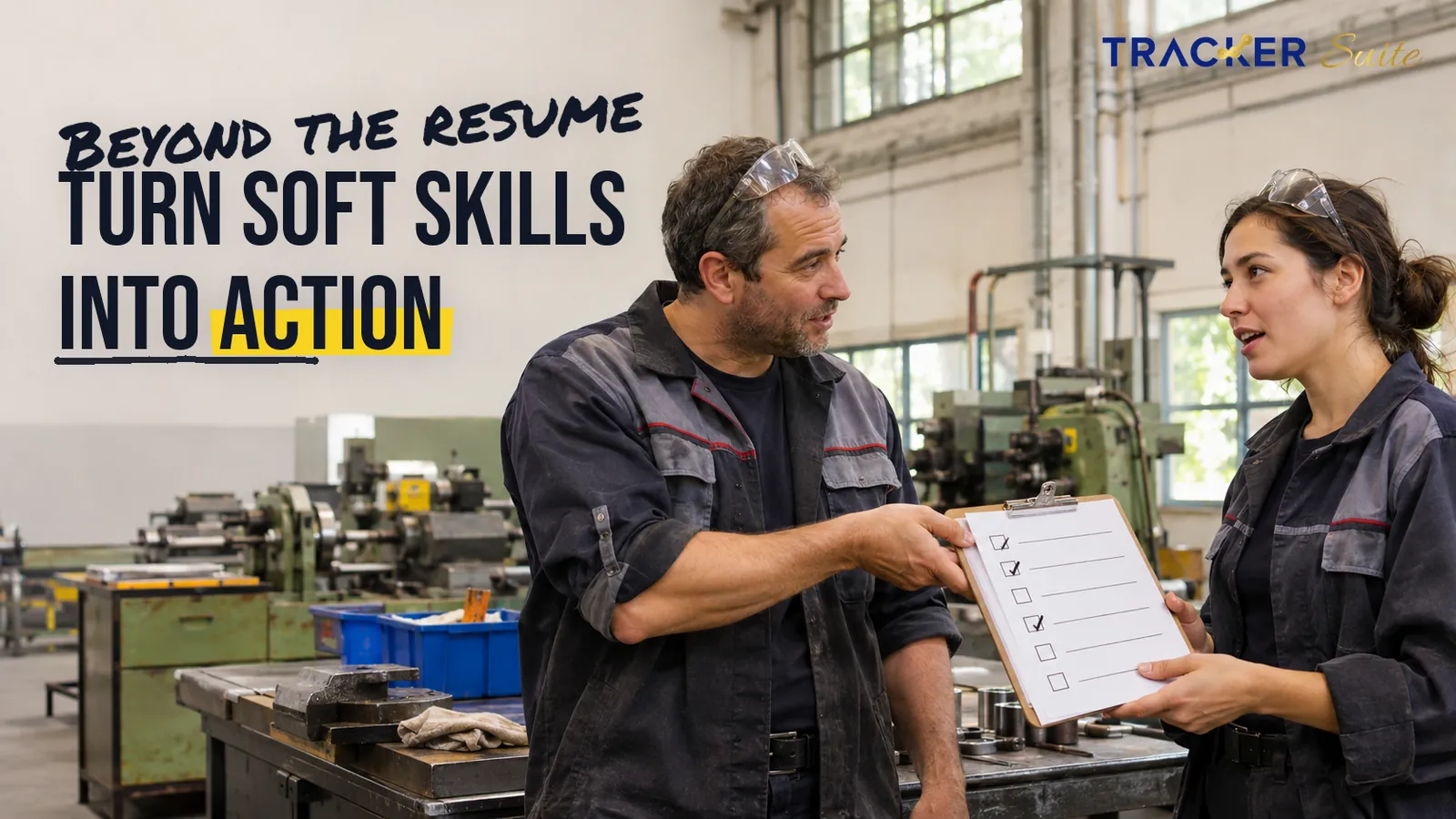
Most managers can tell within a few weeks whether a new hire listens, follows through and stays calm under pressure. Yet a typical list of soft skills gives you a word and a one-line definition, with little help on what that skill looks like on a busy working day. This blog sorts the most useful soft skills into seven groups based on how work gets done. It shows the behaviour behind each one and explains why these skills get harder to see as a team grows.
Key takeaways
- Soft skills are the habits behind how people communicate, decide, cooperate and manage their own work. Hard skills are the technical abilities a job requires.
- Employers rank problem solving and teamwork highest among the things they look for on student resumes (NACE, 2024).
- A soft skill only helps a hiring manager or team lead when it shows up as visible behaviour, such as a clear handover or a follow-up sent on time.
- In a small team, people see each other’s reliability every day. Once there are several sites and shifts, the team needs shared workflows and records to keep that visibility.
- Software can handle reminders, status updates and reporting. Judgement, empathy and coaching conversations stay with people.
At a glance
- What this list covers: Soft skills in seven groups, each defined by what a person actually does
- Who it helps: Job seekers, students, team leads, HR teams and managers planning training
- Skills employers rank highest: Problem solving, teamwork, analytical thinking, resilience and communication
- Key sources: NACE Job Outlook 2025 (surveyed in 2024), World Economic Forum Future of Jobs Report 2025, U.S. Department of Labor soft skills curriculum
- Main lesson for managers: Skills are easier to build when the work they show up in is visible
What is the difference between soft skills and hard skills?
Soft skills are the personal and interpersonal habits that shape how someone works with others and manages their own tasks. Hard skills are the technical abilities a role requires, such as accounting, welding, coding or drafting contracts. Most jobs need both. Hard skills get the work done, while soft skills decide how smoothly it moves between people.
A simple test separates soft skills and hard skills. If a skill is tied to one job or tool, it is usually a hard skill. If it goes with a person from one job to the next, like listening, prioritising or handling a difficult customer, it is a soft skill.
The U.S. Department of Labor’s Office of Disability Employment Policy built its youth workplace curriculum, Skills to Pay the Bills, around six soft skill areas: communication, enthusiasm and attitude, teamwork, networking, problem solving and critical thinking, and professionalism (U.S. Department of Labor, 2012). The framework is still a good starting point because each area describes behaviour, not personality.
Which soft skills do employers value most right now?
Recent employer surveys put problem solving and teamwork at the top. In NACE’s Job Outlook 2025, nearly 90% of employers said they look for problem-solving ability on student resumes, and nearly 80% look for teamwork (NACE, 2024).
The NACE survey collected answers from 237 employers between August and September 2024. Written communication, initiative and a strong work ethic were each named by at least 70% of respondents. More than two-thirds wanted verbal communication and flexibility (NACE, 2024). For students and early-career applicants, a resume needs proof of these habits, not just the words.
The World Economic Forum looks further ahead. Its Future of Jobs Report 2025 says employers expect 39% of workers’ core skills to change by 2030. Leadership and social influence showed the largest rise in importance, up 22 percentage points (World Economic Forum, 2025). Resilience, flexibility and agility, empathy and active listening, and service orientation also appear among its top core skills.
Seven out of 10 companies consider analytical thinking an essential core skill, making it the top core skill employers name (World Economic Forum, 2025).
The full list of soft skills, grouped by how work gets done
The skills below fall into seven groups: communication, teamwork, thinking, self-management, adaptability, leadership and client skills. Each definition describes what a person actually does, so you can spot the skill in daily work, write about it on a resume or CV, or build training around it.
Communication
- Active listening: Lets the other person finish, then repeats back the key point before responding.
- Clear writing: Writes updates that a colleague can act on without asking a follow-up question.
- Verbal clarity: Explains a problem in plain words and checks that the listener understood.
- Asking good questions: Clarifies scope, deadlines and owners before starting work.
- Giving feedback: Describes a specific behaviour and its effect, not the person’s character.
- Receiving feedback: Listens without arguing, asks what to change, then changes it.
- Presenting: Leads with the decision or request, then gives the supporting detail.
Teamwork and collaboration
- Reliability: Does what they said they would do, by the time they said.
- Follow-through: Closes the loop on a task and confirms when it is done.
- Information sharing: Puts updates where the team can find them instead of in private chats.
- Conflict resolution: Raises disagreements early and focuses on the shared goal.
- Respect for differences: Works well with people from other roles, cultures and shifts.
- Supporting colleagues: Offers help when a teammate is overloaded, without being asked.
Thinking and problem solving
- Problem solving: Breaks an issue into causes and tests a fix before calling it solved.
- Critical thinking: Questions assumptions and checks the source behind a claim.
- Analytical thinking: Uses data or records to find patterns, not just gut feel.
- Decision making: Chooses with the information available and explains the reasoning.
- Creativity: Suggests a new approach when the usual one keeps failing.
- Attention to detail: Catches errors in documents, orders or records before they go out.
- Curiosity: Asks why a process works the way it does and how it could work better.
Self-management
- Time management: Plans the day around deadlines and protects time for focused work.
- Prioritisation: Knows which task matters most today and says so when priorities clash.
- Organisation: Keeps files, notes and tasks where they can be found quickly.
- Accountability: Owns mistakes, explains what happened and fixes the process.
- Work ethic: Shows up prepared and finishes work to the agreed standard.
- Initiative: Spots a gap and acts on it without waiting for instructions.
- Self-awareness: Knows their own strengths and limits and asks for help early.
Adaptability and resilience
- Flexibility: Adjusts plans when priorities change without losing track of commitments.
- Resilience: Recovers from setbacks and keeps working towards the goal.
- Stress management: Stays calm and clear when deadlines or customers create pressure.
- Openness to learning: Picks up new tools and methods and shares what they learn.
- Comfort with ambiguity: Makes progress when not every answer is available yet.
Leadership and influence
- Delegation: Hands over work with a clear owner, deadline and definition of done.
- Setting expectations: Explains what good work looks like before the work starts.
- Coaching: Asks questions that help people solve problems themselves.
- Motivating others: Connects daily tasks to a goal the team cares about.
- Negotiation: Finds terms both sides can accept without damaging the relationship.
- Persuasion: Builds support for an idea with evidence and a clear benefit.
Client and customer skills
- Empathy: Recognises how the other person feels and responds to that, not just the facts.
- Patience: Explains things again, calmly, when a customer is confused or upset.
- Service orientation: Looks for the outcome the customer needs, not just the request they made.
- Managing expectations: Gives honest timelines and updates before the client has to chase.
- Professionalism: Stays respectful, discreet and prepared in every interaction.
- Networking: Builds relationships before they are needed and keeps in touch.
Which soft skills matter most in different roles?
Every role draws on the full list, but each job leans on a few skills more than others. Customer service depends on empathy and patience. Engineers need clear writing and critical thinking. Legal teams rely on attention to detail and managing expectations. Students can show teamwork, initiative and time management through projects and part-time work.
- Customer service: Empathy, patience and stress management. A support agent restates the customer’s issue in one sentence before offering a fix, so the customer knows they were heard.
- Engineers: Clear writing, critical thinking and receiving feedback. An engineer writes a design note that a technician on a later shift can follow without calling them.
- Sales teams: Active listening, follow-through and negotiation. A salesperson logs the agreed next step after every call, so the follow-up does not depend on memory.
- Manufacturing and production teams: Attention to detail, accountability and clear writing. A production supervisor logs open quality checks before shift change, so the next shift knows exactly what still needs sign-off.
- Field and operations supervisors: Reliability, delegation and follow-through. A site lead confirms which jobs are open at shift change, rather than leaving the next team to find out.
- Students (including high school students): Teamwork, initiative and time management. Group projects, clubs, sports and part-time jobs all give real examples.
Soft skills for students are often easier to prove than students expect. Organising a club event shows planning, delegation and follow-through, even without a formal job title.
How do you pick soft skills for resume bullet points?
Pick a handful of soft skills that match the job advert, then prove each one inside your experience bullets. Recruiters read "strong communicator" on almost every application. A short example of what you did and what changed is far more convincing than the label alone. The same approach works for a CV.
Use these steps:
- Read the job advert closely. Note which soft skills it repeats, such as teamwork, initiative or customer focus.
- Match each skill to a real situation. Think about a project, shift, customer or deadline where you used it.
- Write the action, not the adjective. Describe what you did in active voice.
- Add the result. Say what improved, using only figures you can back up.
- Keep a short skills section. Use it to support your bullets, not to replace them.
Before and after examples:
- Weak: "Excellent communication skills." Stronger: "Wrote shift handover notes the next team used to pick up open jobs."
- Weak: "Team player." Stronger: "Worked with warehouse and sales colleagues to fix delayed orders before customers chased them."
- Weak: "Good time management." Stronger: "Managed coursework, a part-time job and a club role while meeting every deadline."
Which soft skills for managers matter most as teams grow?
The most important soft skills for managers are delegation, setting expectations, giving feedback, coaching and fair judgement. In a small team, a manager can use these skills through quick conversations. With more people, sites and shifts, the same skills need structure behind them, such as clear owners, written standards and regular reviews.
A new manager often struggles with delegation first. Handing over a task feels risky when there is no easy way to see progress, so the manager keeps doing the work or keeps asking for updates. The fix is usually not more meetings. The fix is a clear owner, a due date and a shared place where status is visible.
Feedback has the same problem. Fair feedback needs facts. When a manager relies on memory, the people they see most often get the most credit, while quieter colleagues and remote staff get overlooked.
Why do soft skills in the workplace get harder to see at scale?
Soft skills in the workplace are easy to notice when everyone sits in one room. As a business grows across teams, locations and shifts, managers stop seeing who follows through, who communicates clearly and who quietly fixes problems. Reliability becomes a matter of opinion unless the work leaves a visible record.
The scaling journey usually looks like this:
- Small operation: Work runs on WhatsApp, Excel, email and calls. The owner sees everyone’s habits every day.
- Growing business: Several teams or locations appear. Updates start to get lost between chats and spreadsheets.
- Complex operation: Approvals, recurring checks and reports pile up. Managers spend much of the day chasing status.
- Scaled operation: Shared workflows, connected data and automation show who owns what, so managers can coach rather than chase.
Think about the difference between a team of a dozen people and one with hundreds of staff, many sites and round-the-clock shifts. At that size, you can only see good follow-through if the work itself is recorded somewhere shared.
What changes when the workflow is connected:
- Before: The manager asks five people for updates. After: One shared status view shows open, done and overdue tasks.
- Before: A salesperson remembers follow-ups manually. After: A structured follow-up step prompts the next action.
- Before: Handovers happen in chat threads. After: Open jobs and notes sit in one record the next shift can read.
Excel and WhatsApp work well for simple tracking. Businesses with multiple teams, locations or recurring workflows may eventually need a more connected operational system.
Where can software and AI help, and where do people stay in charge?
Software can support the visible side of soft skills: reminders, recurring checklists, status updates, proof of completed work and reports. AI can help where it is connected to real task data and configured rules. Empathy, coaching, negotiation and judgement stay with people, and so do decisions about performance.
On an AI-powered operations platform such as TrackerSuite, teams can make the habits behind follow-through visible with less chasing. Based on the TrackerSuite pricing page, Task Tracker includes proof of work within a task, charts with a performance overview, and data export. Recurring tasks, tagging team members, and attendance check-in and check-out are included depending on the plan. For a manager, a recurring handover task with proof of work attached shows reliability far better than a weekly reminder message does.
AI is useful when it works on top of this connected data. Where configured, AI can use existing task records and rules to help teams see what needs attention and when, such as overdue items or work that keeps bouncing between people. A person still decides what the pattern means. A missed task might reflect overload, an unclear brief or a broken process, not a lack of skill.
Two cautions apply. Activity data is not a full measure of soft skills, so use it to start coaching conversations, not to replace them. A very small team in one office with few recurring tasks may need only a shared task list.
How can a team build soft skills through training and daily work?
The best soft skills training topics for employees connect to work people already do: handovers, customer calls, meetings and deadlines. Pick one behaviour, define what good looks like, and build it into an existing workflow. Then review it regularly, so the skill becomes a habit rather than a one-off workshop.
Useful training topics include:
- Writing clear updates and shift handovers
- Giving and receiving feedback
- Prioritising under pressure
- Handling difficult customer conversations
- Running short, focused meetings
- Delegation for new team leads
- Root-cause problem solving
A practical approach:
- Choose one skill per quarter. Start with the one causing the most friction, often follow-through or handovers.
- Describe the behaviour. For example, "every open job has an owner and a note before shift change."
- Build it into the workflow. Use a template or recurring task so the behaviour is the default.
- Review real examples. Look at what happened in practice and coach from those cases.
- Recognise good work. Credit people whose habits keep the team moving, including those at other sites.
What this means for you
If you are a job seeker or student, treat this list of soft skills as a menu, not a checklist. Choose the skills your target role needs and gather one real example for each.
If you lead a team, pick the two or three skills that cause the most friction today. Usually these are follow-through, clear handovers and prioritisation. Define what good looks like and make that behaviour visible in the way work is assigned and closed.
If you run a growing business, ask a direct question: could you see who follows through across every site and shift without phoning anyone? If the answer is no, the gap is probably in your workflows, not your people.
Frequently asked questions
What are the most important soft skills to learn?
Problem solving, teamwork, communication, analytical thinking and resilience appear at the top of recent employer research. NACE puts problem solving and teamwork first, while the World Economic Forum ranks analytical thinking highest and lists resilience among its top core skills. Start with the ones your target role uses daily.
How many soft skills should you put on a resume?
A handful is enough, ideally three to five that match the job advert. Prove each one with a short example in your experience section. A long list of unproven adjectives is less convincing than a few clear examples.
Can soft skills be measured at work?
Not directly, but the behaviours behind them can be observed. Handovers, follow-ups, completed tasks and customer feedback give managers evidence to discuss. Use that evidence to guide coaching, not as a final score.
How can students build soft skills without work experience?
Group projects, volunteering, clubs, sports and part-time jobs all build real soft skills. Students can show teamwork, initiative and time management by describing what they organised and what happened as a result.
Conclusion
Soft skills decide how smoothly work moves between people, and employers rank them highly for good reason. The useful version of any skills list describes behaviour you can see, practise and prove. As teams grow across sites and shifts, that behaviour needs shared workflows and records so it stays visible. People still do the listening, coaching and judging.
If your managers spend their days chasing updates, start with one recurring workflow and make ownership visible. You can compare TrackerSuite plans and start a free trial, and try it with a small team first.
Leave a Reply