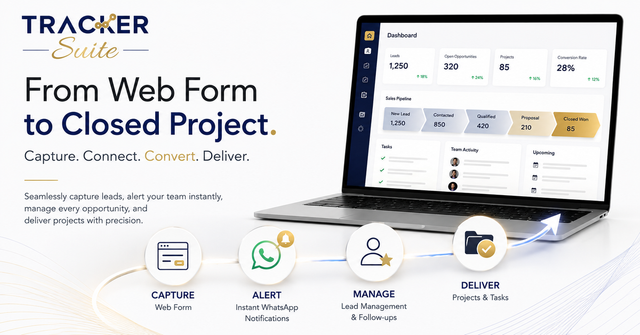
Discover how businesses can transform their sales pipelines by automatically capturing leads via web forms, utilizing instant WhatsApp notifications, and seamlessly transitioning won deals into actionable projects.
In today’s hyper-competitive digital marketplace, the speed at which a business responds to an inbound inquiry can mean the difference between winning a loyal customer and losing out to a competitor. When potential clients fill out a web form on your site, they are indicating immediate interest. However, if that form submission simply lands in an unmonitored email inbox, the momentum is instantly lost.
Modern businesses are eliminating these bottlenecks by integrating intelligent data capture with instantaneous communication channels and robust back-office systems. By leveraging web forms connected directly to CRM pipelines, sending immediate alerts to sales teams on their mobile devices, and subsequently migrating successful conversions into structured workflows, companies are achieving unprecedented operational velocity.
This comprehensive guide explores how organizations can seamlessly manage inbound prospects, utilize instant messaging alerts for rapid engagement, and connect their front-end sales success with back-end operational delivery.
The Core Mechanics of Automated Sales Lead Capture
The foundation of any modern sales pipeline is the ability to ingest inquiries without manual intervention. Automated sales lead capture eliminates the tedious and error-prone process of copying and pasting contact information from an email notification into a database.
When a prospect interacts with your website, lands on a dedicated landing page, or clicks through from platforms like Meta (Facebook, Instagram) or IndiaMart, a well-optimized web form acts as the primary gateway. Instead of merely sending an email to a generic info@ address, the web form is integrated via APIs directly into your sales database.
This automation does more than just save time; it allows for intelligent, rules-based distribution. Depending on the data entered into the web form—such as the prospect’s location, budget size, or requested service—the system can automatically assign the lead to the most appropriate sales executive. This ensures that field representatives or specialized closers receive inquiries that match their exact expertise, radically reducing the time it takes to qualify the prospect.

Elevating Response Times: WhatsApp Notifications for Leads
Even with automated routing, the critical metric in sales remains the “time-to-contact.” Email notifications are frequently buried under internal communications, newsletters, and spam. To break through the noise, proactive sales teams are shifting to mobile-first alerts.
Implementing whatsapp notifications for leads completely changes the dynamic of how a sales team operates. Because WhatsApp is a high-priority application on most smartphones, a push notification for a new lead assignment is seen almost immediately.
Consider a field executive traveling between client meetings. They may not check their email for hours, but a WhatsApp notification instantly alerts them to a high-value prospect who just filled out a form. Tools like TrackerSuite.ai’s Sales Tracker allow for these automated alerts to contain all necessary context—such as the prospect’s name, phone number, and requested service—enabling the sales rep to initiate a conversation via call or message within minutes of the initial inquiry.
Furthermore, these integrations can provide daily automated reports on WhatsApp, keeping executives and managers informed about overdue prospects, due-today follow-ups, and the overall health of the sales pipeline without requiring them to log into a desktop portal.
Strategies for Effective Lead Management
Capturing the lead and notifying the team is only the beginning. Converting that interest into revenue requires disciplined and effective lead management. This involves tracking the entire lifecycle of the prospect through custom sales pipeline stages, maintaining a detailed prospect history, and ensuring no follow-up is missed.
An advanced sales tracker allows teams to implement AI-based predictive tasking, ensuring that representatives know exactly who to call and when. It provides visibility into live location tracking for field executives, custom proposal creation, and one-click proposal sharing through email and WhatsApp.
Additionally, managing data effectively means having structured categorization, bulk upload capabilities for acquired lists, and restricted contact visibility to protect proprietary client data. When a business implements these rigorous standards, companies witness significant metric improvements—often seeing profitability improve by up to 23% and overall costs reduced by 20% amid growth.
The Crucial Handoff: Integrating Project Management and Software
Sales teams celebrate when a prospect’s status shifts to “Closed-Won,” but for the rest of the business, the real work is just beginning. The most common point of failure in scaling businesses is the disconnect between the sales department and the operations or delivery team.
By linking project management and software directly to your lead capture system, the transition becomes frictionless. The details captured during the sales process—client expectations, specific deliverables, and agreed-upon timelines—are automatically translated into actionable tasks and workflows.
This interconnected ecosystem ensures that account managers do not have to ask the client for information they already provided to the sales rep. The momentum built during the rapid WhatsApp follow-up is maintained as the client is seamlessly onboarded into the production phase.
Initiating a Management Software Project from a Won Lead
Once the deal is closed, operations teams must structure the work. When you initiate a management software project, you are essentially taking the raw data from the CRM and converting it into buckets, recurring tasks, and team assignments.
Choosing the right management project software is vital here. You need a platform that supports unlimited tasking, calendar views by bucket or team member, and robust attendance and leave modules to ensure the assigned staff are available to execute the work. TrackerSuite.ai, for example, offers a comprehensive Task Tracker that breaks big objectives into smaller, actionable steps through customizable workflows.
The Digital Agency Use Case: Software Project Management Software
Different industries have distinct operational requirements once a lead is captured. For technology firms, digital marketing agencies, and software developers, the delivery process is highly technical and iterative.
When these organizations win a client, the onboarding process is funneled directly into dedicated software project management software. Within this ecosystem, a capable pm project management software empowers technical leads to organize the requested features into development sprints.
Tracking every single project in software project management means ensuring that developers, quality assurance testers, and account managers have complete, real-time visibility into the delivery timeline. Because development teams thrive on flexibility and continuous iteration, employing project management agile software ensures that deliverables can pivot based on ongoing client feedback without completely derailing the overarching timeline or budget.

The Physical World Use Case: Construction and Project Management Software
Not every captured lead results in a digital product. Many businesses operate in the physical realm, where moving from sales to execution involves complex logistics, site visits, and heavy machinery.
For builders and contractors, construction and project management software becomes the lifeblood of daily operations. Imagine a commercial roofing contractor receiving a high-value inquiry through their website form. The lead is instantly pushed to the sales estimator in the field via WhatsApp, allowing them to route their vehicle to the prospect’s location for an immediate quote using distance calculation features.
Once the bid is won, the project data transitions into the operational system. Evaluating project management software construction options allows these physical-world firms to manage multi-shift attendance, enforce unlimited geo-fenced sites for mobile check-ins, and track complex inventory and material orders as they expand into new markets.
Selecting the Right Project Management Software Tools
As your business scales, relying on a patchwork of disconnected applications will inevitably cause friction, data silos, and communication breakdowns. It is critical for leadership to evaluate modern project management software tools that offer end-to-end visibility—from the moment a web form is submitted to the final delivery of the product or service.
Some technical organizations make the mistake of trying to build project management software in-house. While this might seem appealing for extreme customization, it heavily drains internal engineering resources, takes months or years to deploy, and incurs massive ongoing maintenance costs.
Instead, businesses should adopt established, integrated platforms. A unified task and project management software solution not only records the initial lead details but also manages timesheets, advanced security controls, AI-powered work validation (like TrackerSuite’s TAVI), and complex performance reporting. Opting for a unified toolkit allows your team to focus on doing meaningful work rather than manual data entry.
TrackerSuite.ai: The All-in-One Business Automation Toolkit
TrackerSuite.ai was designed specifically to bridge the gap between sales velocity and operational excellence. With a Business Automation Toolkit that includes Sales Tracker, Task Tracker, and Stack Tracker, businesses of all sizes can unify their operations.
The journey begins with automatic lead capture and assignment from web forms, Gmail, and social channels, alerting your team instantly via WhatsApp. Once the lead is nurtured and won, the data seamlessly flows into the Task Tracker, where managers can deploy workflows, track employee working hours with geo-fencing, and maintain complete accountability.
For companies struggling with stagnancy, adopting this unified approach has proven to drive revenue growth—with many organizations witnessing a 56% growth rate simply by organizing their pipeline and execution strategies into a single, cohesive ecosystem.
Conclusion
Effectively managing leads is no longer just about having a friendly sales team; it is about leveraging technology to be faster, smarter, and more organized than the competition. By capturing leads automatically via web forms, utilizing instant WhatsApp notifications to drive immediate engagement, and transitioning those prospects into structured project management systems, your business can deliver exceptional customer experiences from the very first click to the final project delivery. Embrace an integrated software approach today, and empower your team to focus on what truly matters: growing your business.

Leave a Reply