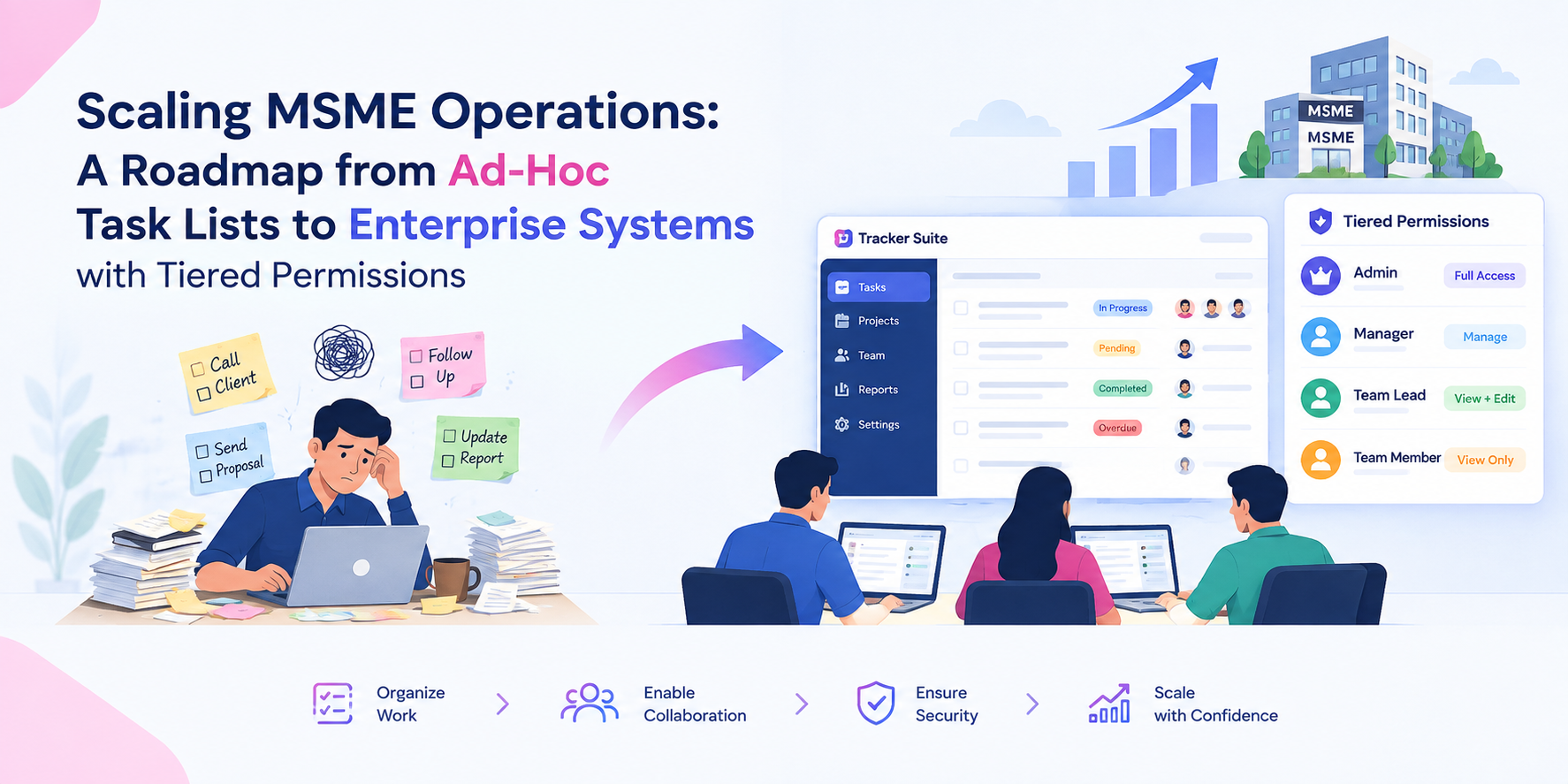
Micro, Small, and Medium Enterprises (MSMEs) often begin with lightweight setups. In the earliest days of a venture, a shared Google Sheet, a few instant messaging channels, and basic sticky-note checklists are enough to keep operations moving. When an organization consists of a handful of people wearing multiple hats, informal coordination feels agile and unencumbered.
However, as customer volume increases, headcount multiplies, and distinct functional units emerge, these early-stage methods quickly deteriorate into operational bottlenecks. Information gets trapped in personal chat histories, project accountability blurs, and sensitive financial or client data becomes accessible to anyone with a document link.
Transitioning to a unified task tracking tool for enterprises is not merely an IT upgrade; it is a fundamental shift in governance, accountability, and operational velocity. This guide outlines the strategic roadmap for MSMEs moving from disconnected productivity apps to robust, multi-department enterprise systems with tiered permissions, automated audit trails, and data-driven visibility.
The Catalysts for Transition: Why Early-Stage Tools Break Down
When evaluating operational maturity, business owners must recognize the warning signs of system exhaustion. Early tools fail under scale primarily due to three limitations:
- Data Silos and Information Fragmentation: Individual departments adopt separate free tools, meaning leadership lacks unified oversight.
- Lack of Access Governance: In basic spreadsheets, permissions are binary—users have total edit rights or none at all, exposing sensitive payroll, customer, and strategic records.
- Absence of Audit Trails: When a deadline slips, an order goes missing, or a critical file is altered, legacy spreadsheets cannot reveal who made the change or when it occurred.
Understanding the broader task tracking tools benefits—such as real-time resource allocation, compliance readiness, and predictable milestone delivery—helps organizations justify the transition from scrappy workarounds to institutionalized workflows.
The 4-Phase Roadmap for MSME Workflow Modernization
Transitioning across an entire enterprise requires a deliberate, phased methodology that balances security controls with team adoption.
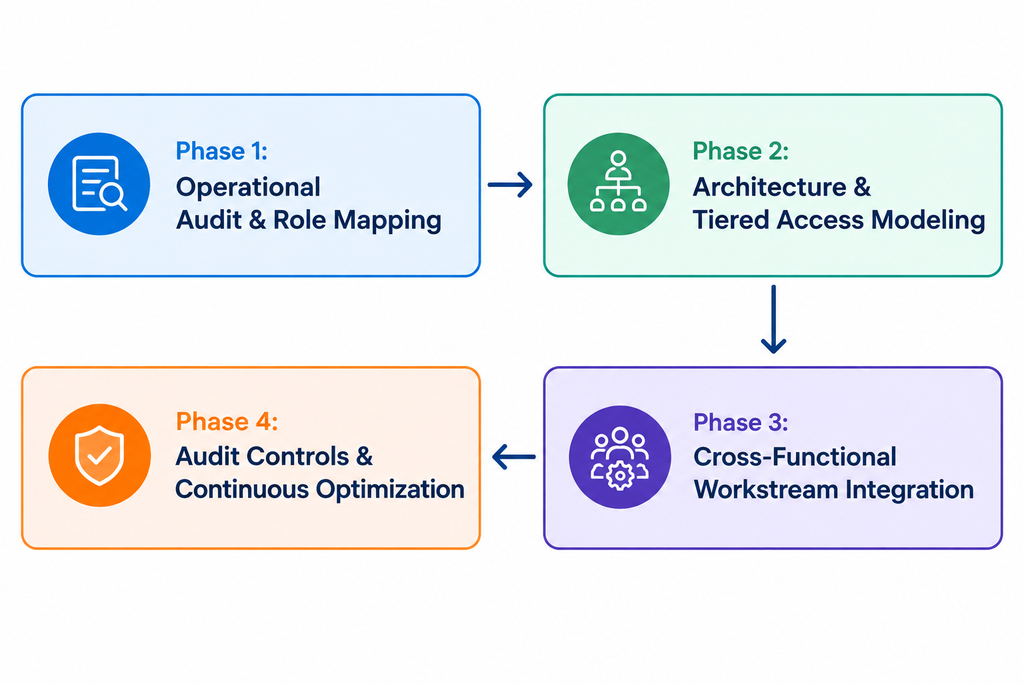
Phase 1: Operational Audit and Role Mapping
Before purchasing enterprise software, map every departmental handoff. Identify who originates work, who approves it, who executes it, and who requires visibility for reporting.
In early growth stages, task tracking tools for entrepreneurs and visionary founders focus primarily on macro-level milestones and cash-flow impact. However, operational execution spans diverse specialized disciplines. Building a clear role-to-permission matrix prevents organizational friction during software rollout.
Phase 2: Designing Tiered Permissions and Data Boundaries
Multi-department enterprise systems rely on Role-Based Access Control (RBAC). A modern permission framework typically includes four distinct layers:
- Executive / Admin Level: Complete visibility across cross-functional performance scores, global project timelines, and administrative settings.
- Departmental Managers: Full control over department-level queues, approval gates, shift assignments, and employee workloads.
- Standard Contributors: Access restricted solely to assigned deliverables, relevant briefs, and peer-level task discussions.
- External Collaborators & Contractors: Sandboxed access limited to designated boards or tickets, preventing visibility into internal discussions or adjacent client accounts.
Establishing these tiers ensures confidentiality without isolating collaborators from the context they need to execute their responsibilities.
Customizing Workflows Across Diverse Functional Departments
An enterprise task infrastructure must accommodate radically different working styles while feeding into a consolidated management dashboard. Here is how modern platforms adapt across specialized functional units:

1. Operations, Engineering, and Field Teams
Technical departments require structured task execution tied to strict tolerances, technical specifications, and site dependencies:
- Engineering & Software Teams: Implementing specialized task tracking tools for engineers provides sprint tracking, issue triage, and technical backlog management.
- Civil Engineering & Infrastructure: Deploying task tracking tools for civil engineers enables structural inspections, blueprint revisions, and multi-contractor signoffs to be tracked against regulatory milestones.
- Field Construction Operations: Ruggedized, mobile-first task tracking tools for construction bridge job-site activities with head-office procurement, offering geofenced site attendance and daily progress logs.
2. Marketing, Media, and Design Workflows
Marketing pipelines rely on asynchronous feedback loops, asset staging, and multi-channel publication calendars:
- Creative Studios & Agencies: Purpose-built task tracking tools for creatives streamline multi-stage creative proofs, asset versioning, and client revisions without messy email attachments.
- Digital Content Operations: Tailored task tracking tools for content creators centralize script drafts, video editing queues, distribution checklists, and social scheduling into repeatable production boards.
- Retail & Digital Commerce: Integrating fast-paced task tracking tools for ecommerce aligns catalog updates, seasonal flash promotions, inventory synchronization, and return logistics.
When scaling retail or physical product operations, connecting daily fulfillment queues with inventory and warehouse management automation ensures warehouse handlers and digital merchandisers operate from the exact same real-time data.
3. Business Intelligence, Executive Support, and Corporate Services
Strategic leadership requires synthesis rather than granular noise:
- Data & Analytics Teams: Advanced task tracking tools for data analyst teams organize complex ETL pipeline checks, dashboard requests, and ad-hoc query queues by stakeholder urgency.
- Executive Assistance & Office Administration: Agile task tracking tools for executive assistants provide high-confidentiality boards for managing board meetings, executive travel itineraries, and cross-department follow-ups.
- Strategic Leadership: Deploying centralized task tracking tools for decision making converts disconnected activity metrics into high-level business intelligence, surfacing operational bottlenecks before they impact quarterly EBITDA.
4. Specialized Sectors and Extended Workforces
- Academic & Institutional Workflows: Flexible task tracking tools for education streamline curriculum development, administrative compliance, faculty reviews, and student project supervision.
- Event Planning & Production: Time-sensitive task tracking tools for event planning unify vendor coordination, venue permits, run-of-show cues, and on-the-ground contingency planning.
- Contractors & Independent Specialists: Intuitive task tracking tools for freelancers allow external contractors to log hours, submit deliverables, and communicate within sandboxed project views without compromising internal corporate communications.
Governance, Audit Trails, and Compliance Controls
As MSMEs grow toward enterprise scale, governance becomes non-negotiable. Whether preparing for ISO certification, financial audits, or client data protection standards, enterprise task management software provides essential layers of operational verification:
Audit & Governance DimensionEarly-Stage Tooling (Spreadsheets / Chats)Enterprise Task Platform (TrackerSuite)Operational ImpactPermission GranularityGlobal open access or locked viewTiered RBAC (Admin, Manager, User, Guest)Eliminates accidental data overwrites and privacy breachesActivity LoggingUnreliable or absentImmutable, timestamped action historyComplete traceability for compliance reviews and QA checksDeadline EnforcementManual reminders and chat nudgesAutomated SLA triggers & WhatsApp escalationsPrevents neglected deliverables from stalling projectsWorkforce VisibilitySelf-reported end-of-day recapsGeofenced tracking, shifts, real-time statusVerifiable field performance and labor efficiency
Automated Audit Logs and Traceability
An enterprise audit trail records every status transition, file upload, deadline modification, and task reallocation. If a client contract delivery shifts by two weeks, management can review the exact decision chain and dependencies that led to the delay.
SLA Monitoring and Predictive Alerts
Modern platforms utilize AI-driven task monitoring to forecast bottlenecks. Rather than waiting for a deadline to fail, intelligent algorithms evaluate historic cycle times and team workload capacity, alerting department heads days in advance.
Implementation Best Practices: Avoiding Change-Management Pitfalls
Migrating dozens or hundreds of team members across departments to an enterprise platform can encounter resistance if managed poorly. Follow these proven organizational change strategies:
1. Appoint Departmental Champions
Identify tech-savvy leads within each functional team (engineering, marketing, accounting). Train these champions thoroughly so they can provide frontline peer assistance, reducing reliance on IT administrators.
2. Standardize Naming Conventions and Custom Fields
Avoid letting teams create haphazard custom tags. Enforce standardized priorities (P1-Critical to P4-Low), standardized stage definitions (Backlog, In Review, Blocked, Complete), and unified client identifiers.
3. Establish Clear Escalation Rules
Define exact protocols for blocked tasks. For instance, if a deliverable remains marked “Blocked” for more than 24 hours, the system should automatically notify the departmental manager via mobile push or messaging integrations.
4. Align with the Broader Organizational Vision
Communicate the purpose of the transition to all staff members. Emphasize that tiered systems and automated monitoring are not about micromanagement, but about eliminating endless status meetings and manual follow-ups—supporting TrackerSuite’s productivity mission of enabling teams to focus on high-impact work.
Measuring ROI After Transitioning
Once an enterprise tracking system is fully operational, leadership should track quantifiable productivity metrics:
- Reduction in Unplanned Follow-Up Meetings: Organizations typically see a 30% to 50% decrease in routine status syncs.
- Cycle Time Acceleration: Measuring the time between task creation and final signoff reveals workflow velocity improvements across sprints.
- On-Time SLA Delivery: Consistent tracking of deadline completion rates improves client satisfaction and project predictability.
- Security & Compliance Audit Readiness: Reduced time spent gathering evidence for regulatory checks, contract reviews, and internal performance assessments.
Empower Your Enterprise Transition with TrackerSuite
Scaling an MSME requires tools that evolve with your organization’s complexity. TrackerSuite provides the all-in-one productivity and governance ecosystem designed specifically for expanding enterprises—combining intuitive day-to-day task workflows with enterprise-grade permission tiers, shift management, geofenced field tracking, and AI-powered predictive reporting.
Ready to eliminate data silos, secure your operational data, and drive cross-departmental accountability? Take the next step in your operational roadmap and explore flexible TrackerSuite plans to find the right configuration for your scaling team.
Leave a Reply