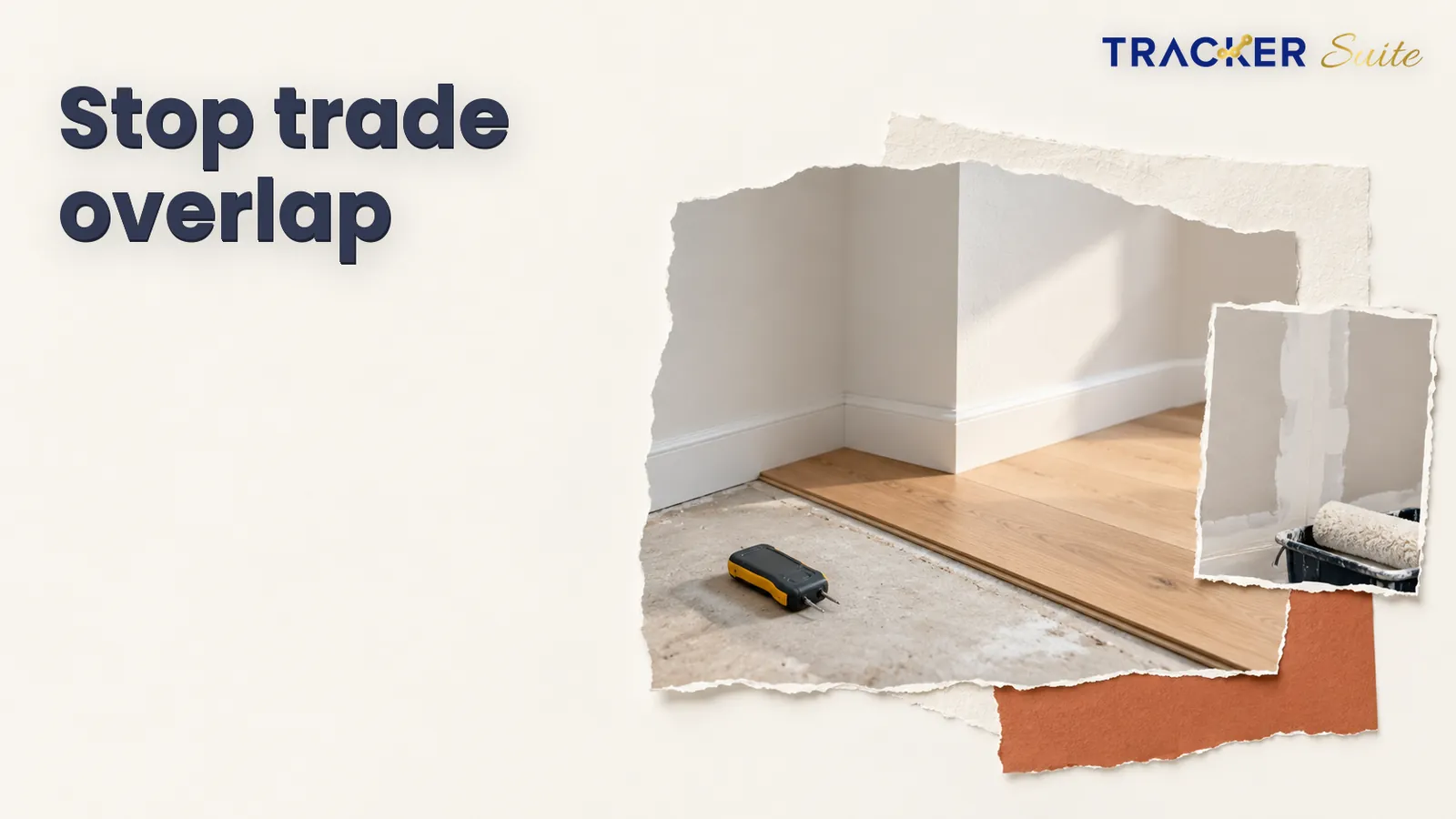
Discover how general contractors and site leads eliminate jobsite friction between drywallers, painters, and flooring installers using standardized task templates, visual stage handoffs, and instant WhatsApp alerts.
Key Takeaways
- Sequence integrity is critical: Interior finishing trades—drywallers, painters, and flooring installers—rely strictly on prerequisite conditions like joint compound curing and subfloor moisture thresholds before work can proceed.
- Trade overlap drives rework: Uncoordinated trade stacking causes wet paint damage, drywall dust contamination on fresh flooring, and disputed backcharges that inflate project schedules.
- Visual handoffs bridge the gap: Standardized task templates with mandatory visual verification and digital sign-offs establish clear accountability before the next subcontractor enters the workspace.
- Instant notifications keep crews aligned: Direct, mobile-first notifications via everyday messaging channels such as WhatsApp remove communication delays and prevent trades from arriving at unready work zones.
- Scalable operations require connected data: Centralizing jobsite tasks into an AI-powered operations platform allows site superintendents, project managers, and trade leads to track progress in real time without endless manual follow-ups.
Industry Context: The Compounding Cost of Sequence Delays
In commercial and residential fit-outs, the interior finishing stage represents one of the most operationally volatile phases of a construction schedule. Unlike structural framing or foundation work, where activities follow clear linear milestones, the final architectural finishes require tight spatial coordination among independent specialty subcontractors.
When trade coordination breaks down, the financial impact escalates rapidly. According to a 2026 industry report by Buildcheck on construction schedule delay statistics, American construction loses an estimated $88.7 billion annually to avoidable rework caused by poor coordination and delayed documentation reviews. The same analysis notes that typical project durations can extend up to 37% longer than originally projected, with more than half of recorded delays lasting between one and three months. For a $10 million project, a 30-day delay alone can generate excess direct carrying costs exceeding $300,000.
On the jobsite floor, these statistics reflect everyday friction: painters arriving while drywall joint compound is still damp, flooring installers working beneath active spray rigs, or trim carpenters tracking grit across unprotected finished hardwood. Eliminating this friction requires moving away from informal phone calls and fragmented chat groups toward structured, automated operations.
The Operational Challenges Drywallers, Painters, and Flooring Installers Face
The triangle of drywall, paint, and flooring represents a classic cascading sequence. Each trade’s quality depends directly on the surface preparation and cleanliness left behind by the preceding trade.
[Drywall Hanging & Mudding]
         │
         ▼  (Sanding dust & compound cure check)
[Prime Coat & First Paint Pass]
         │
         ▼  (Subfloor moisture & leveling sign-off)
[Flooring Installation & Protection]
         │
         ▼  (Final trim & touch-up clearance)
[Final Coat & Handover]
When communication breaks down across this sequence, three acute friction points emerge:
1. Premature Trade Mobilization (Stacking)
Subcontractors operate on tight crew schedules. If a drywall crew falls half a day behind on Level 4 finishing or sanding, but the painting subcontractor has already scheduled a crew of six for the following morning, trade stacking occurs. Painters either wait around billing standby hours or attempt to prime around sanding crews, contaminating wet paint with airborne gypsum dust.
2. Moisture and Curing Conflicts
Both drywall mud and paint release significant ambient humidity into enclosed rooms. If flooring installers lay hardwood or apply moisture-sensitive adhesive vinyl planks before relative humidity and subfloor moisture levels normalize, cupping, blistering, and adhesive failure follow. Without documented moisture testing handoffs, trades dispute liability when failures appear weeks later.
3. Punch List Ambiguity and Unassigned Damage
When a scratch appears on newly installed flooring or a gouge marks a freshly painted wall, the lack of time-stamped milestone records makes it impossible to determine which trade caused the damage. General contractors (GCs) end up absorbing the cost or damaging relationships with trusted subcontractors over disputed backcharges.
Why Traditional Coordination Methods Fail to Scale
Small residential remodelers often coordinate subcontractors through direct phone calls and informal WhatsApp group messages. While this may work for a single home renovation, the approach collapses when managing multiple multi-unit developments, commercial tenant improvements, or simultaneous housing phases.
- Fragmented communication channels: When site updates are scattered across personal text threads, voice notes, and jobsite whiteboards, critical dependencies get buried. A painter might tell the superintendent they need another day, but that message never reaches the flooring contractor waiting to deliver pallets of material.
- Lack of prerequisite sign-offs: Traditional paper checklists stay in the job trailer. Subcontractors on the upper floors have no immediate visibility into whether an area has passed inspection or met curing requirements.
- Manual progress reporting: Project managers spend hours each evening calling trade foremen to compile daily logs. By the time schedule adjustments are entered into desktop planning software, the jobsite reality has already shifted.
Operational Challenge at a Glance
- Field trade handoffs: Traditional approach relies on phone calls, verbal handshakes, and unorganized text groups; scalable approach uses standardized task templates with photo proof and digital milestone approvals.
- Curing and environmental checks: Traditional approach relies on assumption or informal thumb tests; scalable approach uses mandatory data-field logging for subfloor moisture content and ambient humidity.
- Subcontractor schedule alerts: Traditional approach relies on manual superintendent calls after delays happen; scalable approach uses automated WhatsApp alerts triggered as soon as prerequisite stages close.
- Damage accountability: Traditional approach results in finger-pointing and disputed backcharges; scalable approach uses time-stamped visual completion records before workspace handover.
How Standardized Task Templates and Visual Handoffs Maintain Sequence
A scalable operations workflow replaces verbal assumptions with standardized stage templates. By structuring every finishing phase into distinct, repeatable milestones, general contractors ensure that no crew enters a room until prerequisites are verified.
Standardizing the Finishing Lifecycle
Instead of assigning an open-ended task like “Paint Unit 302,” the operations platform divides the work into controlled operational stages:
- Drywall completion & dust extraction: Drywall hanging, taping, 3-coat mudding, inspection-ready sanding, and broom-clean site sweep.
- Prerequisite sign-off (Drywall → Paint): Superintendent verifies joint smoothness and ambient humidity; photo record uploaded to the task.
- Prime coat & ceiling finish: Wall primer applied, ceilings sprayed, initial surface defects flagged.
- Prerequisite sign-off (Paint → Flooring): Painter signs off on prime coat completion; subfloor moisture readings recorded.
- Flooring installation & board protection: Underlayment, flooring laydown, and temporary heavy-duty surface protection applied.
- Finish painting & trim install: Baseboards installed, final wall coat applied, cut-ins completed.
- Final punch inspection: Multi-trade walkthrough, digital punch item logging, final client handover.
Visual Verification as a Contractual Handoff
Visual verification creates a clean line of operational custody. Before the flooring installer unloads materials into Unit 302, they take a mandatory wide-angle photo showing the primed walls and clear subfloor. If a drywall patch occurs later that damages the baseboards or paint drips on the floor, the timeline clearly establishes site conditions at every phase.
Instant WhatsApp and Push Notifications
Subcontractors rarely sit at computers during the workday. When a superintendent marks “Drywall Sanding & Inspection Complete” on their mobile app, the system automatically triggers a WhatsApp notification to the painting foreman: “Unit 302 is cleared for primer application starting tomorrow at 7:00 AM.” If a delay occurs, the notification updates the downstream trades immediately, allowing them to redirect labor to other units rather than wasting transit time.
8 Critical Fit-Out Workflows That Benefit from Standardized Task Tracking
Standardized workflows establish operational predictability across the entire finishing cycle. Here are eight specific workflows where structured task management eliminates downtime:
- Subfloor moisture compliance logging: Flooring crews record moisture percentage and relative humidity levels with time-stamped photos prior to glue-down or floating floor installation.
- Drywall inspection milestone gates: Level 4/5 drywall finishes require digital sign-off from the quality inspector before painting crews are dispatched.
- Paint priming and defect tagging: Painters tag drywall tape blisters or gouges directly in the mobile task interface with attached images for rapid drywall touch-ups.
- Finished floor protection sign-off: Immediate verification that protective paper or neoprene runner mats are secured before painters return for final coat cut-ins.
- Material delivery staging and clearance: Notification workflows that verify pathways and staging rooms are cleared of debris before heavy tile or wood pallets arrive.
- HVAC and climate control verification: Ensuring heating/cooling systems maintain specified temperature and humidity ranges required for paint curing and wood floor acclimation.
- Baseboard and millwork sequence coordination: Handoffs between flooring installers, finish carpenters, and painters for final caulk, fill, and enamel coating.
- Pre-handover punch list remediation: Multi-trade punch lists where tasks are tagged directly to the responsible subcontractor with before-and-after photo verification.
The Broader Landscape: How Task Tracking Tools Benefit Different Disciplines
While trade contractors and site superintendents rely on task tracking tools for construction to control physical sequencing on the jobsite, structured task tracking principles extend across every technical and knowledge-driven industry. The fundamental requirement remains the same: orchestrating complex handoffs, centralizing data, and eliminating operational ambiguity.
Engineering, Technical, and Analytical Roles
- Civil and structural engineers: Using task tracking tools for civil engineers allows structural design teams to manage drawing revisions, submittal reviews, and RFIs across multidisciplinary infrastructure projects.
- Engineering teams: Specialized task tracking tools for engineers streamline sprint planning, code reviews, and hardware-software integration milestones without losing track of dependencies.
- Data analysts: Utilizing task tracking tools for data analyst workflows helps analytical teams organize ETL pipeline testing, query optimization, dashboard builds, and stakeholder reporting cadences.
Operational Leadership and Decision-Making
- Executive leadership: Deploying task tracking tools for decision making gives directors real-time visibility into cross-departmental KPIs, resource allocation, and bottleneck resolution.
- Executive assistants: Leveraging task tracking tools for executive assistants centralizes travel coordination, board meeting preparation, executive correspondence, and confidential approvals.
- Enterprise management: Choosing an enterprise-grade task tracking tool for enterprises ensures robust role-based access control, cross-department visibility, and audit-ready governance.
Commercial, Creative, and Service Operations
- Entrepreneurs and small business owners: Implementing task tracking tools for entrepreneurs helps founders maintain operational momentum across product development, sales outreach, and team onboarding.
- Event planners: Relying on task tracking tools for event planning keeps multi-vendor vendor logistics, catering timelines, venue load-ins, and emergency protocols in lockstep.
- E-commerce operators: Using task tracking tools for ecommerce helps brand managers track product launches, catalog updates, warehouse fulfillment runs, and seasonal promotions.
- Content creators and creative agencies: Employing task tracking tools for creatives and task tracking tools for content creators coordinates multi-stage media pipelines, from scripting and video editing to client review rounds.
- Freelancers and solo practitioners: Adopting task tracking tools for freelancers keeps independent contractors accountable across multiple client deadlines, deliverables, and billing milestones.
- Educational institutions: Implementing task tracking tools for education organizes curriculum development, grading schedules, accreditation reviews, and faculty committee tasks.
Across every domain, the core task tracking tools benefits remain consistent: reducing administrative friction, creating transparency around deadlines, and replacing manual follow-up with automated execution.
How Connected Data Improves Visibility for Project Managers
Operational visibility is not simply about knowing whether a task is complete. It is about understanding how real-time field progress impacts downstream schedules, labor costs, and vendor commitments.
When task data is fragmented across separate notebooks and personal chat threads, project leaders are forced to manage reactively. By centralizing daily task completion, photographic evidence, and attendance data into unified dashboards, operations managers gain clear insights into trade velocity.
[Jobsite Field Data] ──► [Centralized Operations Engine] ──► [Actionable Dashboards]
  • Photo Check-ins          • Dependency Tracking            • Trade Velocity
  • WhatsApp Statuses        • Automated Alerts               • Delay Bottlenecks
  • Subfloor Readings        • AI Workload Balancing          • Audit-Ready Records
With connected data, a site superintendent can immediately see across 40 residential units:
- Which units have completed drywall sanding and passed moisture checks.
- Which units are primed and waiting for flooring deliveries.
- Where trade stacking risks are developing before crews arrive on site.
- Historical trade velocity data to negotiate more accurate subcontractor master schedules.
What to Look for in an Operations Platform for Field Coordination
Not every software tool fits the practical constraints of jobsite operations. When evaluating platforms to manage trade coordination, operations leaders should assess several essential operational capabilities:
- Mobile-first accessibility: Subcontractor crews need interfaces that work effortlessly on mobile devices in high-glare, fast-paced field environments.
- Frictionless communication channels: Platforms that integrate directly with widely used channels like WhatsApp ensure field foremen receive and respond to updates without requiring complex desktop logins.
- Visual and media attachments: Mandatory camera capture within task workflows ensures documentation is recorded live on site rather than pulled from old photo libraries.
- Prerequisite and dependency controls: The ability to lock downstream tasks until prerequisite stages are signed off by authorized personnel.
- Automated daily reporting: Automated digest generation that summarizes daily accomplishments, open punch items, and schedule risks for project stakeholders.
- When a simple tool is enough: If you operate a two-person team handling one simple remodel at a time, a basic shared digital checklist or whiteboard may suffice. But once you scale to multiple concurrent units, independent subcontractor crews, and contractual milestone commitments, an integrated operations platform becomes essential.
How TrackerSuite Fits Construction and Multi-Trade Operations
TrackerSuite provides an AI-powered operations platform designed to help growing teams connect people, workflows, and field execution without drowning in administrative follow-ups.
Rather than forcing subcontractors to adopt complicated enterprise desktop suites, TrackerSuite bridges field execution and management oversight through intuitive, automated tools:
- Task Tracker: Standardize multi-trade finishing templates, create repeatable milestone checklists, and enforce prerequisite stage handoffs across residential and commercial jobsites.
- WhatsApp Reminders & Daily Reports: Automatically push task assignments, schedule updates, and daily completion summaries straight to subcontractor phones via WhatsApp, eliminating the need to chase down foremen for status calls.
- Geolocation & Field Verification: Ensure quality inspections and task sign-offs occur physically on site with time-stamped location validation and photo uploads.
- Stack Tracker: Coordinate finish material staging, tile/hardwood pallet inventory, and jobsite deliveries to prevent material shortages from stalling active crews.
- Predictive Task Management: Leverage AI-powered insights to spot emerging bottlenecks in trade velocity, rebalance crew schedules, and maintain project sequencing.
To learn more about how our platform supports growing operational teams, explore our About Us page or view TrackerSuite Pricing to find the right plan for your business.
Practical Implementation Approach: 4 Steps to Trade Harmony
Transitioning subcontractors from informal text messages to a structured handoff workflow requires a clear, practical rollout strategy.
Step 1: Define Stage Gate Criteria with Subcontractor Leads
Sit down with your core drywall, painting, and flooring trade partners. Agree upon standard physical handoff definitions. For example: drywall is complete only when sanding dust is swept, and floors are ready for installation only when subfloor moisture content is below 12%.
Step 2: Build Standardized Task Templates
Configure repeatable project templates in your operations system. Include mandatory fields for photos, moisture readings, and quality sign-offs so that the workflow enforces consistency across every unit.
Step 3: Enable Automated Notification Triggers
Set up automated WhatsApp and mobile notifications tied to stage gate sign-offs. When the superintendent marks drywall inspection approved, the system automatically alerts the painting lead with site access details.
Step 4: Review Trade Velocity and Refine Schedules
Use dashboard reporting to analyze actual cycle times for each trade. Use this verified operational data to fine-tune future project schedules, reduce buffer waste, and reward high-performing trade partners.
Frequently Asked Questions (FAQs)
Why do drywallers, painters, and flooring installers frequently experience jobsite friction?
These three trades operate in immediate physical succession where the quality of each trade depends strictly on the work of the previous contractor. Friction occurs when uncoordinated schedules cause trade stacking, airborne drywall dust settles on wet paint, or flooring is installed before drywall compound or paint moisture has normalized.
How do visual stage handoffs reduce trade overlap delays?
Visual stage handoffs require the departing trade or site superintendent to upload time-stamped photographs verifying work quality and site cleanliness before the downstream trade is cleared to mobilize. This creates clear accountability, prevents unready mobilizations, and eliminates disputes over unassigned damage.
Can subcontractors use task tracking platforms without downloading complex software?
Yes. Modern operations platforms like TrackerSuite deliver task assignments, reminders, and daily progress updates directly through everyday communication tools like WhatsApp and mobile web interfaces, ensuring high subcontractor adoption without requiring extensive training.
What are the main benefits of using task tracking tools across construction projects?
Task tracking tools provide real-time visibility into project milestones, eliminate manual phone follow-ups, enforce quality prerequisites, create time-stamped audit records for compliance, and prevent costly schedule overruns by alerting project leaders to delays before they cascade.
Transform Your Jobsite Coordination Today
Eliminating sequence friction between drywallers, painters, and flooring installers transforms messy jobsites into predictable, high-margin operations. By combining standardized stage templates, mandatory visual handoffs, and instant mobile alerts, general contractors protect their margins and deliver projects on schedule.
Ready to streamline your field operations and eliminate trade delays? Explore TrackerSuite Pricing and discover how our AI-powered operations platform brings order to complex team workflows.
Leave a Reply