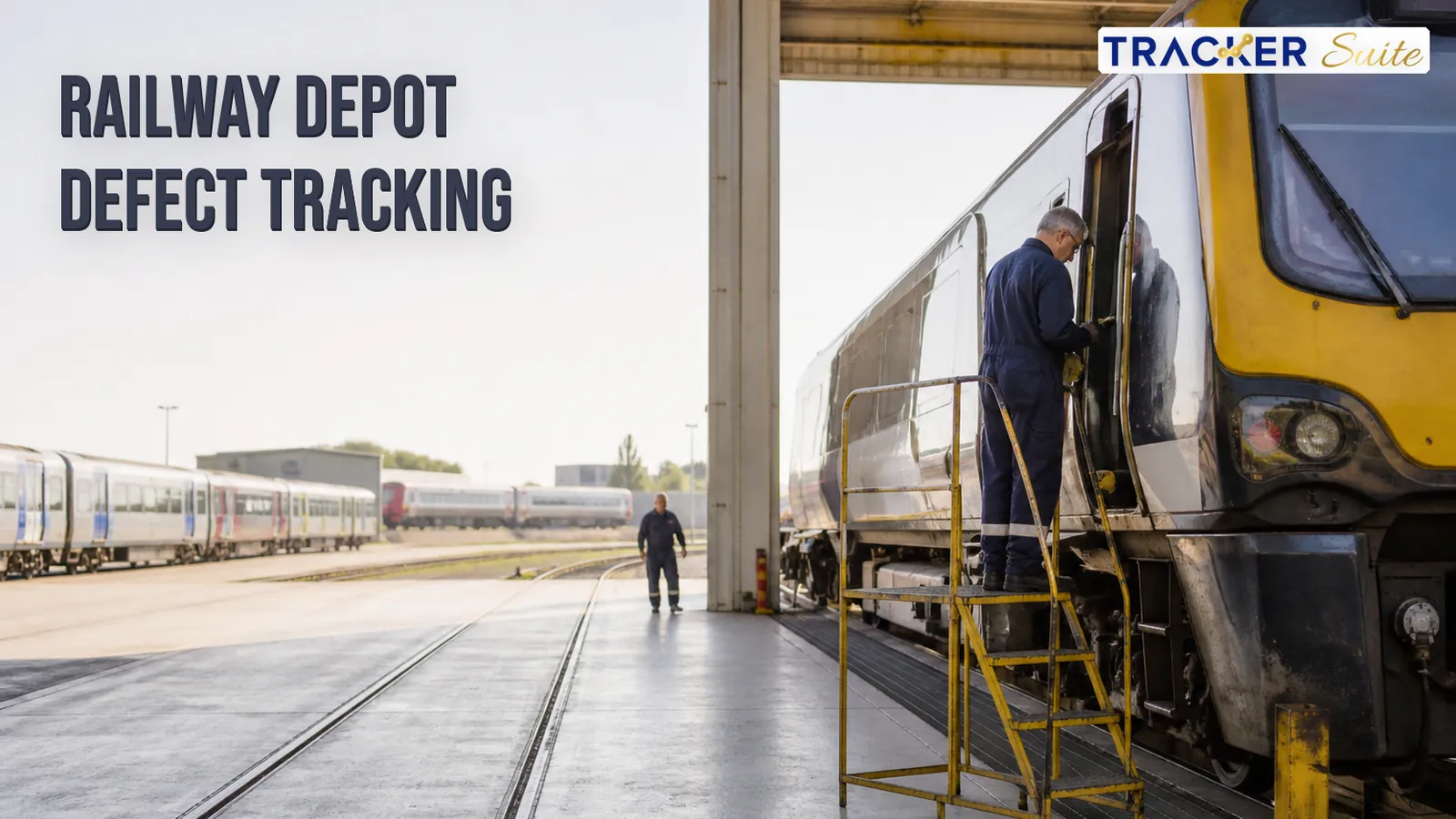
A defect found on the inspection pit (the sunken track where staff examine the underside of coaches) during the night shift has to be logged, assigned, repaired and signed off before the rake leaves the depot. A rake is a set of coaches that runs as one train. When that chain runs on paper registers and WhatsApp groups, defects slip between shifts and supervisors spend the release window chasing updates. Railway depot defect tracking is the discipline of keeping every open defect visible, owned and closed before the next train release.
This guide is for depot in-charges, rolling stock heads and leaders of maintenance contractors. It explains where the process breaks, what changes as fleets and shifts grow, and how a connected task system supports the people who still make the fitness call.
Key takeaways
- Defects get lost at handover, not at inspection. Examiners usually find the defect. The risk is that it loses its owner when the shift changes.
- Schedules come in two kinds. Calendar schedules are easy to repeat. Kilometre based schedules need run data, so plan for them deliberately.
- Spares decide closure time. A defect waiting for a part should show as "waiting for spares", not as a plain "open".
- Software organises the work. People certify fitness. Workflow steps, reminders and reports give visibility. A named, competent supervisor still approves the train for service.
- Start small. One depot, one schedule type and one defect workflow is enough to prove the approach.
What is the scale of rolling stock maintenance in India?
Indian depots maintain one of the world’s largest fleets on tight daily cycles. Every coach, wagon and metro car passes through scheduled examinations, and every examination can produce defects that must be closed before release. At this volume, a defect process that depends on memory gets tested on every shift.
As of 31 March 2024, Indian Railways held 91,948 passenger coaches, including 12,229 EMU coaches, and 327,991 freight wagons (Indian Railways Year Book 2023-24, Ministry of Railways, Railway Board). For a depot leader, the takeaway is practical: rakes return to the pit line day after day, and open defects pile up fast when nobody can see them in one place.
Metro systems run to even tighter margins. Delhi Metro reported 99.95% train punctuality (DMRC, published 10 August 2026), counting a train as late if it arrives more than 59 seconds behind schedule, along with a Mean Distance Between Failures of 2.72 million car-kilometres across 416.5 km and 303 stations (Delhi Metro Rail Corporation, August 2026; see also The Pioneer, citing DMRC, 2026). Mean Distance Between Failures, or MDBF, is the average distance a fleet runs before a failure that affects service. Results like these depend on depot discipline, because a defect found overnight must not reach the morning peak.
Safety outcomes have improved, and keeping them there depends on maintenance that is done and recorded every shift.
Consequential train accidents on Indian Railways fell from 135 in 2014-15 to 40 in 2023-24, according to the Railways Minister’s written replies in Parliament (Ministry of Railways, PIB, November 2024; Rajya Sabha reply reported by All India Radio News, 2024).
The same reply put accidents per million train kilometres at 0.03 in 2023-24, down from 0.11 in 2014-15 (All India Radio News, 2024). Many factors drive those gains. Routine maintenance that is done, recorded and verified every shift is one of them.
Which depot workflows create the most follow-up work?
Most follow-up comes from eight recurring workflows: scheduled inspections, defect logging, trade assignment, spares requests, repeat defects, rolling-in checks, shift handovers and fitness sign-off. Each one produces data, such as rake numbers, defect types, times and names. A register captures that data poorly, and a WhatsApp chat buries it within hours.
Here is how those workflows look on a typical pit line:
- Scheduled inspections. Trip, weekly, monthly and longer examinations, each with its own checklist and due window.
- Defect logging. An examiner records a brake block, coupler, air-conditioning, door or bogie defect against a specific coach or car number.
- Trade assignment. The defect goes to mechanical, electrical, brake or air-conditioning staff, often split between in-house and contractor teams.
- Spares requests. The repair needs a part from the depot store, and the defect waits until the part arrives.
- Repeat defects. The same coach shows the same fault again within a short period, a pattern no single shift is likely to notice.
- Rolling-in and en-route reports. Defects reported by crews or stations must be checked when the rake arrives.
- Shift handover. Open defects, half-finished jobs and pending parts pass to the next supervisor.
- Fitness sign-off. A competent person confirms the rake is fit for service before release.
Every workflow on this list is recurring, time-bound and shared across people. That combination is exactly where manual coordination starts to break.
Why do registers and WhatsApp groups strain across shifts?
Registers and WhatsApp work well for a small depot with one shift and a handful of rakes. They strain when a depot runs several shifts, mixes contractor and in-house staff, and handles many rakes a day. The record still exists, but nobody can see the full picture of open defects at the moment a release decision is due.
The scaling journey usually looks like this:
- Small operation. One supervisor, a defect register, a phone and a WhatsApp group. The supervisor knows every open job personally.
- Growing depot. More shifts and more trades. Defects get written in the register, photographed and posted to the group. The handover becomes a verbal briefing plus a scroll through messages.
- Complex depot. Multiple pit lines, contractor teams, store requests and kilometre based schedules. Supervisors now ask several people for updates before each release.
- Scaled operation. Defects, schedules, spares and sign-offs sit in one connected record. Status is visible without phone calls, and exceptions are flagged automatically.
The specific failure points are predictable. A defect posted in a busy group has no status field, so "done" and "waiting for part" look the same. A register entry has no reminder, so an unclosed defect stays silent until someone reads the page. Monthly reports get compiled by hand from several books, which takes supervisor time away from the pit line.
Excel and WhatsApp are not the problem in themselves. They are simply not built to hold ownership, status, due time and approval for hundreds of defects across shifts.
How should time-based and kilometre-based schedules be managed?
Calendar schedules, such as weekly or monthly examinations, can be set up as recurring tasks that create themselves on time. Kilometre based schedules need distance-run data for each rake or car. Many maintenance regimes trigger work on distance or calendar days, whichever comes first, so the depot needs both clocks visible in one place.
In practice, depots handle this in three ways:
- Calendar triggers. Recurring tasks for each examination type, generated automatically with the checklist attached.
- Distance triggers. Kilometre readings entered or uploaded regularly, with a planner raising the examination task when a rake nears its limit.
- Whichever-first rules. The planner watches both and raises the task on the earlier trigger.
Whether a given system can read kilometre data directly depends on the integrations available. Many depots start by uploading run data in bulk at a fixed time each day, then raise tasks from it. That approach is simple, auditable and good enough to begin with.
How do spares affect defect closure before train release?
Spares often decide whether a defect closes before release or gets deferred. When the store and the pit line keep separate records, supervisors cannot tell which open defects are blocked by parts. Linking each spares request to its defect makes the blocked ones visible early and gives the store a clear priority list.
A connected approach tracks three things for each defect that needs a part:
- The part requested, with the quantity and the rake it is for.
- Stock status at the depot store, or at another depot if the part has to be transferred.
- The defect status, which moves to "waiting for spares" and back to "in repair" when the part is issued.
For depots or contractors running several locations, a shared inventory view by site helps. TrackerSuite’s Stack Tracker manages inventory, orders and warehouses in real time, with visibility across locations and teams. That supports the spares side of defect closure. It does not replace a railway’s own stores or ERP system where one is mandated.
What does railway depot defect tracking look like in a connected system?
In a connected system, each defect is a task with an owner, a due time, a status and a clear set of steps. Railway depot defect tracking then stops being a search through books and chats. Supervisors see open, blocked and closed defects for each rake before release, and reminders go out automatically when something is overdue.
The before and after looks like this:
- Before: The supervisor calls three trade leads to ask what is still open. After: A status view shows open defects by rake, trade and age.
- Before: A defect found at night is described in a voice note. After: The examiner logs it against the coach number with a photo and a defect type.
- Before: Handover depends on what the outgoing supervisor remembers. After: The incoming shift inherits a list of open tasks with owners and notes.
- Before: Monthly reports are compiled by hand. After: Reports come from the same records the team already updates.
The automation is plain and useful. It creates recurring examination tasks, sends reminders before tasks fall due, notifies owners when they are assigned, and sends a daily summary to depot leaders. None of this changes who is accountable. It removes the chasing.
Where can AI help, and where do people keep the fitness decision?
AI is useful when it works on the depot’s own records and configured rules. It can help flag repeat defects on the same coach, suggest which open tasks need attention first, and draft summaries for the next shift. It does not decide whether a train is fit. A competent, named person makes that call.
A sensible division of work looks like this:
- People set the rules: examination intervals, defect categories, who can close what, and who signs fitness.
- The platform holds defects, schedules, spares requests and approvals in one record.
- Automation handles repetitive steps such as task creation, reminders and reports.
- AI assists with prioritisation and pattern spotting where it is configured and where the data is good enough.
Data quality matters more than any algorithm. If defects are logged without coach numbers or defect types, no AI will find patterns in them. Getting the logging right is the first AI project.
What should you look for in task management software for railway maintenance depots?
Good task management software for railway maintenance depots should handle recurring schedules, multi-step workflows, shift handovers, mobile logging on the pit line, approvals and reports. It should also respect permissions, so only authorised people can close defects or record fitness. If your depot is very small, a simple task management app may be enough.
The same criteria apply when you evaluate task management software for metro depot operators, where release windows are shorter and car-level records matter more. Use this decision checklist:
- Several shifts with formal handovers.
- Multiple trades or contractors working on the same rake.
- Recurring examinations on calendar and kilometre triggers.
- High defect volume that managers chase by phone.
- Spares delays that block closure.
- Manual reporting that eats supervisor time.
- Audit needs that require who-did-what records.
If only one or two of these apply, a shared task list may serve you well for now. If most apply, you need connected task tracking with workflow steps and reports.
At a glance
- Best fit: Depots and maintenance contractors with several shifts, trades or sites.
- Core need: Defects logged, assigned, tracked and closed before release.
- Schedules: Calendar triggers as recurring tasks; kilometre triggers from uploaded run data.
- Spares: Defect status linked to part requests and stock by location.
- Human role: Named supervisors approve closures and fitness.
- When a simple tool is enough: One shift, few rakes, low defect volume.
How does TrackerSuite fit railway and metro depot workflows?
TrackerSuite is an AI-powered operations platform that connects tasks, people, inventory and reports. For depots, its value lies in turning recurring examinations and defects into owned, tracked work. It does not certify fitness, and it should sit alongside a railway’s mandated maintenance systems, not replace them.
The relevant capabilities, mapped to depot work:
- Recurring tasks for calendar-based examinations.
- Workflow steps to break a defect into log, assign, repair, inspect and approve.
- Industry task templates and bulk task upload for examination checklists and kilometre-triggered tasks.
- WhatsApp, push and email reminders so owners know what is due before it is late.
- Shift management to see who is on duty for each handover. Workflow steps and shift management are add-ons on the Growth Plan.
- Daily automated reports on WhatsApp, performance scores and reports for depot leaders.
- Stack Tracker for spares stock across depots and stores.
- AI-based predictive tasking powered by TAVI, available on paid plans, to assist with prioritisation based on configured data.
Validate each capability against your own depot rules during a trial, especially permissions and approval steps. Plan details are on the TrackerSuite pricing page.
How should a depot implement digital defect tracking?
Start with one depot, one examination type and one defect workflow. Run the new process alongside the register for a few weeks, compare the two, then expand. That keeps the fitness process stable while the team learns the system.
- Map the current flow. Write down how a defect moves from finding to fitness sign-off today, including who calls whom.
- Define defect categories and owners. Agree on trades, defect types and who can close each type.
- Set up recurring examinations. Load calendar schedules first, then add kilometre triggers from run data.
- Build the workflow steps. Log, assign, repair, inspect and approve, with approval limited to authorised staff.
- Link spares requests. Add a "waiting for spares" status and connect it to the store.
- Standardise the handover. The incoming supervisor reviews open tasks instead of a chat history.
- Switch on reminders and daily reports. Send them to owners and depot leaders.
- Review and expand. Check closure times and repeat defects, then roll out to other shifts and depots.
What this means for you
If you lead a depot or a maintenance contract, your biggest risk is not the inspection itself. The risk sits in the hours between finding a defect and releasing the rake. Making that window visible is the most practical improvement available.
Ask three questions this week. Can you see every open defect on a rake before release without a phone call? Do you know which defects are blocked by spares? Does the incoming shift inherit a clear list of open work? If any answer is no, a connected task management system is worth piloting.
FAQs
What is railway depot defect tracking?
Railway depot defect tracking is the process of logging, assigning, repairing and closing defects found during inspections before a train is released. It records who owns each defect, its status and who approved the closure. The goal is that no defect is lost between shifts.
Can task management software replace the fitness certificate?
No. Software organises defects, schedules and approvals, but a competent, authorised person still decides whether a rake is fit for service. The system records that decision and the work behind it.
How do depots handle kilometre based maintenance schedules digitally?
Most depots enter or upload distance-run data for each rake regularly. Tasks are raised when a rake nears its kilometre limit or its calendar limit, whichever comes first. Bulk upload is a simple way to start.
Is WhatsApp enough for depot defect follow-up?
WhatsApp works for quick messages in a small team. It lacks status, ownership, reminders and reports, so defects get buried as volume and shifts grow. Many depots keep WhatsApp for alerts while the defect record lives in a task system.
When is a simple task management app enough?
A single-shift depot with few rakes and low defect volume may only need a shared task list. Once you have several shifts, trades, contractors or sites, connected workflows and reports become more valuable.
Conclusion
Depots already find defects well. The gap is keeping each defect owned and visible until it is closed and the rake is released. Recurring tasks, clear workflow steps, linked spares and automatic reports close that gap, while people keep the fitness decision. To plan a single-depot pilot, talk to the TrackerSuite team.
Leave a Reply