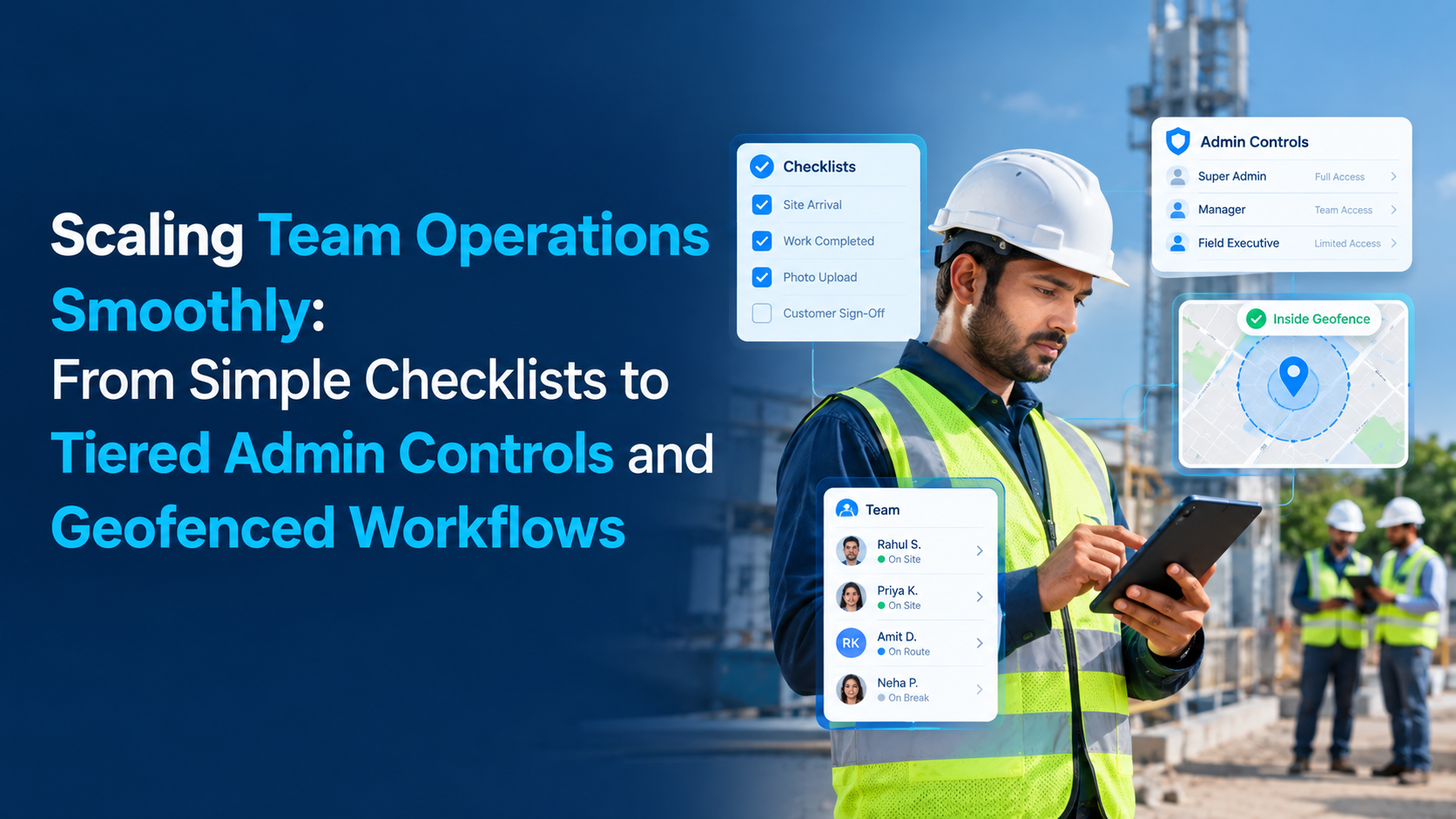
Discover how growing organizations transition from basic to-do lists to scalable task tracking tools featuring tiered admin controls, geofenced job sites, and real-time operational analytics.
Every growing business hits a predictable operational ceiling. When a team consists of three to five people, a shared notepad, a basic Kanban board, or a weekly group chat message is often enough to keep daily work aligned. Everyone knows who is doing what, deadlines are easily communicated over a quick desk chat, and accountability happens organically.
Then headcount doubles, triples, and expands into distributed branches, remote roles, and field sites.
Suddenly, basic checklists begin to crack under operational pressure. Tasks slip through the cracks, managers spend hours chasing progress updates, sensitive company data becomes exposed to general staff, and leaders lack the aggregated visibility needed to make confident business decisions. To cross this chasm without sacrificing team agility, modern organizations must evolve their infrastructure from informal task lists to comprehensive, intelligent operations management.
The Core Benefits of Modern Task Tracking Tools
Transitioning to a structured digital workflow does far more than replace paper to-do lists. The overarching task tracking tools benefits center on creating a single source of truth across diverse business functions:
- Elimination of Follow-Up Overhead: Automated status changes, recurring tasks, and proactive alerts reduce daily manual check-ins by up to 30%.
- Granular Accountability: Clear assignees, timestamped logs, and milestone stages ensure complete ownership over deliverables.
- Data-Driven Visibility: Real-time dashboards transform hidden operational bottlenecks into quantifiable data points.
- Scalable Standardization: Standardized task templates allow expanding teams to onboard new staff and replicate proven processes quickly.
Whether your team is writing software, pouring concrete, coordinating marketing releases, or managing supply chains, modern systems adapt to each functional discipline’s specific operational needs.
Phase 1: From Solo Hustle to Growing Squads
Empowering Solo Founders and Dynamic Startups
In the earliest growth stages, task tracking tools for entrepreneurs serve as an operational command center. Founders juggle sales, vendor onboarding, client delivery, and finances. Without a central system, founder bandwidth quickly becomes the organization’s single biggest bottleneck. Implementing task buckets, priority tagging, and automated reminders allows entrepreneurs to shift from reactive firefighting to systematic delegation.
Transitioning from Freelancers to Full-Service Agencies
Independent professionals quickly discover that task tracking tools for freelancers provide the bridge between individual gig delivery and running an agency. When independent operators scale into collaborative squads, tracking task statuses, client feedback rounds, and billable milestones preserves delivery margins and keeps client promises consistent.
Streamlining Workflows for Creatives and Content Creators
Creative pipelines involve messy, iterative feedback loops. High-performing task tracking tools for creatives and dedicated task tracking tools for content creators establish structured stages: scriptwriting, visual asset design, peer review, client staging, and multi-platform publishing schedules. By housing revisions and approvals within specific task cards, creative teams avoid buried feedback in email chains and missed publication deadlines.
Phase 2: Orchestrating Cross-Functional Specialists
As organizations build out dedicated departments, task management software must handle increasingly complex, specialized workflows.
┌────────────────────────────────────────────────────────┐
│            ORGANIZATIONAL SCALING CONTINUUM            │
├─────────────────┬───────────────────┬──────────────────┤
│  Early Stage    │ Growth Stage      │ Enterprise Tier  │
│  (1 - 5 Users)  │ (5 - 50 Users)    │ (50+ Users)      │
├─────────────────┼───────────────────┼──────────────────┤
│ • Shared Lists  │ • Custom Buckets  │ • Tiered RBAC    │
│ • Manual Alerts │ • Automated Ping  │ • Geofence Sites │
│ • Ad-hoc Comms  │ • Role Delegation │ • Multi-Shift AI │
└─────────────────┴───────────────────┴──────────────────┘
Executive Assistants: Orchestrating Executive Bandwidth
Senior leaders rely on task tracking tools for executive assistants to manage mission-critical cross-departmental initiatives. From scheduling investor board reviews and coordinating confidential vendor proposals to overseeing routine administrative cadences, executive assistants use recurring workflows and priority flags to protect executive focus.
Engineers and Data Analysts: Technical Backlogs and Pipeline Tracking
Technical departments operate with structured precision:
- Task tracking tools for engineers coordinate technical debt backlogs, sprint cycles, infrastructure updates, and cross-functional handoffs.
- Task tracking tools for data analyst teams organize complex ETL requests, dashboard validation cycles, ad-hoc query queues, and model audit checkpoints.
When analytical tasks are tracked alongside business milestones, cross-team transparency improves significantly.
Transforming Raw Task Metrics into Strategic Decision Making
At scale, task records cease to be mere operational logs—they turn into strategic assets. Using task tracking tools for decision making gives C-suite executives and operational managers real-time visibility into team velocity, recurring deadline slippages, and workload distributions. If three consecutive sprints stall at quality assurance, leadership can strategically reallocate budget and staffing before delays impact customer satisfaction.
Phase 3: Physical Operations, Field Sites, and Time-Sensitive Projects
Digital-only task lists fall short when operations require physical presence, inventory logistics, or tight real-world synchronization.
Construction and Civil Engineering Workflows
Physical construction projects cannot afford ambiguity. The requirements for task tracking tools for construction and specialized task tracking tools for civil engineers demand tools that link task execution directly to physical project locations:
- Geofenced Verification: Ensuring that site engineers, quality inspectors, and sub-contractors check into tasks and record sign-offs only when physically present on-site.
- Sequential Milestones: Enforcing that foundation inspections are completed and documented before structural steel fabrication tasks unlock.
- Field Attendance & Shift Management: Tracking multi-shift operations across remote work sites with automated check-in protocols.
Event Planning: Precision Timeline Execution
Live activations and corporate summits require down-to-the-minute execution. Specialized task tracking tools for event planning allow producers to orchestrate vendor deliveries, AV sound checks, VIP arrivals, and staging milestones across distributed event halls with zero margin for error.
E-Commerce and Inventory Synchronization
Retail and direct-to-consumer businesses balance digital sales with physical warehouse reality. Implementing dedicated task tracking tools for ecommerce enables merchandising teams to coordinate product catalog launches, seasonal promotional assets, and inventory restocking cycles. Combining task tracking with a connected inventory and warehouse management platform ensures that marketing campaigns launch only when stock levels in the warehouse are verified.
Education and Academic Operations
Educational institutions and corporate training academies benefit from structured milestone management. Deploying task tracking tools for education helps administrators coordinate curriculum updates, faculty review cycles, accreditation submissions, and student evaluation pipelines smoothly.
Phase 4: Enterprise-Grade Governance and Intelligent Controls
When headcounts exceed 50, 100, or 500 team members across multiple regional offices, operational platforms must deliver advanced administrative safeguards and intelligent automation.
1. Tiered Admin Controls and Granular Permissions
A unified task tracking tool for enterprises requires robust role-based access control (RBAC). In a growing company, not every employee needs visibility into executive strategic plans, client financial contracts, or proprietary R&D tasks.
Tiered management structures enable:
- Super Admins: Global governance over organizational settings, billing, integrations, and company-wide analytics.
- Branch / Department Managers: Full operational authority over their specific functional units, shifts, and team task assignments.
- Field Supervisors: Permissions to approve shift check-ins, sign off on field checklists, and reassign day-to-day tasks.
- Individual Contributors: Focused access limited strictly to assigned tasks, subtasks, and relevant document attachments.
2. Multi-Shift Management and Geofenced Boundaries
For logistics, healthcare, retail, and manufacturing enterprises, workforce management goes hand-in-hand with task completion. Platforms that support unlimited geofenced sites allow enterprises to configure precise virtual perimeters around branch offices, warehouses, and client project sites. Staff clock in and log task updates automatically through mobile apps when entering the geofenced area, eliminating time theft and manual attendance reconciliation.
3. AI-Powered Automation and Unified Communication
Modern operations rely heavily on conversational workflows. Instead of requiring employees to live exclusively inside complex desktop dashboards, enterprise platforms integrate directly with everyday communication tools like WhatsApp.
With integrated AI assistants (such as TrackerSuite’s Tavi AI), staff receive automated task notifications, deadline reminders, and shift alerts directly on mobile devices. Supervisors can review real-time performance scores, identify resource bottlenecks, and assign recurring task templates with minimal administrative effort.
Feature Matrix: Matching Operational Needs to Growth Stage
CapabilityStarter / Small TeamsGrowing OperationsEnterprise & Multi-SiteTask Buckets & ChecklistsBasic Kanban / ListsDynamic WorkflowsCustom Multi-Tier WorkflowsTeam PermissionsOpen CollaborationDepartmental RolesTiered RBAC & Branch AdminLocation GovernanceNone / RemoteBasic GeolocationUnlimited Geofenced SitesShift & AttendanceStandard Check-inShift SchedulingMulti-Shift & Roster AutomationReporting & InsightsBasic Completion LogsPerformance ScoresPredictive AI Analytics & Audit LogsCommunicationEmail / In-AppInstant Push AlertsWhatsApp Bot & AI Integration
Scale Your Operations with Clarity and Control
Scaling an organization does not mean drowning in administrative overhead. As your team grows, the operational infrastructure you choose determines whether you experience chaotic bottlenecks or predictable, high-velocity growth.
At TrackerSuite, our core mission at TrackerSuite is to help businesses of every size transform fragmented workflows into unified, intelligent operational engines—combining task automation, geofenced tracking, and performance analytics in one cohesive workspace.
Ready to elevate your team from basic checklists to enterprise-grade operational excellence? Take the next step and explore TrackerSuite pricing plans to find the perfect fit for your growing workforce.

Leave a Reply