
Key Takeaways
- Jewellery businesses manage many activities, from customer orders and repair requests to production follow-ups and store operations.
- Task management software helps teams assign responsibilities, set deadlines and track pending work from one place.
- Jewellery manufacturers can use task workflows to coordinate designers, karigars, production teams and quality inspectors.
- Retail jewellery businesses can organize store opening and closing checks, customer follow-ups, repair requests and approval tasks.
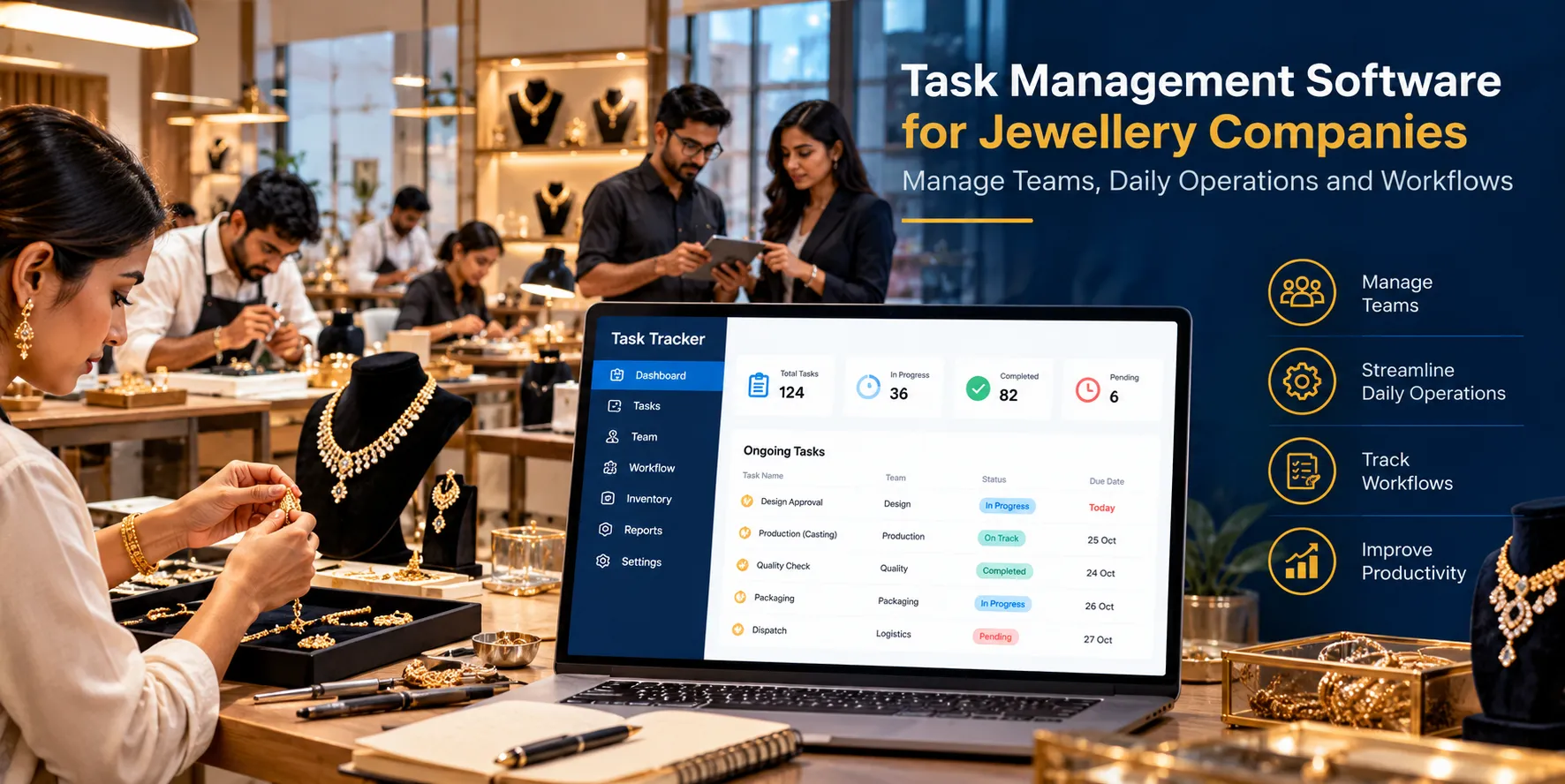
- Task Tracker by TrackerSuite.ai helps businesses manage tasks, reminders, approvals, workforce activities and proof of work through a centralized platform.
Introduction
A jewellery business depends on careful coordination. A designer may need to complete a new design, a karigar may be working on an order, and a sales team member may need to follow up with a customer. Meanwhile, the manager must keep track of pending work and delivery commitments.
When teams rely on spreadsheets, paper registers and WhatsApp messages, important updates can become difficult to follow.
Task management software for jewellery companies helps organize daily responsibilities, track work progress and keep employees informed about what needs to be done next.
Why Do Jewellery Companies Need Task Management Software?
Jewellery businesses operate in different ways. A manufacturer may coordinate production teams and external karigars, while a retailer may manage customer enquiries, repairs and daily showroom activities. Wholesalers and multi-branch jewellery chains have their own coordination requirements.
Despite these differences, they share a common need: employees must complete the right tasks at the right time.
1. Manage Multiple Activities at the Same Time
A jewellery manufacturer may have several orders moving through different stages. One order may need design approval, another may be waiting for stone setting, and a third may require a final quality check.
Managers need to know which activities are complete and which still need attention.
Task management software helps break larger jobs into smaller tasks. Each task can have an assigned employee, a due date and a status. Managers can review progress without collecting separate updates from every department.
2. Reduce Manual Follow-Ups
Managers often contact employees to ask whether a design is ready, whether a repair has been completed or whether a customer has received a call back.
These follow-ups become harder to manage when several employees handle different orders and responsibilities.
A task management system gives employees a central place to check their assignments and update their progress. Reminders can bring attention to approaching deadlines and pending work.
This helps managers spend less time chasing routine updates and more time handling decisions that need their attention.
3. Keep Team Communication Organized
Important instructions can get buried in long messaging conversations. An employee may miss a revised deadline, while a manager may struggle to find an earlier approval.
Task-based workflows help connect work assignments with their status, deadlines and supporting information.
For example, if a customer requests a change to a jewellery design, the team can create a task for the designer, assign a deadline and track the next step. The team can then follow the task through the relevant review process.
How Task Management Software Helps Jewellery Manufacturers
Jewellery manufacturing involves several connected activities. A design may pass through CAD, casting, stone setting, polishing and quality checks before the finished piece is ready for dispatch. The exact stages depend on the product and the manufacturer’s process.
Task management software helps teams coordinate the work between these stages.
Track Jewellery Production Tasks
A production manager can divide an order into individual activities and assign each activity to the responsible team.
For example, a custom necklace order may require:
- Design preparation and approval.
- Production planning and work assignment.
- Casting and finishing activities.
- Stone setting, where applicable.
- Polishing and quality inspection.
- Final review and dispatch preparation.
Managers can create tasks for the activities that need tracking, set deadlines and review their status. If stone setting is delayed, the manager can identify the pending task and follow up with the responsible employee. This makes the next steps easier to coordinate.
Important: Task management software does not automatically track the physical movement or weight of gold and gemstones. Those requirements need suitable inventory or jewellery manufacturing software.
Coordinate Karigars and Production Teams
Karigars play an important role in jewellery manufacturing. Depending on the business, they may work in-house or handle specific jobs externally.
Managers need to communicate job requirements, assign work and follow up on completion.
A digital task system can record the assigned activity, responsible person, expected completion date and current status. Employees can update their tasks as work progresses.
For outsourced work, teams can also create internal follow-up tasks to record when they need to check on an outstanding job or confirm receipt of completed work.
This creates a clearer record of responsibilities and reduces dependence on memory.
Manage Quality Checks and Rework
A jewellery item may need additional work if it does not meet the company’s design or finishing requirements.
When an inspector identifies an issue, the team can create a follow-up task for the appropriate employee. The task can describe the required correction, assign responsibility and set a deadline for review.
After the work is complete, the team can update the status and submit the required supporting information.
Task management helps coordinate these activities, but it does not replace specialist quality inspection or technical checks.
How Jewellery Retailers Can Manage Daily Store Operations
Jewellery showrooms handle many small but important activities throughout the day. These include preparing the store, following up with customers, coordinating repairs, managing approvals and completing closing checks.
When several employees share these responsibilities, a structured task list can help keep daily work organized.
Organize Store Opening and Closing Checklists
A showroom may require employees to complete specific checks before opening and after closing.
An opening checklist could include:
- Checking that the showroom is ready for customers.
- Confirming that designated security procedures have been followed.
- Checking display arrangements.
- Reviewing the day’s appointments and assigned responsibilities.
- Confirming that required operational checks are complete.
A closing checklist may cover securing displays, completing records and following the store’s closing procedures.
Managers can assign these activities to the responsible employees and review completion status.
For jewellery businesses, security procedures must follow the company’s approved policies. A task checklist can document completion, but it does not replace physical security controls.
Track Customer Enquiries and Follow-Ups
A customer may enquire about a particular design, request a custom order or ask when a repair will be ready.
If the salesperson does not record the next action, the follow-up can be missed during a busy day.
A task management system helps employees record follow-up activities, assign responsibility and set a date for the next contact.
For example, a salesperson can create a task to call a customer after receiving confirmation about a custom ring. The task remains available for review until the employee updates its status.
Sales Tracker may also be relevant when the business needs dedicated lead management and sales pipeline tracking.
Manage Jewellery Repairs and Custom Orders
Repair requests and custom orders often involve several steps. Employees may need to record the request, coordinate with a workshop, communicate an expected date and confirm completion.
Task management software helps organize these responsibilities.
A manager can assign a repair follow-up to the appropriate employee and set a reminder for the expected completion date. Once the workshop completes the work, the responsible employee can update the task and coordinate customer communication.
For custom orders, teams can create separate tasks for design approval, customer confirmation and final handover.
The actual repair history, product details and billing records may still need to be maintained in the jewellery business’s dedicated system.
How Multi-Branch Jewellery Businesses Can Coordinate Teams
Jewellery chains often have employees working across different showrooms, offices and warehouses. Head-office managers may need updates from branch managers without contacting every employee individually.
Task management software helps establish a shared process for assigning and reviewing work.
Assign Responsibilities by Branch
A head-office manager can create tasks for individual branches or teams, depending on the platform’s configuration.
Examples include preparing for a seasonal promotion, completing a store audit, updating display arrangements or submitting a branch report.
Each task can have an owner and deadline. Branch managers can review the work assigned to their teams and follow up on outstanding activities.
Track Pending Approvals
Some jewellery business decisions require approval from a manager or owner. These may include operational requests, promotional activities or specific business expenses.
A task workflow can record the request, route it to the responsible person and show whether approval is pending or complete.
This helps teams identify requests that need attention instead of searching through messages to find the latest update.
Maintain Consistent Store Procedures
A business may want every branch to follow the same opening checks, reporting schedules and promotional procedures.
Managers can organize these activities into standardized task lists and assign them to the relevant teams.
A consistent process helps employees understand their responsibilities, while management can review completion across branches.
How Photo and Video Proof of Work Helps Jewellery Companies
Some tasks require more than a status update. A manager may need supporting evidence to confirm that an activity has been completed according to the company’s instructions.
For example, a jewellery business may ask employees to submit:
- Photographs of completed display arrangements.
- Images documenting approved promotional material placement.
- Supporting documents for store audits.
- Photographs of completed non-technical maintenance work.
- Documents required for an internal review.
Employees can attach the required material to the relevant task where the software supports it. Managers can then review the submission and follow up if information is missing.
Task Tracker offers AI Work Validation, which checks submitted images, videos or documents against configured criteria and can flag submissions for review.
For example, a business could configure a task to require a particular type of display photograph. The system can check the submission against the configured criteria and flag it for further review.
This feature should be used within the limits of its configured checks. It should not be treated as proof of a gemstone’s authenticity, gold purity, product value or compliance with hallmarking requirements.
How Task Tracker by TrackerSuite.ai Helps Jewellery Companies
Task Tracker helps businesses organize work, assign responsibilities and manage workforce activities. Jewellery companies can apply these capabilities to their own daily workflows.
Centralized Task Assignment
Managers can assign tasks to employees, set deadlines and review status updates in one place.
A manufacturer can use this approach for internal production follow-ups, while a retailer can use it for customer callbacks, store checks and repair coordination.
Reminders and Notifications
Task reminders help employees stay aware of assigned work and approaching deadlines.
Managers can use task status to identify activities that need follow-up. This is useful when several employees handle different responsibilities across departments or branches.
Approvals and Reassignment
When a task needs approval or another employee must take responsibility, task approval and reassignment workflows can help coordinate the next step.
For example, a branch employee may submit an operational request for approval. The responsible manager can review the request and move it forward according to the company’s workflow.
Attendance and Workforce Management
Jewellery businesses with several branches or production teams may need to coordinate attendance and daily assignments.
Task Tracker includes workforce management capabilities such as attendance tracking, task assignment and proof-of-work submission. Businesses can apply these features according to their operational requirements and configuration.
Task Visibility Across Teams
A centralized task system helps managers review assigned work and identify pending activities across their teams.
It can provide a clearer view of who is responsible for each task, when the work is due and whether the employee has updated its status.
Task Tracker focuses on task and workforce management. Businesses that need jewellery-specific stock valuation, metal-weight reconciliation, barcode billing, hallmarking records or detailed production costing should evaluate dedicated jewellery management or ERP software for those requirements.
How to Choose Task Management Software for a Jewellery Company
The right software depends on whether the business operates a showroom, a manufacturing unit, a wholesale operation or a multi-branch chain.
Before selecting a platform, consider the following questions.
1. Can You Assign Tasks with Clear Deadlines?
Employees should know what they need to do, who is responsible and when the work is due.
2. Can Managers Review Pending Work?
Check whether managers can view task status and identify overdue activities without collecting updates manually.
3. Does the System Support Approvals and Reminders?
These features can help coordinate requests, reviews and time-sensitive follow-ups.
4. Can Employees Submit Supporting Documents or Photos?
Confirm whether the software supports the evidence required for your workflows.
5. Can You Manage Tasks Across Teams and Locations?
Multi-branch businesses should check whether the platform supports their reporting structure and branch-level responsibilities.
6. Does It Integrate with Your Existing Jewellery Software?
A task management platform may need to work alongside your ERP, inventory system, billing software or CRM. Confirm the available integrations before making a decision.
7. Is It Suitable for Your Actual Workflow?
Test a real process, such as a repair request or a production follow-up. Check whether employees can use the system consistently and managers can review the task without unnecessary steps.
Frequently Asked Questions About Task Management Software for Jewellery Companies
What Is Task Management Software for Jewellery Companies?
Task management software helps jewellery businesses assign work, set deadlines, track progress and coordinate employees. Teams can use it for production follow-ups, repair requests, customer callbacks, store checklists and internal approvals.
How Can Jewellery Manufacturers Track Production Tasks?
Manufacturers can divide work into stages, assign tasks to the responsible teams and set deadlines. Managers can review task status and follow up on pending activities.
Detailed production tracking and material reconciliation may require dedicated jewellery manufacturing software.
Can Jewellery Retailers Use Task Management Software?
Yes. Retailers can use task management software to organize store checklists, customer follow-ups, repair coordination, internal requests and branch activities.
How Can Jewellery Chains Manage Tasks Across Multiple Branches?
A centralized task management system can help head-office managers assign work, set deadlines and review status updates from different branches, depending on the platform’s capabilities and configuration.
Can Task Management Software Track Gold and Diamond Inventory?
Not necessarily. General task management software organizes work and responsibilities. Tracking metal weight, gemstone quantities, product movement and stock valuation requires suitable inventory or jewellery management functionality.
How Does Task Tracker Help Jewellery Companies?
Task Tracker provides task assignment, reminders, approvals, workforce management and proof-of-work capabilities. Jewellery businesses can apply these features to relevant operational workflows after mapping their requirements.
Conclusion: Bring Jewellery Business Tasks into One Organized Workflow
Jewellery businesses depend on careful coordination between employees, departments and locations. Whether a company manages production activities, showroom operations or customer follow-ups, pending tasks need clear ownership and timely updates.
Task management software helps businesses organize daily work, monitor progress and keep responsibilities visible across teams.
Task Tracker by TrackerSuite.ai provides task and workforce management capabilities that jewellery companies can apply to their operational processes. For businesses looking to reduce dependence on scattered messages and manual follow-ups, it offers a way to bring task assignments, reminders, approvals and proof of work into a more organized workflow.
Explore Task Tracker by TrackerSuite.ai to see how it can fit into your jewellery com operations.
Leave a Reply