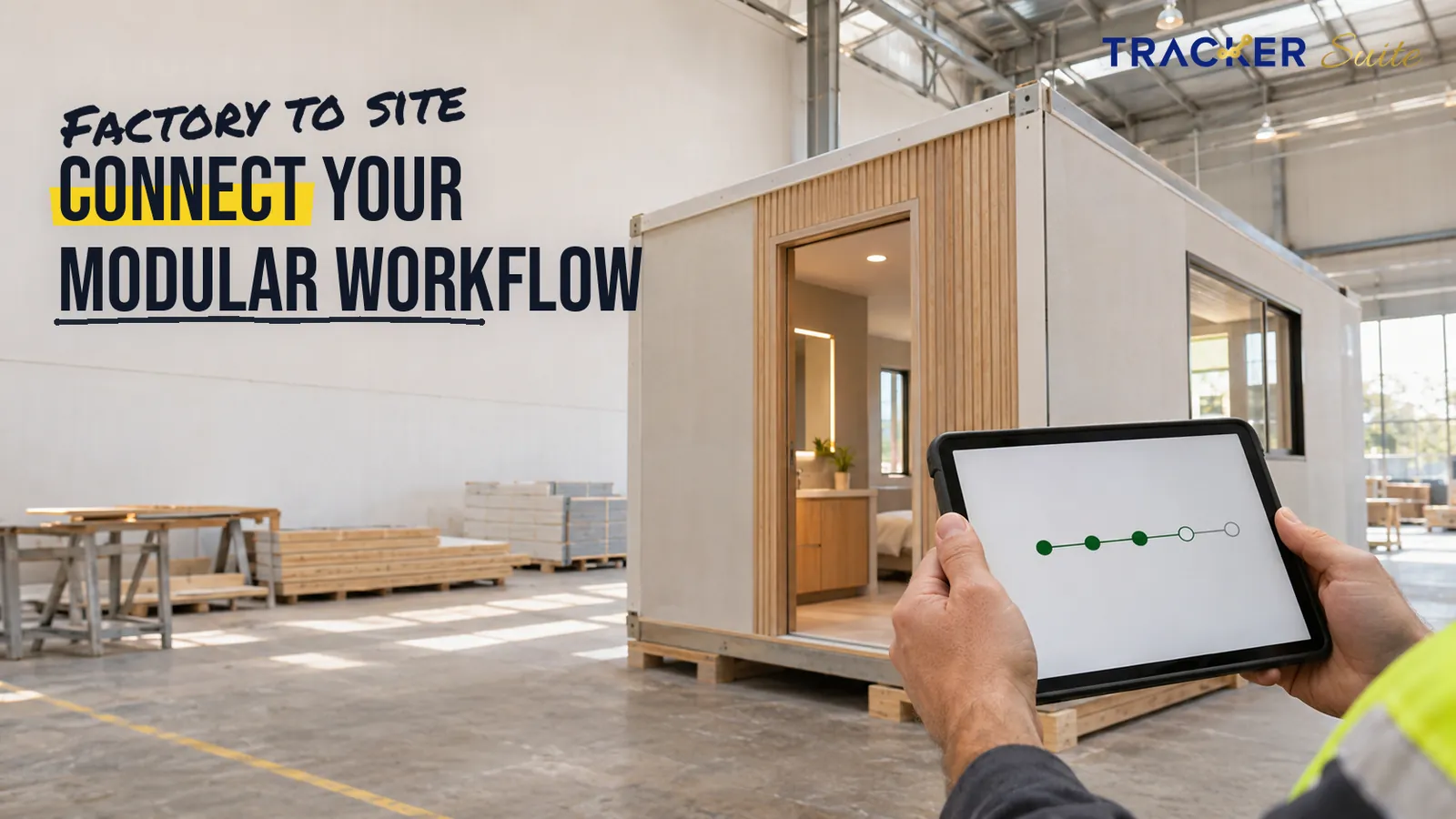
A crane is booked for Tuesday, and on Friday the module it is meant to lift fails its QC check in the factory. That risk is built into how modular and prefab companies work, because they run two operations at once: a factory that builds modules under controlled conditions and a field operation that transports, sets and connects those modules on site. Task management software for modular construction companies earns its place when it follows each module from the production line, through quality sign-off and dispatch, to installation in one shared record.
Key takeaways
- Modular builders run a factory production schedule and a site installation schedule at the same time. Many delays, disputes and rework issues surface where those two schedules meet.
- A connected workflow treats each module as one traceable unit that moves through production stations, quality control (QC) hold points, yard storage, dispatch and installation.
- Activity-based stock stages record where each module and material kit physically sits. For a firm producing a few units a month from one location, they usually add overhead without much benefit.
- Automation and AI help most with configured reminders, exception alerts and status summaries. People stay responsible for QC acceptance, lifting plans and site safety.
- Start with one product line or project, define the stage gates, confirm the data is reliable, then expand.
At a glance
- Who this is for: Volumetric modular builders, panelised and prefab component manufacturers, and contractors who install factory-built units.
- Core problem: Factory and site teams work from separate updates, so nobody holds one current view of each module.
- Workflows covered: Production scheduling, material kitting, station work, QC sign-offs, rework, yard storage, dispatch, site installation, snagging and reporting.
- When it is overkill: One small crew, a few units a month, a single location and components bought job by job.
- Market context: Global Market Insights sizes the modular and prefabricated construction market at USD 180.3 billion in 2026.
How large is the modular and prefabricated construction market in 2026?
Two market reports size the 2026 market differently because they define it differently: about USD 180 billion for modular and prefabricated construction, and about USD 198 billion for the broader offsite construction market. Global Market Insights points to factory-based quality control and skilled-labour shortages, while the Research and Markets report highlights AI, IoT and smart tracking. Both forecasts suggest more work will pass through the factory-to-site handover in coming years.
Global Market Insights estimates that the global modular and prefabricated construction market grew from USD 171.1 billion in 2025 to USD 180.3 billion in 2026 (Global Market Insights, 2026). The February 2026 report covers permanent and relocatable buildings in steel, wood and concrete. Its applications span residential, office, hospitality, retail and healthcare, and it cites skilled-labour shortages in markets such as North America and Germany.
Global Market Insights forecasts that the modular and prefabricated construction market will reach USD 307.2 billion by 2035, growing at 6.1% a year from 2026 (Global Market Insights, 2026).
A second report uses the broader category of offsite construction: designing, manufacturing and assembling building components in a factory, then transporting and installing them on site. Research and Markets, selling a January 2026 report by The Business Research Company, values that market at USD 185.03 billion in 2025 and USD 198.24 billion in 2026 (Research and Markets, 2026). Its scope also includes services such as logistics and delivery, plus quality assurance and testing.
The same report names "increasing integration of AI and IoT in offsite construction" as a forecast-period driver and lists AI-based design and quality control as a major trend. IoT, the internet of things, means connected sensors and devices that report their status automatically. Neither report evaluates any software product. Both point to quality control and logistics as growth areas, which makes reliable tracking data more important.
Where do modular builders lose visibility between factory and site?
Modular builders usually lose visibility at handovers: between factory stations, from production to QC, from the storage yard to the truck and from the truck to the crane. Each handover changes a module’s status. Yet that change often lives in a supervisor’s memory, a WhatsApp thread or a spreadsheet the other team cannot open.
Consider an illustrative example. A volumetric builder (one that produces fully enclosed, three-dimensional room modules) is supplying 48 apartment modules to a mid-rise project. The site has booked a crane for Tuesday to set modules 15 to 20 in sequence.
On Friday, module 17 fails a waterproofing check and goes back for rework. The QC inspector records the failure on paper, and the production manager learns about it on Monday. The site manager finds out when the truck arrives without module 17. Because installation follows a fixed set sequence, the order in which modules must be lifted, modules 18 to 20 cannot go up either.
No one in this example acted carelessly. The problem is structural: the factory and the site each held accurate information, but the information never reached the person who needed it in time.

Which workflows does a modular or prefab business need to connect?
A modular or prefab business needs to connect every workflow that changes a module’s status or affects when it can be installed. Each one generates data, such as timestamps, checklists, photos and stock movements. Most of that data is still captured by hand in firms that have grown faster than their systems.
A typical modular or prefab business runs a set of recurring workflows such as these:
- Production scheduling: Assigning module IDs, target dates and station slots for each project.
- Material kitting: Preparing kits of studs, sheathing, fixings and fittings per module and flagging shortages.
- Station work: Framing, MEP rough-in (mechanical, electrical and plumbing services), insulation and finishes, each with start and finish times.
- QC sign-offs at hold points: Checklists, photos and inspector approval before a module moves on.
- Rework and non-conformance: Recording defects, assigning fixes and confirming re-inspection.
- Yard storage: Logging where each finished module sits and whether it is protected from weather.
- Dispatch and transport: Load lists, permits, escort bookings and delivery windows.
- Site installation: Set sequence, crane time, and stitching (joining modules structurally and connecting services on site).
- Snagging and handover: Clearing punch-list items, the minor defects found before client acceptance.
- Reporting: Weekly progress for clients, lenders and management.
Why do manual processes stop scaling in modular construction?
Manual processes stop scaling once the number of modules, shifts and sites multiplies the number of handovers faster than supervisors can chase them. A single factory feeding one site can run on calls and spreadsheets. Several projects, two shifts and multiple installation crews cannot.
The scaling journey follows a familiar pattern. A small operation coordinates through WhatsApp, Excel, phone calls and a shared drive, and that works because the owner sees everything. A growing operation adds a second shift and a second project, and the production manager starts spending the day asking people for updates.
A complex operation adds third-party inspectors, client approvals and transport permits. At this stage, accountability blurs because nobody can see who owns the next step. Picture 200 employees, three active sites and thousands of status changes a month. At that scale, no supervisor can know which module is blocked without a shared record.
Excel works well for simple tracking. However, businesses with multiple teams, locations or workflows usually need a more connected operational system, where each status change is recorded once and visible to everyone who depends on it.

How can one connected workflow follow a module from factory to site?
One connected workflow follows a module by treating it as a single record that passes through defined stage gates. Each gate has an owner, an entry condition, required evidence and an exit condition. The module cannot advance until the gate is closed, and everyone downstream sees the change immediately.
A practical stage-gate sequence for prefab construction tracking looks like this:
- Released to production: Drawings approved, module ID created and kit list issued.
- Station complete: Each station lead confirms completion, with photos where useful.
- QC hold point passed: The inspector signs off the checklist, or raises a non-conformance that opens a rework task.
- Moved to yard: Location and protection status recorded.
- Loaded and dispatched: Load list confirmed, with the driver and delivery window logged.
- Received on site: Site team confirms arrival and condition.
- Set and stitched: Installation crew confirms placement and service connections.
- Snag-free and handed over: Punch-list items closed and client acceptance recorded.
In the module 17 example, a failed QC hold point would automatically show the module as blocked. The site manager would see that before Monday, not when the truck arrives. Because every gate records who approved what and when, disputes about acceptance become much easier to settle.
What are activity-based stock stages, and when are they overkill?
Activity-based stock stages update inventory when work happens, not through periodic counts. Material moves from received to kitted, issued to a station, built into a module, then shipped. Each activity changes the stock status, so planners know what is available, what is committed and what is already inside a finished module.
This approach suits firms that build several projects at once from shared material. Without it, a kitted bundle of fittings can look available on a spreadsheet while it is already allocated to another module. Linking stock stages to the module record also shows which delay is a material problem and which is a labour problem.
Activity-based stock stages are usually overkill when:
- The firm produces only a few units a month.
- Materials are bought job by job and delivered straight to the station.
- One person handles purchasing, storage and issuing.
- There is a single factory and no separate yard or warehouse.
In those cases, a simple materials list per project and a weekly check are often enough.
Where do automation and AI help, and where do people stay in charge?
Automation helps by handling repetitive steps such as reminders, status notifications and report compilation. AI helps when it uses existing business data and configured rules to flag what needs attention, such as modules at risk of missing their dispatch date. People still define the rules and make the safety and quality decisions.
Useful automations include:
- Reminding the inspector when a module has waited at a QC hold point beyond an agreed time.
- Alerting the site manager when a module linked to a crane booking fails inspection.
- Notifying the transport coordinator when the dispatch date of a module changes.
- Compiling a daily progress summary by project instead of building it by hand.
AI adds value on top of that connected data. An assistant can summarise which modules are blocked, list overdue tasks by station or answer a manager’s question about a project’s status. It works only as well as the data feeding it, which is why stage gates come first.
People must keep ownership of QC acceptance, structural and lifting decisions, transport safety and client sign-off. Software can surface the information, but responsible people should make and record those calls.
What should task management software for modular construction companies include?
Task management software for modular construction companies should link tasks to individual modules, support stage gates with evidence, work on mobile devices for factory floors and sites, and give managers one status view across locations. It should also control who sees and approves what, because QC records carry contractual weight.
Use this checklist when assessing options. The same criteria apply to task management software for prefab construction companies that produce panels or components rather than full volumetric modules.
- Multiple locations: Factory, yard and one or more active sites.
- Shift work: Two or more production shifts that hand over unfinished modules.
- Field teams: Installation crews whose attendance and location matter.
- Recurring workflows: The same stage sequence repeated for every module.
- High follow-up volume: Managers spend hours chasing status updates.
- Fragmented data: QC records, stock and schedules held in separate files.
- Manual reporting: Weekly client reports assembled by hand.
- Permissions: Different access for inspectors, supervisors, subcontractors and clients.
If only one or two of these apply, a shared task list or a simple visual board may be enough. A dedicated operations platform becomes worthwhile as more items apply at once.
How does TrackerSuite fit modular and prefab operations?
TrackerSuite is an AI-powered operations platform that connects task tracking, field workforce management and inventory. For modular builders, that means station tasks, QC checks and site installation work can sit in one system, with the factory and site teams seeing the same status.
Task Tracker supports task assignment across teams, and its Workflow add-on breaks large jobs into smaller, actionable steps, which suits a module moving through stations and hold points. Mobile attendance with geofencing, multi-shift attendance and geolocation tracking help managers see which crews are working where. WhatsApp notifications and reminders, performance scores and reports reduce the amount of manual chasing.
Stack Tracker manages inventory, orders and warehouses in real time, with Tavi AI-powered visibility across locations and teams. For a modular firm, that gives the factory store, yard and sites one inventory view. Tavi, TrackerSuite’s AI assistant, is included from the Growth plan.
For larger organisations, the Enterprise plan adds custom workflows, advanced security and controls, and connections to existing tools. Firms that rely on BIM (building information modelling) or a manufacturing ERP (enterprise resource planning) may still run those systems alongside an operations platform.
How should a modular builder implement a connected workflow?
A modular builder should implement a connected workflow in stages, starting with one project or product line. Map the current module journey, define the gates and owners, run a pilot, check data quality and only then extend to other projects, sites and stock.
- Map the current journey. Walk one module from release to handover and note every handover, document and delay.
- Define stage gates. Agree on owners, required evidence and exit conditions for each gate.
- Pilot one project. Choose a project with a committed site manager and a manageable module count.
- Configure notifications. Set reminders and alerts for the handovers that caused the most trouble in step 1.
- Add stock stages if needed. Link material movement to modules only if the overkill test above does not apply.
- Review after four to six weeks. Check whether updates are complete and timely before trusting dashboards.
- Expand. Roll the model out to other projects, shifts and sites, then introduce AI summaries.
What this means for you
For factory managers, a connected workflow replaces chasing updates with a status view by module and station. For site managers, it means knowing about a blocked module before the crane arrives. For owners, it means client reports and accountability that do not depend on who happens to be on shift.
The practical first step is to map one module’s journey this week and count how many times its status lived in only one person’s head. That count shows where connected data would help first.
Beyond construction: the same stage-gate logic works in other sectors. Task management software for lending companies follows a loan file through document checks and credit approval, task management software for payment companies does the same for merchant onboarding, and task management software for recruitment companies applies it to candidate pipelines.
For a modular builder, the starting point does not change: map one module’s journey from factory release to site handover before you choose any tool.
FAQs
What is prefab construction tracking?
Prefab construction tracking means recording where each factory-built component or module sits, from production through QC, storage, dispatch and installation. Good tracking ties each status change to an owner and a time, so factory and site teams share one view.
Do small modular builders need dedicated software?
Not always. A firm producing a few units a month from one factory, with one installation crew, can often manage with a shared task list and spreadsheet. Dedicated software becomes useful once multiple projects, shifts or sites create more handovers than a manager can follow by hand.
How do QC hold points work in a connected workflow?
A QC hold point is a stage the module cannot pass until an inspector approves a checklist. In a connected workflow, a failed check opens a rework task and marks the module as blocked, so dispatch and site teams see the issue immediately.
Can one system manage both factory and site teams?
Yes, if the system links tasks to modules and works on mobile devices in both settings. The aim is one record per module that the factory updates during production and the site updates during installation.
Conclusion
Modular and prefab growth means more modules crossing the factory-to-site handover, and that handover is where visibility usually breaks. Task management software for modular construction companies helps most when it turns each module into one record that moves through clear stage gates, with stock, QC evidence and installation status attached.
Start small, prove the data is reliable, and add automation and AI once the workflow is stable. When you are ready, talk to the TrackerSuite team about mapping your module stages.
Related resources
Sources
-
Global Market Insights, Modular and Prefabricated Construction Market report, February 2026
-
talk to the TrackerSuite team about mapping your module stages
Sources
- Offsite Construction Market Report 2026 – Research and Markets
- Modular Construction Market Size, Growth | Share Analysis 2031
- Modular and Prefabricated Construction Market Outlook 2026-2035 – Featuring Profiles of Leading Companies Skanska, Bouygues Construction, and Laing O’Rourke
About the author
Ved Prakash · Marketing Technology Expert, TrackerSuite.AI
Leave a Reply