Key Takeaways
- FMCG companies need to coordinate field sales teams, distributors, retail outlets, and internal operations every day.
- A task tracker helps managers assign work, set deadlines, monitor progress, and follow up on pending activities.
- Field teams can submit task updates and photos to provide evidence of completed work.
- Recurring tasks, reminders, and approval workflows help teams follow standard operating procedures across locations.
- TrackerSuite.ai helps businesses manage tasks, attendance, workflows, and team performance from one platform.
- A task tracker complements existing sales, inventory, and ERP systems rather than replacing them.
Introduction
Fast-moving consumer goods (FMCG) companies work in a fast-moving environment. Products need to reach distributors and retail outlets on time, sales representatives need to complete daily visits, and merchandising teams need to ensure products are displayed correctly. At the same time, managers must coordinate teams across territories, monitor pending activities, and resolve issues reported from the field.
The challenge is not always a lack of people or effort. It is often difficult to keep everyone aligned when work is managed through WhatsApp messages, phone calls, spreadsheets, and manual reports. A sales representative may complete a store visit but forget to submit the report. A merchandising task may remain pending because nobody follows up. A regional manager may struggle to identify which activities are complete and which need attention.
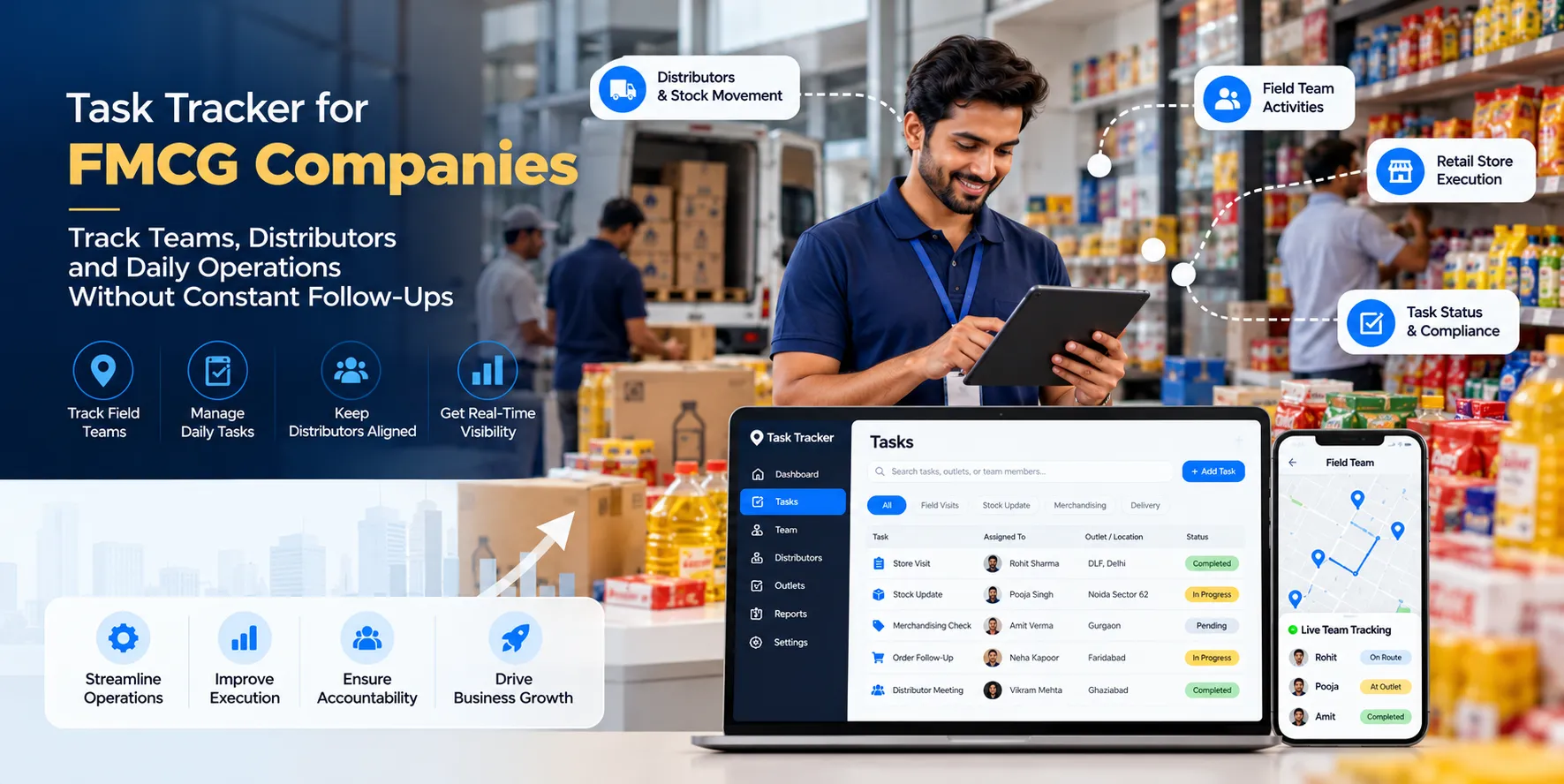
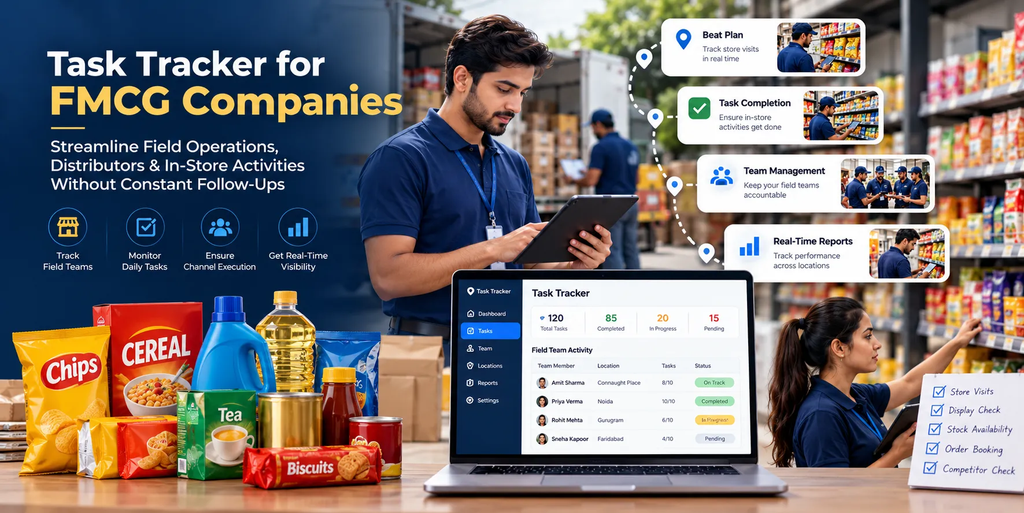
A task tracker for FMCG companies helps organize these activities in one place. Managers can assign responsibilities, set deadlines, track progress, and review completion updates without relying entirely on manual follow-ups.
With a structured task management system, FMCG companies can improve coordination between field teams and office staff while keeping daily operations easier to monitor.
Why Do FMCG Companies Need Task Tracker Software?
FMCG businesses depend on consistent execution across a large network of employees, distributors, and retail outlets. Even small gaps in daily activities can affect customer experience, product visibility, and sales execution.
Here are some common challenges a task tracker can help address.
1. Managing Field Sales Teams Across Territories
FMCG sales representatives often visit multiple retail outlets during the day. Their responsibilities may include checking product availability, discussing orders, communicating promotional schemes, and reporting retailer feedback.
When managers rely on calls and end-of-day spreadsheets, it can be difficult to track the progress of these activities throughout the day.
A task tracker allows managers to assign specific activities to individual team members, set due dates, and check task status. Field employees can update their assigned work, while managers can identify pending activities that need attention.
2. Ensuring Retail Visits Lead to Action
A store visit does not automatically mean that every planned activity has been completed.
A sales representative may visit a retailer but miss a planned display check, fail to share an update, or leave an issue unresolved.
With task tracking, managers can create clear instructions for each activity. For example, a retail visit may include checking product placement, recording an issue, and uploading a photo of the display.
The employee can update the task once the work is complete. Managers can then review the submitted information instead of depending only on verbal confirmation.
3. Coordinating Distributors and Internal Teams
FMCG operations involve coordination between sales, distribution, warehousing, finance, and customer support teams.
For example, a distributor may raise an issue that requires action from the sales manager and the supply team. If the issue is discussed across multiple calls and messages, responsibility can become unclear.
A task management system helps assign the next action to the right person, set a deadline, and monitor progress. It makes follow-ups more structured and reduces the risk of requests being overlooked.
4. Following Standard Operating Procedures
FMCG companies often repeat the same activities across branches, warehouses, territories, and retail locations.
These activities may include outlet checks, promotional execution, stockroom inspections, documentation, and periodic reporting.
Without a consistent process, employees may follow different methods or miss important steps.
A task tracker can help standardize these activities through predefined task templates, recurring schedules, instructions, and approval steps. Managers can use the same process across teams while adjusting responsibilities to suit local requirements.
What Is a Task Tracker for FMCG Companies?
A task tracker is a digital tool that helps businesses create, assign, organize, and monitor work.
For FMCG companies, it can be used to manage field sales activities, retail execution, distributor follow-ups, internal requests, recurring operational checks, and team responsibilities.
Instead of maintaining separate lists or relying on message histories, managers can use a centralized system to see:
- What work needs to be completed.
- Who is responsible for each task.
- When the task is due.
- Whether the task is pending, in progress, or completed.
- What updates or evidence have been submitted.
- Which tasks need review or follow-up.
A task tracker focuses on the execution of work. It does not replace specialized systems that manage sales transactions, stock levels, orders, or enterprise resource planning.
How Task Tracker Software Helps FMCG Companies
1. Organize Daily Field Sales Activities
Field sales teams have multiple responsibilities beyond visiting retailers. They may need to follow up with distributors, share market feedback, complete reports, and coordinate promotional activities.
Managers can create tasks for these activities and assign them to the relevant employees.
For example, a regional sales manager can assign a representative to:
- Visit selected retail outlets.
- Check the execution of a promotional display.
- Submit a store visit report.
- Share feedback about a product availability issue.
- Follow up with a distributor on an outstanding request.
Each task has a clear owner and deadline. Managers can review progress through task lists and dashboards instead of collecting every update manually.
2. Track Retail Execution and Merchandising
Product visibility matters in FMCG. Teams may need to check whether displays are set up correctly, promotional materials are in place, and agreed merchandising activities have been completed.
A task tracker can turn these requirements into specific assignments.
For example, a merchandising manager can create a task to verify the placement of promotional material at selected outlets. The employee can submit a photo and completion update as part of the task.
Where appropriate, managers can review the submitted evidence and request corrections if the work does not meet the defined requirements.
This creates a clearer record of what was assigned and what was reported as completed. A task tracker supports this process, although it does not automatically guarantee that every retail outlet has been visited or that every display meets the required standard.
3. Improve Distributor Follow-Ups
Distributor relationships require regular communication and timely action.
Teams may need to collect documents, resolve operational queries, share scheme details, coordinate meetings, or follow up on pending requests.
When these activities are spread across different conversations, it becomes harder to identify the next action and the person responsible.
A task tracker helps convert follow-ups into assigned work with due dates and status updates.
For example, if a distributor requests clarification about a promotional scheme, the sales representative can create a follow-up task for the relevant manager. The manager can review the request, provide an update, and mark the task complete once the required action is taken.
This helps teams maintain continuity without treating every follow-up as a new conversation.
4. Monitor Field Team Attendance and Work Updates
FMCG companies often have employees working across different territories and locations. Managers may need to review attendance, field activity, and completion reports.
Task management software with attendance and geo-location features can help organizations maintain attendance records and improve visibility into where check-ins were recorded.
Employees can also update assigned tasks through the platform, helping managers review work progress alongside relevant attendance information.
These are separate types of information: an attendance record shows a check-in, while a completed task with supporting evidence helps document the activity reported by the employee. Neither should automatically be treated as proof of every aspect of a field visit.
5. Reduce Manual Follow-Ups
When managers cannot see task status clearly, they often spend time calling employees and sending messages to ask whether work is complete.
This creates unnecessary administrative work and takes time away from planning, coaching, and resolving operational issues.
A task tracker makes ownership, deadlines, and task status easier to review.
Reminders and notifications can alert employees about upcoming deadlines or pending work, depending on the configured workflow.
Managers can focus on overdue or high-priority activities instead of repeatedly asking every team member for updates.
6. Standardize Recurring Activities
Many FMCG activities follow a daily, weekly, or monthly schedule.
Examples include daily sales reporting, weekly retail audits, periodic distributor reviews, promotional checks, and internal performance reviews.
A task tracker can help schedule recurring tasks and assign them to the right employees. Reusable task templates also help teams follow consistent instructions.
For example, a company can create a standard checklist for a weekly merchandising review and use it across relevant teams. Managers can monitor completion and identify activities that repeatedly remain pending.
7. Improve Coordination Between Departments
Field activities frequently require support from office-based teams.
A retail issue may need attention from sales. A distributor query may require finance or operations. A merchandising problem may need approval from a regional manager.
Task workflows help route responsibilities between people and teams. Subtasks, comments, notifications, and approval steps can make the handover clearer.
Instead of relying on one employee to remember every follow-up, the organization can track the next action and its status.
8. Review Team Performance and Pending Work
Managers need more than a final sales figure to understand how daily operations are progressing.
They may also need to know whether planned activities are being completed, which tasks are overdue, where approvals are delayed, and whether workloads are distributed appropriately.
A task tracker with dashboards and performance reports can help managers review task completion, pending work, and employee activity.
These reports support operational decisions, but they should be interpreted alongside business results. Completing more tasks does not necessarily mean that a territory has generated more sales or achieved better market coverage.
Task Tracker vs. WhatsApp and Spreadsheets for FMCG Operations
WhatsApp and spreadsheets are useful tools, particularly for smaller teams. The difficulty arises when they become the main way to coordinate large volumes of recurring work across multiple territories.
| Activity | WhatsApp and Spreadsheets | Task Tracker Software |
|---|---|---|
| Task assignment | Instructions may be spread across messages. | Assignments can be organized in one system. |
| Responsibility | Ownership may need to be clarified manually. | Each task can have a defined owner. |
| Deadlines | Follow-ups often depend on reminders from managers. | Due dates and reminders can be configured. |
| Field updates | Updates may be shared in separate chats. | Updates can be linked to the relevant task. |
| Proof of work | Photos may be difficult to connect to specific activities. | Photos and notes can be attached to supported tasks. |
| Recurring activities | Lists and reminders may need manual maintenance. | Recurring tasks and templates can standardize work. |
| Progress reporting | Information may need to be consolidated manually. | Dashboards and reports can summarize task status. |
The goal is not to stop employees from using familiar communication tools. It is to ensure that important work has a clear owner, deadline, and record of completion.
Features to Look for in FMCG Task Management Software
Not every task tracker is suitable for an FMCG business. Before choosing one, consider the following capabilities.
- Task assignment and deadlines: Managers should be able to assign work to specific employees and set priorities and due dates.
- Mobile access: Field employees need a practical way to view assignments and submit updates while working away from the office.
- Photo and note attachments: Supporting evidence can help managers review merchandising activities, inspections, and other field tasks.
- Attendance and geo-location: These features can support attendance management and field-team coordination where required.
- Recurring tasks and templates: Reusable workflows help teams follow consistent procedures across territories and locations.
- Reminders and notifications: Alerts can help employees act on deadlines and reduce manual follow-ups.
- Approvals and reassignment: Managers should be able to review submitted work, assign corrections, or transfer tasks when responsibilities change.
- Dashboards and performance reports: These help managers review pending tasks, completion status, and team workloads.
- Integration with existing systems: Check whether the software can work with the company’s current tools and whether the required integrations are supported.
- Security and access controls: FMCG companies should review access permissions, data handling, and security practices before adopting any business software.
How TrackerSuite.ai Helps FMCG Companies Manage Daily Work
TrackerSuite.ai offers task and workflow management capabilities that can help FMCG companies organize field activities, internal requests, recurring work, and team responsibilities.
Its Task Tracker can support the following workflows.
Centralized Task Management
Managers can create tasks, assign owners, set deadlines, and monitor progress from a central system. This helps teams organize daily responsibilities rather than relying entirely on separate lists and conversations.
Field Team Coordination
Attendance with geo-location, mobile task updates, and task-related proof of work can support organizations that need better visibility into field activities.
Proof of Work
Employees can attach photos, notes, or timestamps to supported tasks. Where AI Work Validation is configured, submitted images, videos, or documents can also be checked against defined task requirements.
This can help managers review reported completion and identify work that needs further attention.
Reminders and Recurring Workflows
Recurring task schedules, reminders, notifications, and predefined task structures can help teams manage routine activities and follow-ups more consistently.
Performance Visibility
Task dashboards and reports help managers review task status, overdue work, and team activity. This makes it easier to identify where follow-up or additional support may be needed.
AI-Assisted Task Planning
TAVI AI can provide task recommendations based on available task history and team context. This can help managers organize upcoming work and consider the next steps, depending on the data available and how the system is configured.
For FMCG companies, the practical value is having a clearer way to manage daily work across people and locations.
Explore the platform: TrackerSuite.ai Task Tracker.
Important: Task Tracker is intended to support task execution and workforce coordination. FMCG companies should continue using their existing systems for order processing, invoicing, demand forecasting, inventory records, distributor transactions, and other specialized functions unless the relevant capability and integration have been verified.
How to Implement a Task Tracker in an FMCG Company
A successful implementation starts with a clear operational problem. Moving every activity into a new tool at once can make adoption harder.
Step 1: Identify the Main Bottleneck
Start with the activities that require the most manual follow-up. These might include retail visit reporting, merchandising checks, distributor requests, or recurring internal reports.
Step 2: Define the Workflow
For each activity, decide who creates the task, who owns it, when it is due, what information is required, and who approves completion.
Step 3: Create Standard Task Templates
Use consistent instructions for recurring work. For example, a retail execution task might include the outlet name, required checks, submission deadline, and photo evidence where applicable.
Step 4: Start With One Team or Territory
Run a pilot with a selected sales team or region. Check whether employees can understand the tasks, submit updates, and complete work without excessive administrative effort.
Step 5: Review Results and Expand
Monitor overdue tasks, completion patterns, missing updates, and feedback from employees and managers. Refine the workflow before rolling it out across more teams.
The aim is to make work easier to manage, not to create more reporting for field employees.
Frequently Asked Questions
1. What is a task tracker for FMCG companies?
A task tracker helps FMCG companies assign, organize, and monitor daily work. It can support field sales activities, merchandising tasks, distributor follow-ups, recurring checks, approvals, and internal coordination.
2. Can task tracking software help manage FMCG field sales teams?
Yes. Managers can assign activities, set deadlines, review task updates, and monitor pending work. Attendance and geo-location features can provide additional visibility where supported and configured.
3. Can FMCG companies track retail visits using a task tracker?
A task tracker can help organize visit-related tasks and record submitted updates, notes, or photos. The level of visit verification depends on the software’s features and how the company configures its workflow.
4. Can a task tracker help with merchandising audits?
Yes. Managers can create standardized merchandising tasks, specify the checks required, request photo evidence, and review reported completion. More specialized retail audit requirements may need dedicated audit software or integrations.
5. Does task tracker software replace FMCG ERP or sales systems?
No, not by default. A task tracker focuses on assigned work, deadlines, progress, and team coordination. ERP, sales, order management, and inventory systems handle their own specialized business records and processes.
6. How does a task tracker reduce manual follow-ups?
It gives managers a central view of task ownership, deadlines, and progress. Configured reminders and notifications can prompt employees to act, reducing the need to ask for every update individually.
7. Is TrackerSuite.ai suitable for FMCG field teams?
TrackerSuite.ai offers task assignment, reminders, recurring workflows, attendance with geo-location, proof-of-work attachments, and performance reporting. FMCG companies can assess these features against their field operations and workflow requirements.
Conclusion
FMCG companies need consistent execution across field sales teams, distributors, retail outlets, and internal departments. When daily work is managed through scattered messages and spreadsheets, managers can spend too much time collecting updates and chasing pending activities.
A task tracker for FMCG companies helps bring task assignments, deadlines, progress updates, and proof of work into a more structured process. It can improve accountability, standardize recurring activities, and make operational follow-ups easier to manage.
TrackerSuite.ai helps businesses organize tasks, coordinate teams, and review work progress through one platform. By starting with a specific operational challenge and building clear workflows around it, FMCG companies can reduce manual coordination and give managers better visibility into daily execution.
Sources and Further Reading
- KPMG India CX Report 2025: FMCG — Distributor experience, operational challenges, and the importance of better coordination in the FMCG sector.
Leave a Reply